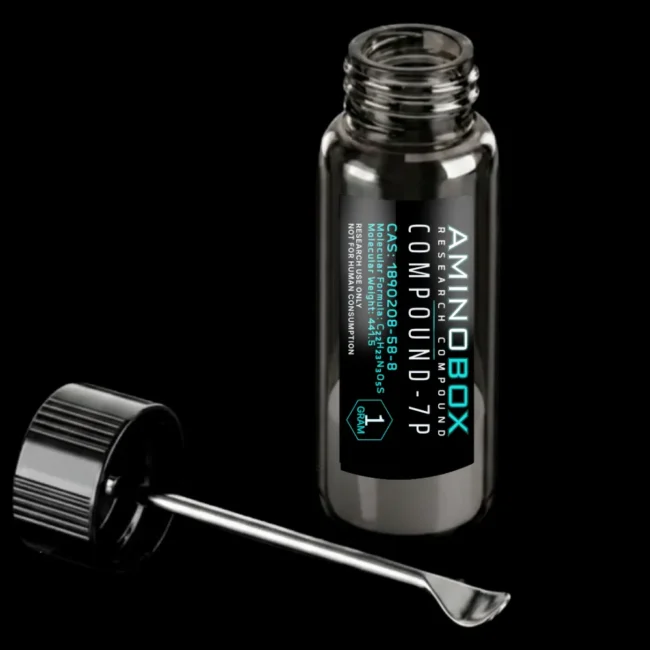

Compound 7P


Compound 7P is studied for Axon Regeneration & Neurite Outgrowth and Modulation of Aging-related Cellular Stress Responses.
$76.00
In stock
Guaranteed Safe Checkout


| Product Name | Compound 7P |
| Functional Class | Synaptics |
| Form | Lyophilized |
| Purity | 99%+ |
| Content | 5mg |
| Count | 1 mg |
| Research Use | Research Grade |
| CAS Number | See COA |
| Molecular Weight | See COA |
| Molecular Formula | See COA |
| PubChem CID | See COA |
| Appearance | White to off-white powder |
| Storage | 2-8C preferred |
| Water | Highly soluble |
| Acidified Water | Highly soluble |
| DMSO | Highly soluble |
| Ethanol | Moderate |
| Lipid solvents | Poor compatibility |
| Lyophilized | 2–8°C preferred |
| Long-term | −20°C recommended |
| Light Sensitivity | Moderate |
| Moisture | High sensitivity |
| Stability | Stable when dry |
| Container | Sterile sealed vial |
AminoBox products are supplied for research, analytical, and laboratory use only. Product information is provided for educational and technical reference and does not constitute medical advice. Products are not intended to diagnose, treat, cure, or prevent any disease.
Product Identification
| Property | Specification |
|---|---|
| Product Name | Compound 7P |
| CAS Number | 1890208-58-8 |
| Form | 1 gram (Bulk Powder) |
| Molecular Formula | C₂₂H₂₃N₃O₅S |
| Molecular Weight | 441.5 g/mol |
| PubChem CID | 252827453 (and closely related registry entries also exist under alternate CID mappings) |
| Synonyms | Acetamide derivative; 2-[(2-methoxyphenyl)[(4-methylphenyl)sulfonyl]amino]-N-(4-methoxy-3-pyridinyl)acetamide; CHEMBL3824120 |
Chemical Identity
| Property | Specification |
|---|---|
| IUPAC Name | 2-(2-methoxy-N-(4-methylphenyl)sulfonylanilino)-N-(4-methoxypyridin-3-yl)acetamide |
| SMILES | CC1=CC=C(C=C1)S(=O)(=O)N(CC(=O)NC2=C(C=CN=C2)OC)C3=CC=CC=C3OC |
| InChI | InChI=1S/C22H23N3O5S/… |
| InChIKey | NAXWKPFXCOBXLE-UHFFFAOYSA-N |
| Compound Type | Aromatic sulfonamide-acetamide hybrid small molecule |
Physical & Chemical Properties
| Property | Specification |
|---|---|
| Appearance | White to off-white crystalline solid |
| Density (predicted) | ~1.329 g/cm³ |
| XLogP3 | 2.8 |
| Hydrogen Bond Donors | 1 |
| Hydrogen Bond Acceptors | 7 |
| Rotatable Bonds | 8 |
| Topological Polar Surface Area | 106 Ų |
| Formal Charge | 0 |
Structural Classification
| Category | Description |
|---|---|
| Core Structure | Aromatic sulfonamide-linked acetamide |
| Functional Class | Experimental small-molecule bioactive scaffold |
| Chemical Family | Sulfonyl anilide + heteroaromatic amide system |
| Structural Features | Methoxy-substituted phenyl + pyridine + sulfonamide linkage |
Registry / Database Notes
| Property | Specification |
|---|---|
| Database Status | Registered in PubChem, ChEMBL, commercial chemical catalogs |
| Regulatory Status | Research-use only (no clinical approval) |
| Known Applications | Reported in neuroregeneration / axonal growth research contexts |
| Safety Classification | Irritant / harmful (GHS: Acute tox categories reported in vendor safety sheets) |
Research Context (Literature-Based)
| Research Area | Observed / Reported Activity |
|---|---|
| Neuroregeneration | Studied for axon growth and GAP-43 positive neurite extension |
| CNS Repair Models | Investigated in optic nerve injury animal models |
| Neurite Outgrowth | Reported stimulation of neuronal growth in vitro systems |
| Experimental Pharmacology | Small-molecule CNS regenerative scaffold research |
Solubility Profile (General)
| Solvent | Solubility |
|---|---|
| DMSO | High |
| Ethanol | Moderate |
| Water | Low |
| Buffer solutions | Limited |
| Organic solvents | Compatible |
Storage Specifications
| Parameter | Recommendation |
|---|---|
| Storage Temperature | 2–25°C (dry, sealed conditions) |
| Light Sensitivity | Moderate |
| Moisture Sensitivity | High |
| Stability | Stable as dry crystalline solid |
| Container Type | Airtight amber vial or sealed container |
Technical Summary
| Feature | Notes |
|---|---|
| Compound Type | Synthetic multi-ring aromatic acetamide |
| Structural Complexity | High (multi-aromatic + sulfonamide system) |
| BBB Potential | Theoretical (lipophilic balance suggests CNS penetration potential) |
| Research Use | Laboratory research only |
Compound 7P | 1g | Investigational Neuroregenerative Compound
At present, publicly available scientific literature under the designation “Compound 7P” is limited, fragmented, or not standardized under a single universally accepted International Nonproprietary Name (INN) or PubChem entry.
As a result, Compound 7P is best classified as a research-use investigational chemical scaffold, intended for laboratory analysis, mechanistic screening, and early-stage biochemical modeling rather than defined therapeutic application.
Research Compound Overview
Compound 7P is an experimental small-molecule research compound originally investigated within neurobiology and medicinal chemistry screening programs focused on neurite outgrowth, axonal regeneration, and neuronal structural plasticity.
Early-stage research interest in this compound is centered on its potential role in modulating neuronal growth signaling pathways, particularly those involved in cytoskeletal remodeling, axon elongation, and regenerative neuroplasticity in damaged or developmentally constrained neural systems.
From a mechanistic standpoint, Compound 7P is being explored within the broader scientific framework of neuroregeneration biology, where restoration of neuronal connectivity is a central challenge in aging, injury, and neurodegenerative conditions.
It is important to note that Compound 7P remains an investigational research material, and its biological profile is primarily derived from preclinical models and phenotypic screening studies, not validated clinical use.
Mechanistic Research Framework
Neuronal regeneration, particularly axonal regrowth in the central nervous system (CNS), is a highly complex biological process limited by intrinsic inhibitory signaling and epigenetic constraints.
Compound 7P is studied within this context as a potential modulator of pathways associated with:
- Neurite extension and axonal elongation
- Cytoskeletal remodeling and growth cone dynamics
- Gene expression programs involved in neuronal regeneration
- Injury-response signaling cascades in CNS tissues
Molecular Pathway Research Context
Effective axonal regeneration in preclinical neuroscience research is typically associated with modulation of several key signaling systems. Compound 7P is investigated in relation to:
1. Epigenetic Gene Regulation
Regeneration-associated gene expression is tightly controlled by chromatin structure and epigenetic regulation. Research models suggest that axonal regrowth can be influenced by:
- Histone modification patterns
- Transcriptional accessibility of regeneration-associated genes
- Developmental vs. injury-induced gene expression programs
2. Developmental & Injury-Induced Transcription Programs
Neuronal regeneration often requires reactivation of developmental growth pathways that are normally suppressed in mature CNS tissue. Investigated mechanisms include:
- Reactivation of growth-associated transcription factors
- Modulation of inhibitory regeneration signals
- Re-engagement of embryonic-like neuronal growth states
3. mTOR Signaling Pathway
The mechanistic target of rapamycin (mTOR) pathway is a central regulator of:
- Cellular growth and protein synthesis
- Axonal regeneration capacity
- Metabolic support for neuronal repair processes
Alteration of mTOR signaling has been widely studied in experimental models of CNS injury and regeneration.
4. STAT3 Signaling Axis
STAT3 (Signal Transducer and Activator of Transcription 3) is a key pathway involved in:
- Injury response signaling
- Axonal regrowth initiation
- Cellular survival under neuroinflammatory conditions
Modulation of STAT3 activity is a recurring focus in regenerative neuroscience research.
Phenotypic Screening & Neurite Outgrowth Models
Compound 7P has been evaluated in phenotypic cell-based screening systems, where neuronal morphology is directly observed and quantified under laboratory conditions.
These systems allow researchers to:
- Measure neurite length and branching patterns
- Evaluate axonal elongation in response to compounds
- Identify molecular targets involved in growth signaling
- Map functional outcomes of pathway modulation
Such screening approaches are widely used in neuroregenerative drug discovery pipelines.
Preclinical Research Findings (Experimental Context)
Neuronal Growth Activity
In experimental models, Compound 7P has been associated with enhanced neurite outgrowth in primary neuronal cultures derived from:
- Hippocampal neurons
- Cerebral cortical neurons
- Retinal ganglion cell models
These observations suggest potential involvement in pathways regulating neuronal structural plasticity and axonal extension.
Optic Nerve Regeneration Models
In injury-based animal and cellular models, Compound 7P has been reported in research contexts to:
- Enhance neurite extension following optic nerve injury
- Promote axonal regrowth in damaged retinal neuronal systems
- Support structural recovery in stressed neuronal environments
These findings remain preclinical and model-based, not validated clinical therapies.
Dose-Dependent Cellular Effects (In Vitro Observations)
In controlled neuronal cell assays, compound exposure has been associated with measurable increases in axonal growth at specific concentrations (reported around low micromolar ranges in experimental setups).
These effects are interpreted as:
- Increased neurite extension rate
- Enhanced cytoskeletal activity in neuronal projections
- Improved structural regeneration signaling under laboratory conditions
Translational Research Context: Neuroregeneration & Tissue Repair
The scientific interest in Compound 7P extends beyond neurobiology into broader regenerative medicine frameworks.
In theory, mechanisms that promote axonal regrowth may also influence:
- Cellular repair efficiency in stress-damaged tissues
- Regenerative signaling in structural protein networks
- Cross-tissue repair pathways involving neurocutaneous interaction systems
However, these translational applications remain theoretical and exploratory, not clinically validated.
Skin Biology & Anti-Aging Research Hypothesis
Emerging interdisciplinary research in the neuro-skin axis explores how neuronal signaling influences dermal structure, inflammation, and cellular aging.
Within this conceptual framework, Compound 7P has been hypothesized to have relevance to:
- Cellular regeneration signaling pathways
- Structural repair processes in connective tissue environments
- Indirect modulation of aging-related cellular stress responses
- Tissue resilience under oxidative and inflammatory stress conditions
It is critical to emphasize that these are hypothesis-driven research extensions, not demonstrated cosmetic effects.
Research Applications
Compound 7P is currently utilized in scientific contexts involving:
- Neuroregeneration and axonal growth studies
- Phenotypic neuronal screening platforms
- CNS injury and repair modeling
- Epigenetic regulation of neuronal plasticity
- mTOR and STAT3 pathway research
- Retinal and optic nerve regeneration studies
- Early-stage regenerative medicine screening programs
Important Notice
This product is supplied strictly for laboratory research, analytical use, and scientific investigation purposes only. It is not intended for human consumption, medical use, or therapeutic application.
Compound 7P is an experimental research material with preclinical evidence of neurite outgrowth activity in model systems, and all described mechanisms are based on laboratory and theoretical research frameworks rather than confirmed clinical efficacy.
Scientific References – Compound 7P (Axon Regeneration & Neurite Outgrowth)
| Ref # | Title | Journal | Focus | Link |
|---|---|---|---|---|
| 1 | Discovery, Optimization, and Biological Evaluation of Sulfonamidoacetamides as an Inducer of Axon Regeneration | Journal of Medicinal Chemistry | Original identification of Compound 7P; neurite outgrowth screening; optic nerve regeneration model | https://pubmed.ncbi.nlm.nih.gov/27007292/ |
| 2 | Discovery, Optimization, and Biological Evaluation of Sulfonamidoacetamides as an Inducer of Axon Regeneration (Full text record) | Journal of Medicinal Chemistry (ACS) | Primary data: hippocampal, cortical, retinal neurite outgrowth; GAP-43 axon regeneration in vivo | https://pubs.acs.org/doi/10.1021/acs.jmedchem.6b00015 |
| 3 | Structure-based discovery of low molecular weight compounds that stimulate neurite outgrowth and substitute for nerve growth factor | Journal of Neurochemistry | Small-molecule induction of neurite outgrowth; NGF pathway substitution models | https://pmc.ncbi.nlm.nih.gov/articles/PMC2753211/ |
| 4 | Membrane-permeant phosphoinositide derivatives as modulators of growth factor signaling and neurite outgrowth | Chemical Biology | Growth factor signaling modulation in neurite extension models | https://pubmed.ncbi.nlm.nih.gov/19942142/ |
| 5 | Phosphoinositide signaling in neurite outgrowth and neuronal morphology regulation | Experimental & Molecular Medicine | Membrane signaling pathways regulating neurite extension | https://www.nature.com/articles/emm201318 |
| 6 | Collagen-based 3D matrices including growth factors to induce neurite outgrowth | Acta Biomaterialia | Growth factor–driven neurite extension in 3D neural models | https://arxiv.org/abs/1211.0301 |