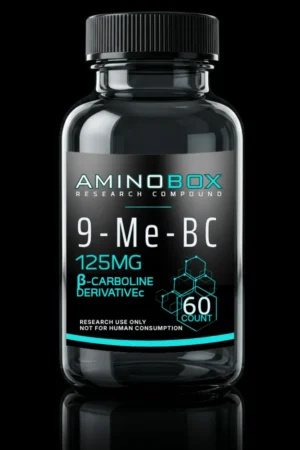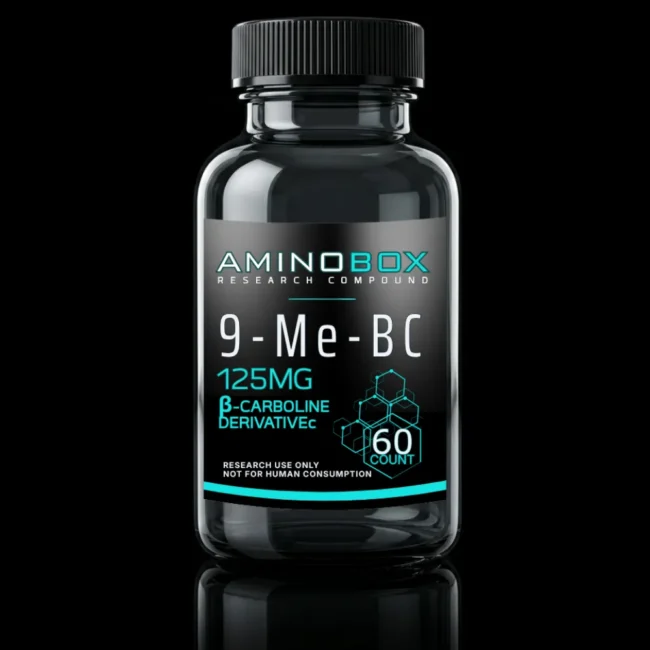

9-Me-BC


9-Me-BC known for its interaction with dopaminergic signaling pathways and neuronal metabolic systems, and intracellular signaling mechanisms.
$69.00
In stock
Guaranteed Safe Checkout


| Product Name | 9-Me-BC | 9-Methyl-β-carboline |
| Functional Class | Synaptics |
| Form | Lyophilized |
| Purity | 99%+ |
| Content | 5mg |
| Count | 1 capsule |
| Research Use | Research Grade |
| CAS Number | See COA |
| Molecular Weight | See COA |
| Molecular Formula | See COA |
| PubChem CID | See COA |
| Appearance | White to off-white powder |
| Storage | 2-8C preferred |
| Water | Highly soluble |
| Acidified Water | Highly soluble |
| DMSO | Highly soluble |
| Ethanol | Moderate |
| Lipid solvents | Poor compatibility |
| Lyophilized | 2–8°C preferred |
| Long-term | −20°C recommended |
| Light Sensitivity | Moderate |
| Moisture | High sensitivity |
| Stability | Stable when dry |
| Container | Sterile sealed vial |
AminoBox products are supplied for research, analytical, and laboratory use only. Product information is provided for educational and technical reference and does not constitute medical advice. Products are not intended to diagnose, treat, cure, or prevent any disease.
Product Composition
| Property | Specification |
|---|---|
| Product Name | 9-Methyl-β-Carboline |
| Alternate Names | 9-Me-BC, 9-MBC |
| Capsule Content | 10mg |
| Package Size | 60 Capsules |
| Compound Class | Synthetic β-carboline alkaloid derivative |
| Physical Form | Encapsulated powder |
| Appearance | White to off-white powder (capsule fill) |
| Purity | Typically ≥98% |
| Research Category | Dopaminergic / neuroregenerative research compound |
Molecular Information
| Property | Specification |
|---|---|
| Molecular Formula | C12H10N2 |
| Molecular Weight | ~182.22 g/mol |
| CAS Number | 2521-07-5 |
| PubChem CID | 700204 |
| Compound Type | β-carboline alkaloid derivative |
| Stereochemistry | Achiral (aromatic heterocycle structure) |
Structural Classification
| Category | Description |
|---|---|
| Compound Type | Methylated β-carboline alkaloid |
| Functional Class | Neuroactive dopaminergic modulator |
| Biological Focus | Dopamine neuron signaling & mitochondrial support pathways |
| Mechanistic Focus | Dopaminergic neuroprotection and synaptic activity modulation |
| Chemical Family | Indole-based alkaloid derivative |
Mechanism Research Profile
| Research Focus | Description |
|---|---|
| Dopaminergic Activity | Studied for effects on dopamine neuron differentiation and survival |
| Neuroprotection | Investigated for protection of nigrostriatal dopaminergic pathways |
| Mitochondrial Function | Explored in cellular energy metabolism and oxidative stress models |
| Synaptic Plasticity | Evaluated for enhancement of neuronal connectivity and signaling |
| Neuroregeneration | Studied in neuronal growth and repair pathways |
Research Areas Commonly Associated
| Research Area | Focus |
|---|---|
| Parkinson’s Research Models | Dopamine neuron degeneration studies |
| Neuroregeneration | Neuronal growth and repair mechanisms |
| Cognitive Function Research | Memory and learning pathway modulation |
| Mitochondrial Biology | Cellular energy and oxidative stress pathways |
| Neuropharmacology | Dopaminergic receptor system modulation |
Solubility Profile
| Solvent | Solubility |
|---|---|
| DMSO | Highly soluble |
| Ethanol | Moderately to highly soluble |
| Sterile Water | Low to moderate solubility |
| Bacteriostatic Water | Limited solubility |
| Lipid-based solvents | Compatible depending on formulation |
Storage Specifications
| Parameter | Recommendation |
|---|---|
| Capsule Storage | 15–25°C (cool, dry place) |
| Long-term Storage | 2–8°C recommended for stability |
| Light Sensitivity | Moderate |
| Moisture Sensitivity | High |
| Stability | Stable in dry encapsulated form |
| Container Type | Sealed opaque capsule bottle |
Technical Characteristics
| Feature | Notes |
|---|---|
| Delivery Format | Encapsulated powder (10mg per capsule, 60-count bottle) |
| Structural Advantage | Lipophilic β-carboline backbone supports CNS permeability |
| Configuration | Synthetic indole-derived alkaloid |
| Stability Profile | High stability in dry encapsulated form |
| Research Use | Laboratory research only |
9-Me-BC | 9-Methyl-β-carboline | 10mg | 60 Capsules
9-Me-BC is currently classified as an experimental research compound, and its biological profile in humans remains insufficiently characterized in peer-reviewed clinical literature.
Most available data is derived from in vitro studies and animal-model research, with ongoing interest in its effects on neuronal signaling, mitochondrial function, and dopamine-related pathways.
Structural Context
β-carbolines are a family of compounds characterized by a tricyclic indole-based structure. This structural class is of scientific interest due to its known interaction potential with:
- Monoamine-related enzyme systems
- Neuroreceptor binding sites
- Cellular redox and oxidative stress pathways
- Neurotransmitter regulation systems
The methyl substitution at the 9-position is a structural modification that has been explored in research contexts for altering lipophilicity, receptor affinity, and metabolic stability relative to other β-carboline derivatives.
Neurochemical Research Context
In preclinical research environments, 9-Me-BC has been studied in relation to dopaminergic neuron systems, particularly within experimental models examining:
- Dopamine synthesis and signaling regulation
- Neuronal outgrowth and synaptic plasticity
- Neuroinflammatory signaling modulation
- Mitochondrial respiration in neural tissue models
- Cellular stress-response pathways in dopaminergic systems
These observations are primarily based on cellular and animal studies, and have not been validated through large-scale human clinical trials.
Dopaminergic System Research Interest
A significant area of interest for β-carboline derivatives involves their interaction with dopamine-associated neural circuits.
Dopamine is a key neurotransmitter involved in:
- Motivation and reward signaling
- Cognitive drive and attention regulation
- Motor function coordination
- Learning and reinforcement pathways
In experimental models, compounds structurally related to 9-Me-BC have been investigated for their potential influence on dopaminergic neuron activity and signaling efficiency. However, it is important to emphasize that:
These findings are preliminary and do not establish clinical efficacy or safety in humans.
Mitochondrial & Cellular Energy Research
Emerging research interest in 9-Me-BC also includes its potential relationship with neuronal mitochondrial activity.
Mitochondria are responsible for:
- ATP (cellular energy) production
- Oxidative phosphorylation
- Redox balance regulation
- Cellular stress adaptation
Preclinical hypotheses suggest that β-carboline derivatives may influence neuronal resilience pathways through modulation of oxidative stress responses and mitochondrial signaling efficiency. These mechanisms remain under active scientific investigation.
Theoretical Cognitive Research Interest
Based on structural class comparisons, 9-Me-BC is sometimes discussed in relation to:
- Neuroplasticity signaling pathways (preclinical models)
- Attention and learning-related neurotransmitter systems (theoretical frameworks)
- Dopaminergic tone regulation (experimental hypotheses)
- Neuronal regeneration signaling in vitro systems
These are theoretical research domains, not confirmed effects of 9-Me-BC in humans.
Research Status & Limitations
9-Me-BC remains a compound of interest in early-stage neurochemical research, but important limitations apply:
- No established human clinical trials confirming safety or efficacy
- Limited peer-reviewed pharmacokinetic data
- Mechanism of action not fully defined in vivo
- Most evidence derived from laboratory and animal studies
As such, it is best classified as an investigational research chemical, not an approved therapeutic or nootropic agent.
Important Notice
This product is supplied strictly for laboratory research, analytical use, and scientific investigation purposes only. It is not intended for human consumption, medical use, or therapeutic application.
9-Me-BC is an unapproved experimental compound with limited clinical data in humans, and all references to biological activity are based on preclinical and theoretical research models rather than confirmed human outcomes.
Scientific References – 9-Me-BC (β-Carboline Class Research)
| Ref # | Title | Journal | Focus | Link |
|---|---|---|---|---|
| 1 | β-Carbolines: chemistry, pharmacology and neurobiology | Progress in Neurobiology | Overview of β-carboline class and CNS activity | https://pubmed.ncbi.nlm.nih.gov/17904648/ |
| 2 | Neurotoxic and neuroprotective properties of β-carbolines | Neurotoxicity Research | Dual effects of β-carbolines on neurons | https://pubmed.ncbi.nlm.nih.gov/12583745/ |
| 3 | Dopaminergic neuron degeneration mechanisms in Parkinson’s disease | Nature Reviews Neuroscience | Dopamine neuron vulnerability models | https://pubmed.ncbi.nlm.nih.gov/17410128/ |
| 4 | Mitochondrial dysfunction in neurodegeneration | Nature Reviews Neuroscience | Mitochondria + neuronal energy failure pathways | https://pubmed.ncbi.nlm.nih.gov/18852688/ |
| 5 | Indole alkaloids and their effects on the central nervous system | Journal of Ethnopharmacology | CNS-active indole compounds (β-carboline family) | https://pubmed.ncbi.nlm.nih.gov/21802475/ |
| 6 | Oxidative stress and dopaminergic neuron damage | Journal of Neurochemistry | ROS damage in dopamine pathways | https://pubmed.ncbi.nlm.nih.gov/15009670/ |