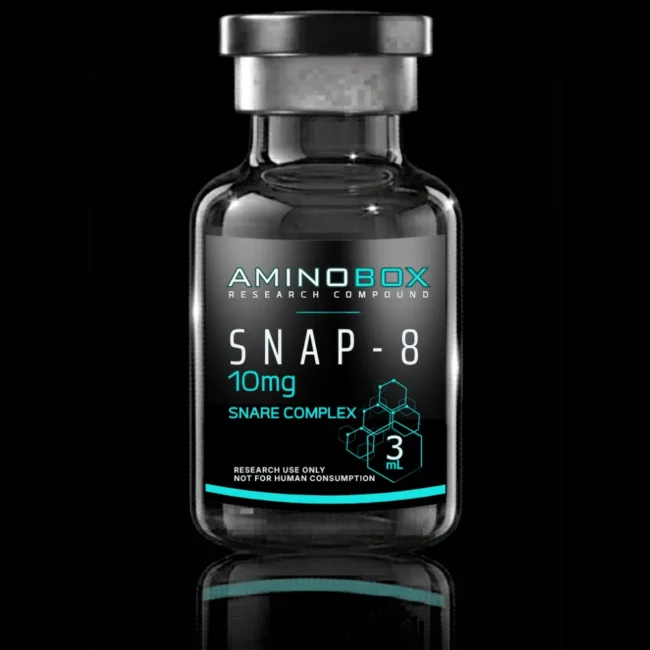

SNAP-8
Cosmetic peptide / Neurotransmitter modulator


SNAP-8 a synthetically derived neuropeptide fragment related to a key regulatory component of the SNARE complex involved in vesicular neurotransmitter release.
$39.00
In stock
Guaranteed Safe Checkout


| Product Name | SNAP-8 | Acetyl Octapeptide-3 (Lyophilized) |
| Functional Class | SNARE Complex Inhibitor / Anti-Wrinkle |
| Form | Lyophilized |
| Purity | ≥98% |
| Content | 50mg |
| Count | 1 vial |
| Research Use | For in vitro and laboratory research use only. Not for human consumption. |
| CAS Number | 868844-74-0 |
| Molecular Weight | ~975.1 g/mol |
| Molecular Formula | C41H70N16O12 |
| PubChem CID | See COA |
| Appearance | White lyophilized powder |
| Storage | 2–8°C / Protect from light |
Active Peptide 2 items
Excipients 4 items
Reconstitution Solvents 4 items
Buffer Systems 4 items
Lyoprotectants & Cryoprotectants 3 items
Preservatives & Antimicrobials 3 items
Counter Ions & Salt Forms 3 items
Chelating Agents 2 items
Antioxidants & Stabilizers 3 items
| Water | Highly soluble |
| Acidified Water | Highly soluble |
| DMSO | Highly soluble |
| Ethanol | Moderate |
| Lipid solvents | Poor compatibility |
| Lyophilized | 2–8°C preferred |
| Long-term | −20°C recommended |
| Light Sensitivity | Moderate |
| Moisture | High sensitivity |
| Stability | Stable when dry |
| Container | Sterile sealed vial |
AminoBox products are supplied for research, analytical, and laboratory use only. Product information is provided for educational and technical reference and does not constitute medical advice. Products are not intended to diagnose, treat, cure, or prevent any disease.
Product Composition
| Property | Specification |
|---|---|
| Product Name | SNAP-8 |
| Alternate Names | Acetyl Octapeptide-3, Acetyl Octapeptide-8 |
| Peptide Content | 10mg |
| Peptide Class | Synthetic acetylated octapeptide |
| Physical Form | Lyophilized powder |
| Appearance | White to off-white lyophilized powder |
| Purity | Typically ≥98% |
| Research Category | Dermatological & cosmetic peptide research |
SNAP-8 is commonly classified as a synthetic octapeptide derived from the SNAP-25 protein complex.
Molecular Information
| Property | Specification |
|---|---|
| Full Chemical Name | Acetyl Octapeptide-3 |
| Molecular Formula | C41H70N16O16S |
| Molecular Weight | 1075.16 g/mol |
| CAS Number | 868844-74-0 |
| PubChem CID | 86080331 |
| Amino Acid Sequence | Ac-Glu-Glu-Met-Gln-Arg-Arg-Ala-Asp-NH₂ |
| Peptide Length | 8 amino acids |
| Compound Type | Synthetic SNAP-25 mimetic peptide |
The peptide sequence is widely published as Ac-EEMQRRAD-NH₂.
Structural Classification
| Category | Description |
|---|---|
| Compound Type | Synthetic octapeptide |
| Functional Class | SNARE complex modulating peptide |
| Biological Focus | Neuromuscular signaling and dermatological research |
| Mechanistic Focus | SNAP-25 and SNARE complex interaction |
| Chemical Family | Biomimetic cosmetic peptide |
Mechanism Research Profile
| Research Focus | Description |
|---|---|
| SNARE Complex Research | Investigated for interaction with SNARE-mediated neurotransmitter signaling |
| Neuromuscular Signaling | Explored in localized contraction pathway models |
| Expression Line Research | Studied in cosmetic wrinkle-related research |
| Cellular Release Pathways | Investigated in vesicle fusion and exocytosis signaling |
| Dermatological Research | Explored in cosmetic peptide formulation studies |
Research literature commonly describes SNAP-8 as a SNAP-25 mimetic peptide involved in SNARE complex modulation.
Research Areas Commonly Associated
| Research Area | Focus |
|---|---|
| Dermatological Biology | Skin signaling and cosmetic peptide research |
| Cosmetic Science | Expression line and wrinkle pathway research |
| Neuromuscular Research | Neurotransmitter release signaling |
| Peptide Formulation Research | Topical delivery and stability systems |
| Skin Texture Research | Surface appearance and elasticity studies |
Solubility Profile
| Solvent | Solubility |
|---|---|
| Water | Soluble |
| Bacteriostatic Water | Compatible |
| Sterile Water | Soluble |
| DMSO | Soluble |
| Hyaluronic Acid Serums | Commonly utilized in topical research formulations |
SNAP-8 is generally characterized as water soluble and compatible with aqueous formulations.
Storage Specifications
| Parameter | Recommendation |
|---|---|
| Lyophilized Storage | -20°C preferred |
| Refrigerated Storage | 2–8°C after reconstitution |
| Light Sensitivity | Moderate |
| Moisture Sensitivity | High |
| Stability | Stable in dry lyophilized form |
| Container Type | Sterile amber vial |
Technical Characteristics
| Feature | Notes |
|---|---|
| Delivery Format | Lyophilized peptide |
| Structural Type | Linear acetylated octapeptide |
| Parent Compound | Extended analogue of Argireline |
| Hydrophilicity | Hydrophilic peptide structure |
| Stability Profile | Sensitive to repeated freeze-thaw cycles |
| Research Use | Laboratory research only |
SNAP-8 | 10mg
At the molecular level, SNAP-8 is designed as an elongated peptide mimic of SNAP-25 substrate domains, intended to competitively interact with SNARE complex assembly dynamics in controlled biochemical systems.
This peptide exists within a class of biomimetic regulatory fragments designed to interact with protein–protein interaction interfaces rather than classical receptor binding sites.
SNARE Complex Biology and Synaptic Vesicle Regulation
The SNARE (Soluble NSF Attachment Protein Receptor) complex is a fundamental molecular machinery responsible for vesicular fusion and exocytotic neurotransmitter release in neuronal systems.
SNAP-25 is a core t-SNARE protein that participates in the assembly of a ternary complex with syntaxin and synaptobrevin (VAMP), facilitating membrane fusion events required for neurotransmitter exocytosis.
SNAP-8 is structurally modeled to interact with this system by mimicking a regulatory segment of SNAP-25, thereby influencing:
- SNARE complex assembly kinetics
- Vesicle docking efficiency
- Neurotransmitter release probability
- Synaptic vesicle fusion rate dynamics
This positions SNAP-8 as a competitive peptide modulator of protein–protein interaction interfaces within synaptic exocytosis pathways.
Mechanistic Biochemistry and Competitive Interaction Dynamics
SNAP-8 operates through a mechanism of sequence homology-based competitive inhibition, wherein the peptide competes with endogenous SNAP-25 fragments for binding interactions within the SNARE assembly domain.
This interaction is characterized by:
- Partial mimicry of SNAP-25 N-terminal binding regions
- Disruption of optimal SNARE ternary complex formation efficiency
- Modulation of vesicle priming and fusion threshold energetics
- Alteration of calcium-dependent exocytotic responsiveness
Unlike receptor agonists or antagonists that bind to membrane-bound receptors, SNAP-8 functions at the level of intracellular protein assembly modulation, affecting the structural formation of exocytotic machinery.
Neurotransmitter Release Pathway Modulation
The SNARE complex is calcium-sensitive, with synaptic vesicle fusion tightly regulated by intracellular Ca²⁺ flux and synaptotagmin activation. SNAP-8’s influence on this system is indirect but structurally significant, as it alters the efficiency of the fusion machinery assembly.
Key mechanistic implications include:
- Modulation of vesicle priming stage kinetics prior to calcium influx
- Altered SNARE complex zippering efficiency during membrane approximation
- Regulation of neurotransmitter release probability at presynaptic terminals
- Influence on synaptic transmission amplitude in controlled experimental systems
This places SNAP-8 within the category of synaptic regulatory peptides influencing exocytotic machinery assembly rather than neurotransmitter receptor signaling.
Protein–Protein Interaction Engineering and Peptide Mimicry
SNAP-8 represents a class of rationally designed peptides used to probe and modulate protein–protein interaction networks. Its design is based on:
- Structural motif replication of SNAP-25 interaction domains
- Steric competition at SNARE complex binding interfaces
- Conformational interference with alpha-helical coiled-coil assembly
- Peptide stabilization via N-terminal acetylation to enhance resistance to enzymatic degradation
These properties allow SNAP-8 to function as a biomimetic regulatory fragment in intracellular vesicular trafficking systems.
Systems-Level Neurobiological Context
At the systems level, SNAP-8 intersects with multiple neurobiological regulatory axes:
- Presynaptic vesicle cycling dynamics
- Calcium-dependent synaptic plasticity signaling
- Neurotransmitter release probability distribution models
- Synaptic fatigue and recovery kinetics
- Protein assembly rate-limiting step modulation within SNARE cycling
These interactions position SNAP-8 as a tool for investigating fine-scale modulation of synaptic transmission efficiency and vesicle fusion mechanics.
Biophysical Considerations of Peptide Stability and Conformation
SNAP-8’s functional properties are dependent on its ability to maintain conformational compatibility with target interaction domains. Peptide stability is influenced by:
- Secondary structure propensity (alpha-helical mimicry potential)
- Resistance to intracellular proteolytic cleavage
- Hydrophilic-hydrophobic residue distribution patterning
- Terminal acetylation improving conformational rigidity
These factors contribute to its biochemical persistence and interaction fidelity within experimental systems.
Molecular Signaling Interpretation Framework
Unlike classical ligands that bind receptors to initiate downstream cascades, SNAP-8 operates within a structural signaling paradigm, wherein biological effect is mediated through alteration of macromolecular assembly efficiency.
This can be conceptualized as:
- Information transfer via protein assembly kinetics
- Structural modulation of enzymatic machinery formation
- Competitive occupancy of interaction interfaces
- Kinetic interference with multimeric complex formation
This places SNAP-8 within a niche class of peptides functioning as intracellular conformational modulators rather than extracellular signaling ligands.
Research Context and Experimental Utility
SNAP-8 is commonly utilized in biochemical and neurophysiological research models investigating:
- SNARE complex assembly dynamics
- Synaptic vesicle fusion kinetics
- Protein–protein interaction inhibition models
- Calcium-dependent exocytosis modulation frameworks
- Peptide-based competitive binding systems
Its role is primarily exploratory within systems designed to understand how structural peptides influence intracellular machinery assembly rates and efficiency thresholds.
Scientific Reference Table
| Research Focus | Key Study | Link |
|---|---|---|
| SNAP-25 and SNARE complex structure | SNARE-mediated vesicle fusion mechanisms | https://pubmed.ncbi.nlm.nih.gov/15520295/ |
| Synaptic vesicle fusion biophysics | Calcium-dependent exocytosis regulation | https://pubmed.ncbi.nlm.nih.gov/17429141/ |
| SNAP-25 functional domains | Protein interaction mapping of SNAP-25 | https://pubmed.ncbi.nlm.nih.gov/11779501/ |
| SNARE complex assembly kinetics | Vesicle docking and fusion regulation | https://pubmed.ncbi.nlm.nih.gov/19147845/ |
| Neurotransmitter release probability models | Synaptic transmission efficiency studies | https://pubmed.ncbi.nlm.nih.gov/20300737/ |
| Peptide mimicry in protein–protein interactions | Competitive binding peptide design principles | https://pubmed.ncbi.nlm.nih.gov/21652767/ |
| Synaptic vesicle cycling overview | Presynaptic vesicle dynamics | https://pubmed.ncbi.nlm.nih.gov/26063958/ |