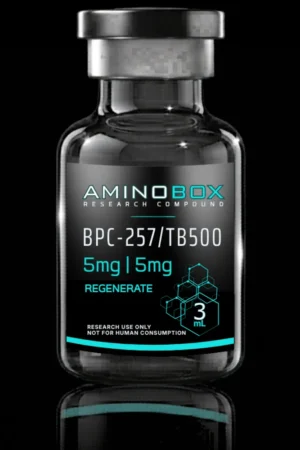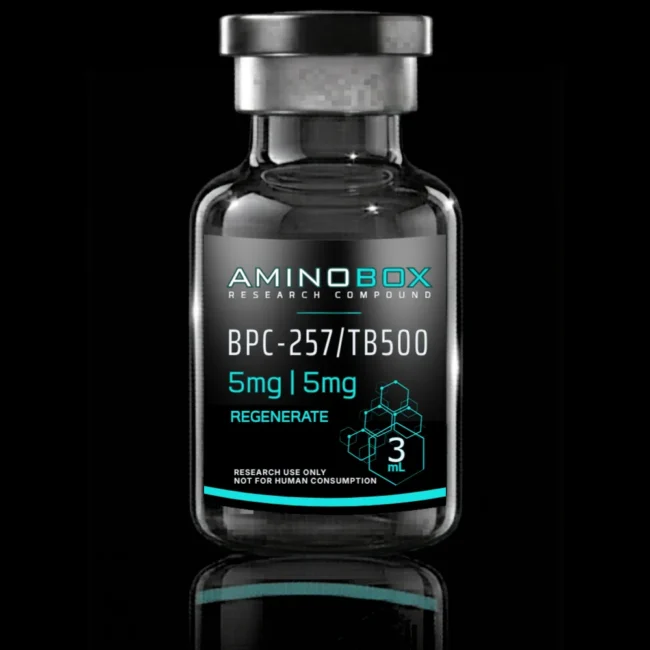

BPC-157/TB-500
Regenerative peptide combination


BPC-157 primarily influences localized tissue repair signaling, vascular integrity, nitric oxide pathways, and fibroblast migration. TB-500 is associated with systemic actin regulation, cellular migration, wound remodeling, and regenerative signaling cascades.
$74.00
In stock
Guaranteed Safe Checkout


| Product Name | BPC-157 / TB-500 Blend |
| Functional Class | Tissue Repair & Angiogenesis |
| Form | Lyophilized |
| Purity | ≥98% |
| Content | 5mg |
| Count | 1 vial |
| Research Use | For in vitro and laboratory research use only. Not for human consumption. |
| CAS Number | 137525-51-0 / 77591-33-4 |
| Molecular Weight | BPC-157: ~1419.5 g/mol / TB-500: ~4963.5 g/mol |
| Molecular Formula | BPC-157: C62H98N16O22 / TB-500: C212H350N56O78S |
| PubChem CID | See COA |
| Appearance | White lyophilized powder |
| Storage | –20°C long-term / 2–8°C short-term |
Active Peptide 2 items
Excipients 4 items
Reconstitution Solvents 4 items
Buffer Systems 4 items
Lyoprotectants & Cryoprotectants 3 items
Preservatives & Antimicrobials 3 items
Counter Ions & Salt Forms 3 items
Chelating Agents 2 items
Antioxidants & Stabilizers 3 items
| Water | Highly soluble |
| Acidified Water | Highly soluble |
| DMSO | Highly soluble |
| Ethanol | Moderate |
| Lipid solvents | Poor compatibility |
| Lyophilized | 2–8°C preferred |
| Long-term | −20°C recommended |
| Light Sensitivity | Moderate |
| Moisture | High sensitivity |
| Stability | Stable when dry |
| Container | Sterile sealed vial |
AminoBox products are supplied for research, analytical, and laboratory use only. Product information is provided for educational and technical reference and does not constitute medical advice. Products are not intended to diagnose, treat, cure, or prevent any disease.
Blend Composition
| Compound | Content |
|---|---|
| BPC-157 | 5mg |
| TB-500 (Thymosin Beta-4 Fragment) | 5mg |
| Total Peptide Content | 10mg |
Additional Scientific Details
| Category | BPC-157 | TB-500 (Thymosin Beta-4 Fragment Analog) |
|---|---|---|
| Full Name | Body Protection Compound-157 | Thymosin Beta-4 Fragment Analog |
| CAS Number | 137525-51-0 | No universally standardized CAS for “TB-500” specifically |
| Molecular Formula | C62H98N16O22 | Varies depending on peptide fragment/manufacturer |
| Molecular Weight | ~1419.56 g/mol | ~4963 g/mol (full Thymosin Beta-4 reference) |
| Peptide Chain | Gly-Glu-Pro-Pro-Pro-Gly-Lys-Pro-Ala-Asp-Asp-Ala-Gly-Leu-Val | Synthetic fragment analog derived from Thymosin Beta-4 |
| Primary Research Category | Angiogenic & tissue repair peptide | Actin-regulating regenerative peptide |
| Primary Mechanisms | VEGF modulation, NO signaling, fibroblast migration | Actin binding, cellular migration, wound remodeling |
| PubMed Reference ID | PMID: 21030672 | PMID: 25950542 |
| Common Synonyms | BPC-157, Pentadecapeptide BPC-157, PL-14736 | TB-500, Thymosin Beta-4, Tβ4 |
Compound Overview
| Property | Specification |
|---|---|
| Product Type | Dual-peptide research blend |
| Peptide Class | Synthetic regenerative peptides |
| Appearance | White lyophilized powder |
| Purity | Typically ≥98% |
| Formulation Type | Lyophilized peptide blend |
| Reconstitution | Bacteriostatic water compatible |
Peptide 1 — BPC-157 Specifications
| Property | Specification |
|---|---|
| Chemical Name | Body Protection Compound-157 |
| Molecular Formula | C62H98N16O22 |
| Molecular Weight | 1419.53 g/mol |
| Amino Acid Sequence | GEPPPGKPADDAGLV |
| Peptide Length | 15 amino acids |
| Compound Type | Synthetic gastric peptide fragment |
| Solubility | Water soluble |
| Research Focus | Tissue signaling and recovery pathways |
Structural Classification
| Category | Description |
|---|---|
| Compound Type | Multi-peptide regenerative blend |
| Functional Class | Tissue recovery and signaling research |
| Biological Focus | Cellular repair and recovery pathways |
| Mechanistic Focus | Angiogenesis, migration, and tissue remodeling research |
Research Areas Commonly Associated
(avoid framing as medical claims)
- Recovery signaling research
- Tissue remodeling pathways
- Musculoskeletal research
- Angiogenesis research
- Connective tissue studies
- Cellular migration pathways
- Soft tissue recovery research
Solubility Profile
| Solvent | Solubility |
|---|---|
| Bacteriostatic Water | Highly soluble |
| Sterile Water | Soluble |
| Acetic Acid Solutions | Compatible |
| DMSO | Limited use |
Storage Specifications
| Parameter | Recommendation |
|---|---|
| Lyophilized Storage | -20°C preferred |
| Refrigerated Storage | 2–8°C |
| Reconstituted Stability | Limited; refrigerated use recommended |
| Light Sensitivity | Moderate |
| Moisture Sensitivity | High |
| Container Type | Sterile amber vial |
Technical Characteristics
| Feature | Notes |
|---|---|
| Delivery Format | Lyophilized injectable peptide blend |
| Compound Stability | Stable under frozen dry storage |
| Reconstitution | Bacteriostatic water recommended |
| Research Use | Laboratory research only |
BPC-157 + TB-500 is a dual-peptide research formulation combining two extensively studied regenerative peptides investigated for their roles in tissue repair, angiogenesis, cytoskeletal remodeling, and cellular recovery signaling. Together, these peptides are studied as a multi-pathway regenerative system targeting recovery dynamics across connective tissue, muscle, tendon, ligament, vascular, and epithelial structures.
BPC-157 Overview (Body Protection Compound-157)
BPC-157 is a synthetic pentadecapeptide derived from a protective protein sequence originally isolated from gastric juice.
In research literature, BPC-157 is studied for its influence on:
- Tissue regeneration signaling
- Angiogenic pathway modulation
- Nitric oxide system regulation
- Fibroblast migration and collagen organization
- Gastrointestinal epithelial integrity
- Tendon-to-bone healing dynamics
Unlike many peptides that act through highly specific receptor systems, BPC-157 appears to influence broad cytoprotective and regenerative signaling networks.
BPC-157 Mechanistic Research
1. Angiogenesis & Vascular Repair
BPC-157 is strongly associated with modulation of:
- VEGF (vascular endothelial growth factor) pathways
- Endothelial cell migration
- Microvascular circulation and capillary formation
This may support:
- Oxygen and nutrient delivery to damaged tissues
- Accelerated tissue remodeling under injury conditions
- Improved recovery dynamics in hypoxic environments
2. Nitric Oxide (NO) System Regulation
BPC-157 demonstrates interaction with nitric oxide signaling systems involved in:
- Vascular tone regulation
- Endothelial stability
- Blood flow modulation
- Cellular stress adaptation
These effects are believed to contribute to its observed protective properties in experimental injury models.
3. Connective Tissue Remodeling
Preclinical studies associate BPC-157 with:
- Fibroblast recruitment and migration
- Collagen synthesis organization
- Tendon and ligament healing support
- Extracellular matrix remodeling
This places BPC-157 at the center of connective tissue recovery research.
TB-500 Overview (Thymosin Beta-4 Analog)
TB-500 is a synthetic peptide modeled after naturally occurring Thymosin Beta-4, a peptide involved in cellular migration and actin regulation throughout the body.
Its biological significance is linked to:
- Cytoskeletal organization
- Cellular mobility and migration
- Tissue remodeling
- Inflammatory response modulation
- Regenerative wound-healing signaling
TB-500 is especially researched for its systemic regenerative properties, in contrast to the more localized repair signaling commonly associated with BPC-157.
TB-500 Mechanistic Research
1. Actin Binding & Cytoskeletal Dynamics
Thymosin Beta-4 is a naturally occurring actin-sequestering peptide, meaning it regulates:
- Cellular structure and movement
- Cytoskeletal remodeling
- Cell migration during tissue repair
This mechanism is fundamental in:
- Wound healing biology
- Regenerative tissue remodeling
- Structural cellular repair systems
2. Cellular Migration & Regeneration
TB-500 has been associated with:
- Keratinocyte migration
- Fibroblast movement
- Endothelial cell repair activity
- Stem-cell-associated regenerative signaling
These pathways are essential during:
- Tissue remodeling phases
- Injury recovery responses
- Structural regeneration processes
3. Inflammatory Response Modulation
Research models suggest TB-500 may influence:
- Cytokine signaling pathways
- Cellular inflammatory responses
- Oxidative stress conditions during tissue injury
This may contribute to improved regenerative efficiency in damaged tissues.
Synergistic Peptide Research Model
The scientific interest in combining BPC-157 and TB-500 stems from their potentially complementary mechanisms:
| BPC-157 | TB-500 |
|---|---|
| Vascular & localized tissue repair | Systemic cellular migration |
| Nitric oxide modulation | Cytoskeletal remodeling |
| Tendon/ligament healing pathways | Tissue-wide regenerative signaling |
| Fibroblast and collagen organization | Actin regulation and wound remodeling |
Together, the peptides are explored as a:
“Multi-pathway regenerative peptide system targeting vascular repair, connective tissue remodeling, and systemic recovery signaling.”
Research Areas
This peptide combination is commonly investigated in:
- Tendon and ligament injury models
- Muscle recovery and regeneration research
- Connective tissue remodeling studies
- Angiogenesis and vascular biology
- Wound healing pathways
- Gastrointestinal tissue integrity models
- Recovery physiology and regenerative medicine research
Scientific Summary
BPC-157 + TB-500 is best categorized as:
“A dual-regenerative peptide complex combining angiogenic repair signaling with systemic cytoskeletal remodeling and cellular migration pathways.”
Primary mechanistic domains include:
- VEGF-mediated angiogenesis
- Nitric oxide signaling modulation
- Fibroblast activation and collagen organization
- Actin regulation and cytoskeletal repair
- Cellular migration and regenerative tissue remodeling