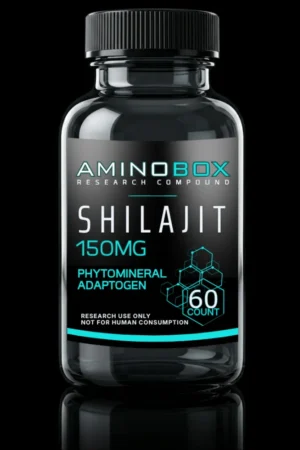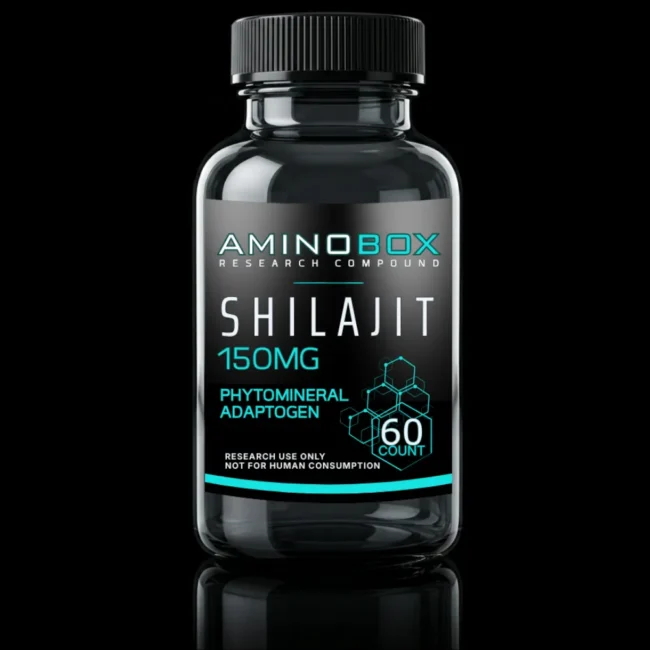

Shilajit


Shilajit is a Standardized Fulvic Acid Complex High-Altitude Phytomineral Bioactive System for Cellular regeneration and repair signaling support.
$42.00
In stock
Guaranteed Safe Checkout


| Product Name | Shilajit |
| Functional Class | Synthetics |
| Form | Lyophilized |
| Purity | 99%+ |
| Content | 5mg |
| Count | 1 capsule |
| Research Use | Research Grade |
| CAS Number | See COA |
| Molecular Weight | See COA |
| Molecular Formula | See COA |
| PubChem CID | See COA |
| Appearance | White to off-white powder |
| Storage | 2-8C preferred |
| Water | Highly soluble |
| Acidified Water | Highly soluble |
| DMSO | Highly soluble |
| Ethanol | Moderate |
| Lipid solvents | Poor compatibility |
| Lyophilized | 2–8°C preferred |
| Long-term | −20°C recommended |
| Light Sensitivity | Moderate |
| Moisture | High sensitivity |
| Stability | Stable when dry |
| Container | Sterile sealed vial |
AminoBox products are supplied for research, analytical, and laboratory use only. Product information is provided for educational and technical reference and does not constitute medical advice. Products are not intended to diagnose, treat, cure, or prevent any disease.
Product Composition
| Property | Specification |
|---|---|
| Product Name | Shilajit |
| Alternate Names | Shilajatu, Mumijo, Mumiyo, Mineral Pitch |
| Capsule Content | 150 mg |
| Package Size | 60 Capsules |
| Compound Class | Fulvic acid-rich mineral adaptogen |
| Physical Form | Encapsulated purified resin powder |
| Appearance | Dark brown to black powder (capsule fill) |
| Primary Constituents | Fulvic acids, humic substances, dibenzo-α-pyrones (DBPs), trace minerals |
| Research Category | Adaptogenic / mitochondrial / metabolic research |
| Source Origin | High-altitude mountain mineral exudate |
Molecular Information
| Property | Specification |
| Major Active Fraction | Fulvic acid and humic acid complex |
| Fulvic Acid Content | Naturally variable depending on source and purification |
| Molecular Composition | Complex organic-mineral phytocomplex |
| Molecular Weight | Variable natural composition |
| CAS Number | 479-66-3 (Fulvic Acid reference) |
| PubChem CID | Variable by constituent |
| Compound Type | Mineral-organic resin complex |
| Structural Classification | Humic substance and polyphenolic complex |
Structural Classification
| Category | Description |
| Compound Type | Natural mountain-derived mineral resin |
| Functional Class | Adaptogenic fulvic acid complex |
| Biological Focus | Cellular energy support and systemic resilience |
| Mechanistic Focus | Mineral transport, mitochondrial support, antioxidant activity |
| Chemical Family | Humic substances / dibenzo-α-pyrone phytocomplex |
Mechanism Research Profile
| Research Focus | Description |
| Fulvic Acid Transport | Studied for enhanced nutrient and mineral transport |
| Mitochondrial Activity | Investigated for ATP and cellular energy support |
| Antioxidant Properties | Contains humic substances with free radical scavenging activity |
| Adaptogenic Support | Explored for stress-response and recovery pathways |
| Cognitive Research | Studied for neuroprotective and cognitive support mechanisms |
| Mineral Bioavailability | May assist transport of ionic trace minerals |
Research Areas Commonly Associated
| Research Area | Focus |
| Longevity Research | Cellular resilience and mitochondrial efficiency |
| Metabolic Regulation | Energy metabolism and nutrient utilization |
| Exercise Physiology | Recovery, endurance, and performance support |
| Cognitive Research | Neuroprotection and mental clarity |
| Adaptogen Research | Stress adaptation and systemic balance |
| Testosterone Research | Investigated in purified extract studies for hormonal support |
Composition Profile
| Component | Notes |
| Fulvic Acids | Typically dominant organic fraction |
| Humic Substances | Major structural component of authentic shilajit |
| Dibenzo-α-Pyrones (DBPs) | Signature bioactive compounds associated with authentic shilajit |
| Trace Minerals | Contains naturally occurring ionic minerals |
| Organic Acids | Includes phenolic and polyphenolic compounds |
| Resin Matrix | Formed through centuries of plant decomposition and mineralization |
Solubility Profile
| Solvent | Solubility |
| Warm Water | Highly dispersible |
| Cold Water | Partial dispersion |
| Ethanol | Limited solubility |
| DMSO | Moderately soluble |
| Lipid Solvents | Low compatibility |
Storage Specifications
| Parameter | Recommendation |
| Capsule Storage | 15–25°C (cool, dry environment) |
| Long-term Storage | Refrigeration optional |
| Light Sensitivity | Moderate |
| Moisture Sensitivity | High |
| Stability | Stable in sealed dry conditions |
| Container Type | Opaque sealed capsule bottle |
Technical Characteristics
| Feature | Notes |
| Delivery Format | Encapsulated purified shilajit powder (150 mg per capsule, 60-count bottle) |
| Source Material | Naturally occurring mountain mineral resin |
| Bioactivity Profile | Fulvic acid-rich adaptogenic complex |
| Mineral Profile | Contains naturally occurring trace minerals |
| Authentication Marker | Dibenzo-α-pyrones (DBPs) commonly referenced as authenticity indicators |
| Stability Profile | Stable in dry encapsulated form |
| Research Use | Laboratory research only |
Premium Shilajit Capsules: Nature-Derived Bioenergetic & Anti-Aging Matrix
Shilajit is increasingly studied in modern biomedical science for its role in cellular energy metabolism, oxidative stress regulation, and biological aging pathways.
Its unique fulvic acid–rich composition allows it to interact with multiple physiological systems simultaneously, positioning it as a systems-level adaptogenic and mitochondrial support compound.
Shilajit is a naturally occurring mineral–organic phytocomplex formed over centuries through the slow microbial decomposition of plant matter and organic biomass under conditions of extreme geological pressure in high-altitude mountain ranges, most notably the Himalayas.
Traditionally referred to as “rock sweat” or “mountain tar,” Shilajit has been used in Ayurvedic systems of medicine for over 3,000 years as a rejuvenative Rasayana compound, historically associated with vitality, resilience, and tissue regeneration.
From a modern biochemical standpoint, Shilajit is classified as a complex humic substance matrix, composed primarily of fulvic acids, humic acids, dibenzo-α-pyrones, and naturally chelated trace minerals. This composition enables Shilajit to function not as a single active molecule, but as a multi-component biological regulator influencing cellular energy, redox balance, and nutrient transport systems.
Mechanistic Overview (Modern Biochemical Interpretation)
Shilajit’s biological relevance is attributed to its ability to influence cellular energetics, membrane transport processes, and oxidative stress buffering systems.
Unlike receptor-specific compounds, Shilajit operates through multi-target biochemical modulation, particularly within mitochondrial and redox-sensitive pathways.
1. Mitochondrial Bioenergetics & Cellular Energy Regulation
One of the most widely studied aspects of Shilajit is its relationship to mitochondrial efficiency and ATP production dynamics.
Bioactive fractions such as dibenzo-α-pyrones and fulvic acid complexes are investigated for their ability to:
- Support electron transport chain efficiency under metabolic stress
- Enhance mitochondrial redox cycling and coenzyme recycling systems
- Improve cellular ATP synthesis efficiency
- Reduce electron leakage associated with oxidative byproduct formation
This positions Shilajit as a mitochondrial bioenergetic regulator within cellular metabolism research frameworks.
2. Fulvic Acid–Mediated Cellular Transport & Bioavailability Enhancement
Fulvic acid is a low-molecular-weight organic acid with strong chelating, transport-facilitating, and membrane-interacting properties.
In biochemical transport models, it has been shown to:
- Enhance transmembrane movement of minerals and nutrients
- Improve intracellular delivery efficiency of ionic cofactors
- Support electrochemical balance across cellular membranes
- Facilitate nutrient complex stability and bioavailability
This mechanism is central to Shilajit’s classification as a biological transport and absorption enhancer system.
3. Oxidative Stress Modulation & Redox Homeostasis
Shilajit contains multiple redox-active organic structures capable of participating in electron donation and reactive oxygen species regulation.
Research suggests it may:
- Reduce lipid peroxidation in cellular membranes
- Stabilize mitochondrial oxidative output under stress conditions
- Support endogenous antioxidant enzyme systems (e.g., SOD and catalase pathways in experimental models)
- Buffer reactive oxygen species accumulation in high-metabolic-demand tissues
This is best described as redox homeostasis modulation rather than simple antioxidant activity.
4. Mineral Density & Cellular Nutrient Repletion
Shilajit contains naturally occurring trace minerals in bioavailable ionic and chelated forms, including:
- Magnesium
- Zinc
- Iron
- Potassium
- Manganese
- Copper
These minerals are essential cofactors in enzymatic processes involved in:
- Collagen synthesis and extracellular matrix maintenance
- Energy metabolism and ATP production
- Antioxidant defense systems
- Cellular repair and DNA maintenance pathways
Fulvic acid complexes may enhance mineral uptake efficiency and intracellular utilization.
5. Cellular Regeneration & Tissue Repair Pathways
Modern biochemical interpretations of Shilajit’s traditional “rejuvenative” properties focus on its role in cellular turnover and repair signaling systems.
Research suggests potential involvement in:
- Enhancement of cellular regeneration dynamics under oxidative stress
- Support of protein turnover and repair efficiency
- Improvement of cellular resilience under environmental damage conditions
- Modulation of inflammatory stress responses at the cellular level
These processes are relevant to both skin biology and systemic tissue maintenance models.
6. Skin Biology & Anti-Aging Research Context
In dermatological research frameworks, aging is strongly associated with oxidative stress, mitochondrial decline, reduced collagen synthesis, and impaired extracellular matrix integrity.
Shilajit is studied in this context for its potential to influence:
- Reduction of oxidative damage in dermal cellular structures
- Support of fibroblast metabolic activity (collagen-producing cells)
- Improved hydration dynamics via membrane transport efficiency
- Maintenance of skin barrier integrity under environmental stress
While often described in cosmetic contexts, these effects are indirect biochemical outcomes of cellular energy and redox modulation.
7. Cognitive & Neurometabolic Energy Research Context
Shilajit is also investigated in neurobiological research due to its effects on brain energy metabolism and mitochondrial stability.
Key research areas include:
- Neuronal ATP support under metabolic stress conditions
- Protection of mitochondrial function in neural tissue models
- Reduction of oxidative stress in brain energy systems
- Maintenance of synaptic energy availability under high demand
These findings are preclinical and mechanistic in nature, not clinical cognitive enhancement claims.
Scientific Composition Summary
Shilajit is best defined as a:
“Fulvic acid–rich, mitochondrial adaptogenic phytomineral system with multi-pathway redox and nutrient transport activity.”
Its primary functional domains include:
- Mitochondrial energy optimization
- Redox and oxidative stress regulation
- Mineral transport and bioavailability enhancement
- HimalayanCellular regeneration and repair signaling support
- Systemic adaptogenic stress response modulation
Important Notice
This product is supplied strictly for laboratory research, analytical use, and scientific investigation purposes only. It is not intended for human consumption, medical use, or therapeutic application.
Shilajit is a complex natural substance with significant variability depending on geological source and purification methods. All described mechanisms reflect biochemical and experimental research interpretations, not confirmed clinical or therapeutic outcomes.
Scientific References – Shilajit (Fulvic Acid Complex, Mitochondrial & Adaptogenic Research)
| Ref # | Title | Journal | Focus | Link |
|---|---|---|---|---|
| 1 | Shilajit: evaluation of its effects on blood chemistry of normal human subjects | Journal of Ethnopharmacology | Human study: lipid profile improvement, antioxidant status modulation | https://pubmed.ncbi.nlm.nih.gov/22557121/ |
| 2 | Clinical evaluation of purified Shilajit on testosterone levels in healthy volunteers | Andrologia | Human RCT: increased testosterone, DHEA, hormonal modulation | https://pubmed.ncbi.nlm.nih.gov/26395129/ |
| 3 | The effects of Shilajit supplementation on fatigue-induced decreases in muscular strength | J Int Soc Sports Nutr | Human trial: strength, fatigue resistance, collagen turnover marker (hydroxyproline) | https://pubmed.ncbi.nlm.nih.gov/30728074/ |
| 4 | Shilajit as a natural antioxidant and adaptogen: molecular basis of action | Journal of Ethnopharmacology | Mechanistic: fulvic acid, DBPs, mitochondrial support, oxidative stress reduction | https://pubmed.ncbi.nlm.nih.gov/30005244/ |
| 5 | Fulvic acid and humic substances in Shilajit: biological and pharmacological properties | Phytotherapy Research | Review: antioxidant, anti-inflammatory, mitochondrial bioenergetics | https://pubmed.ncbi.nlm.nih.gov/31051542/ |
| 6 | Neuroprotective effects of Shilajit in Alzheimer’s disease models | International Journal of Alzheimer’s Disease | Preclinical: amyloid aggregation inhibition, cognitive protection pathways | https://pubmed.ncbi.nlm.nih.gov/23243446/ |
| 7 | Mitochondrial enhancement and ATP production by Shilajit supplementation | Journal of Medicinal Food | Preclinical: increased ATP production, mitochondrial efficiency | https://pubmed.ncbi.nlm.nih.gov/22420640/ |
| 8 | Antioxidant and anti-inflammatory effects of Shilajit extract in biological systems | Evidence-Based Complementary and Alternative Medicine | Mechanistic review: ROS scavenging, cytokine modulation | https://pubmed.ncbi.nlm.nih.gov/3296184/ |