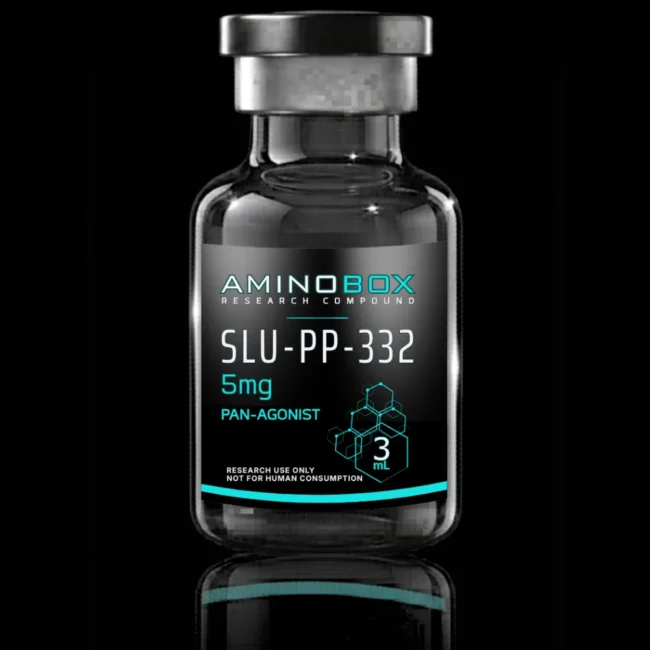

SLU-PP-332
Synthetic ERR agonist


SLU-PP-332 is known for Mitochondrial biogenesis, Oxidative phosphorylation, Cellular energy metabolism, Skeletal muscle metabolic adaptation, Fatty acid oxidation.
$56.00
In stock
Guaranteed Safe Checkout


| Product Name | SLU-PP-332 Raw Powder (Cold Chain) |
| Functional Class | ERR Pan-Agonist |
| Form | Lyophilized |
| Purity | ≥99% |
| Content | 5mg |
| Count | 1 mg |
| Research Use | For in vitro and laboratory research use only. Not for human consumption. |
| CAS Number | 303760-60-3 |
| Molecular Weight | ~290.32 g/mol |
| Molecular Formula | C18H14N2O2 |
| PubChem CID | See COA |
| Appearance | White to off-white powder |
| Storage | –20°C long-term / 2–8°C short-term |
Active Peptide 2 items
Excipients 4 items
Reconstitution Solvents 4 items
Buffer Systems 4 items
Lyoprotectants & Cryoprotectants 3 items
Preservatives & Antimicrobials 3 items
Counter Ions & Salt Forms 3 items
Chelating Agents 2 items
Antioxidants & Stabilizers 3 items
| Water | Highly soluble |
| Acidified Water | Highly soluble |
| DMSO | Highly soluble |
| Ethanol | Moderate |
| Lipid solvents | Poor compatibility |
| Lyophilized | 2–8°C preferred |
| Long-term | −20°C recommended |
| Light Sensitivity | Moderate |
| Moisture | High sensitivity |
| Stability | Stable when dry |
| Container | Sterile sealed vial |
AminoBox products are supplied for research, analytical, and laboratory use only. Product information is provided for educational and technical reference and does not constitute medical advice. Products are not intended to diagnose, treat, cure, or prevent any disease.
Product Composition
| Property | Specification |
|---|---|
| Product Name | SLU-PP-332 5mg |
| Alternate Names | ERR agonist 332, Exercise mimetic compound |
| Vial Content | 5 mg |
| Package Size | 5 mg lyophilized vial |
| Compound Class | Small molecule estrogen-related receptor (ERRα/β/γ) agonist |
| Physical Form | Lyophilized powder |
| Appearance | White to off-white powder |
| Purity | Typically ≥98–99% (research grade, vendor dependent) |
| Research Category | Metabolic regulation / exercise mimetic / mitochondrial activation research compound |
Molecular Information
| Property | Specification |
|---|---|
| Molecular Formula | C18H14N2O2 |
| Molecular Weight | ~290.32 g/mol |
| CAS Number | 303760-60-3 |
| PubChem CID | 5338394 |
| Compound Type | Benzohydrazide-derived small molecule |
| Stereochemistry | Achiral (small molecule, not peptide-based) |
Structural Classification
| Category | Description |
|---|---|
| Compound Type | Synthetic small molecule |
| Functional Class | Estrogen-related receptor (ERR) pan-agonist |
| Biological Target | ERRα (primary), ERRβ, ERRγ |
| Mechanistic Focus | Activation of transcriptional pathways linked to mitochondrial biogenesis and oxidative metabolism |
| Chemical Family | Nuclear receptor agonist / metabolic modulator |
Mechanism Research Profile
| Research Focus | Description |
|---|---|
| Mitochondrial Biogenesis | Activates gene expression pathways associated with increased mitochondrial density |
| Energy Metabolism | Enhances oxidative phosphorylation and fatty acid oxidation signaling |
| Exercise Mimetic Effect | Mimics endurance exercise–like metabolic adaptations in preclinical models |
| Endurance Capacity | In animal studies, associated with increased treadmill running performance |
| Metabolic Flexibility | Shifts energy utilization toward fat oxidation pathways |
| Cardiometabolic Effects | Studied in models of obesity, insulin resistance, and cardiac dysfunction |
Research Areas Commonly Associated
| Research Area | Focus |
|---|---|
| Metabolic Research | Energy expenditure and fat oxidation pathways |
| Exercise Physiology | Endurance adaptation and muscle fiber switching |
| Mitochondrial Biology | PGC-1α–linked mitochondrial biogenesis signaling |
| Cardiovascular Research | Cardiac efficiency and oxidative metabolism |
| Neuroendocrine Signaling | Nuclear receptor modulation (ERR pathways) |
Solubility Profile
| Solvent | Solubility |
|---|---|
| Water | Poor to limited |
| DMSO | Highly soluble |
| Ethanol | Moderate |
| Lipid-based solvents | Moderate compatibility |
| Buffered aqueous solutions | Limited stability depending on formulation |
Storage Specifications
| Parameter | Recommendation |
|---|---|
| Lyophilized Storage | 2–8°C (refrigerated, dry environment) |
| Long-term Storage | -20°C preferred |
| Light Sensitivity | Moderate |
| Moisture Sensitivity | High (hygroscopic after reconstitution) |
| Stability | Stable in dry form; limited stability once reconstituted |
| Container Type | Sterile sealed lyophilized vial with desiccant protection |
Technical Characteristics
| Feature | Notes |
|---|---|
| Delivery Format | 5mg lyophilized vial (research use) |
| Structural Advantage | Small molecule enables systemic receptor activity (not peptide-limited) |
| Bioactivity Profile | ERR receptor activation → mitochondrial gene expression signaling |
| Pharmacokinetics | Short half-life reported in preclinical models (~1–2 hours range) |
| Administration (research) | Reported in literature as oral or injectable in animal studies |
| Research Use | Preclinical metabolic and exercise-mimetic research only |
SLU-PP-332 | ERR Pan-Agonist Metabolic Research Compound
Mitochondrial Biogenesis • Oxidative Metabolism • Exercise-Mimetic Signaling Research
SLU-PP-332 is a research-stage small molecule ERR (Estrogen-Related Receptor) pan-agonist studied for its role in regulating cellular energy metabolism at the transcriptional level.
Unlike stimulant-based thermogenic compounds that act through sympathetic activation, SLU-PP-332 is investigated for its ability to influence upstream nuclear receptor signaling pathways involved in mitochondrial function and oxidative energy production.
Because of this mechanism, it is frequently described in preclinical literature as an exercise-mimetic metabolic regulator.
What Are ERR Receptors?
Estrogen-related receptors (ERRα, ERRβ, ERRγ) are orphan nuclear receptors that function as key regulators of cellular energy metabolism.
They play a central role in controlling gene networks involved in:
- Mitochondrial biogenesis and density
- ATP production and cellular respiration
- Oxidative metabolism efficiency
- Fatty acid utilization pathways
- Skeletal muscle endurance adaptation
ERR receptors are highly expressed in energy-demanding tissues such as:
- Skeletal muscle
- Cardiac tissue
- Brown adipose tissue
- Liver
- Brain
SLU-PP-332 is studied as a pan-agonist, meaning it interacts with multiple ERR receptor subtypes rather than a single isoform.
Mechanism of Action
1. ERR Activation & Metabolic Gene Expression
SLU-PP-332 activates:
- ERRα (Estrogen-related receptor alpha)
- ERRβ (Estrogen-related receptor beta)
- ERRγ (Estrogen-related receptor gamma)
This activation influences transcriptional programs involved in:
- Oxidative phosphorylation
- Fatty acid transport and metabolism
- Mitochondrial enzyme expression
- Cellular respiration pathways
- Energy substrate utilization
This results in metabolic signaling patterns associated with endurance-type cellular adaptation.
2. Mitochondrial Biogenesis & Energy Production
A key area of research interest is SLU-PP-332’s role in supporting pathways linked to:
- Mitochondrial proliferation
- Mitochondrial efficiency
- ATP production capacity
Mitochondria are essential for:
- Oxidative energy generation
- Fat oxidation
- Cellular endurance performance
- Metabolic efficiency
Preclinical studies explore its potential influence on transcriptional regulators associated with increased mitochondrial density and function.
3. Exercise-Mimetic Metabolic Signaling
Exercise triggers broad metabolic adaptations, including:
- Increased oxidative metabolism
- Improved mitochondrial efficiency
- Enhanced endurance capacity
- Greater fatty acid oxidation
SLU-PP-332 is studied for its ability to mimic aspects of these adaptations through nuclear receptor signaling, without direct stimulation of adrenergic (stimulant) pathways.
This is why it is commonly described as an:
“Exercise-mimetic metabolic regulator” (preclinical terminology)
4. Fatty Acid Oxidation & Metabolic Flexibility
ERR activation is strongly associated with:
- Increased fatty acid transport activity
- Enhanced β-oxidation pathways
- Improved lipid utilization
- Greater metabolic flexibility
This shifts cellular energy preference toward oxidative metabolism over glycolytic reliance.
5. Skeletal Muscle Metabolic Adaptation
Research interest includes its potential role in:
- Endurance-related muscle metabolism
- Oxidative muscle fiber activity
- Energy efficiency during sustained activity
- Exercise physiology signaling pathways
These effects are associated with gene expression changes, rather than acute stimulant-based energy increases.
6. Cardiometabolic & Longevity Research Interest
Mitochondrial function is a key focus in:
- Aging biology
- Metabolic health research
- Neurodegenerative disease models
- Cardiovascular efficiency studies
Because of this, ERR agonists like SLU-PP-332 are being explored in:
- Metabolic resilience research
- Healthy aging studies
- Cellular energy optimization models
- Cardiometabolic dysfunction research
Scientific Significance
SLU-PP-332 is notable because it targets upstream metabolic regulation rather than downstream stimulant pathways.
It differs mechanistically from:
- Sympathomimetic stimulants
- Adrenergic thermogenics
- Acute metabolic boosters (e.g., caffeine-like compounds)
Instead, it operates through:
- Nuclear receptor signaling
- Transcriptional metabolic programming
- Mitochondrial gene regulation
- Oxidative energy pathway modulation
Research Applications
SLU-PP-332 is studied in:
- Exercise-mimetic metabolic research
- Mitochondrial biogenesis studies
- Endurance physiology models
- Fatty acid oxidation research
- Obesity and metabolic dysfunction research
- Cellular energy metabolism studies
- Longevity and aging biology research
Important Notice
This product is not intended for human consumption, medical use, or therapeutic application.
SLU-PP-332 is an investigational metabolic research compound with ongoing preclinical evaluation. All descriptions reflect mechanistic and experimental literature only and do not constitute approved therapeutic claims.
Scientific References – SLU-PP-332 (ERR Pan-Agonist)
| Ref # | Title | Journal | Focus | Link |
|---|---|---|---|---|
| 1 | An exercise mimetic selective estrogen-related receptor agonist improves muscle endurance and oxidative metabolism | Nature Communications | Core SLU-PP-332 study: endurance enhancement and mitochondrial metabolism | https://www.nature.com/articles/s41467-023-38354-5 |
| 2 | Estrogen-related receptors and the regulation of mitochondrial metabolism | Molecular Endocrinology | ERRα/ERRγ regulation of mitochondrial biogenesis | https://pubmed.ncbi.nlm.nih.gov/19920270/ |
| 3 | ERR nuclear receptors orchestrate metabolic transcriptional networks | Physiological Reviews | Comprehensive review of ERR metabolic biology | https://pubmed.ncbi.nlm.nih.gov/21885675/ |
| 4 | PGC-1α and estrogen-related receptors in oxidative metabolism | Nature Reviews Molecular Cell Biology | Mitochondrial transcription and oxidative phosphorylation | https://pubmed.ncbi.nlm.nih.gov/16103874/ |
| 5 | Estrogen-related receptor gamma controls aerobic capacity and muscle metabolism | Cell Metabolism | Skeletal muscle endurance and oxidative adaptation | https://pubmed.ncbi.nlm.nih.gov/17403375/ |
| 6 | Nuclear receptor regulation of mitochondrial function and energy metabolism | Cold Spring Harbor Perspectives in Biology | Transcriptional metabolic control systems | https://pubmed.ncbi.nlm.nih.gov/23028197/ |
| 7 | ERRα regulates fatty acid oxidation pathways and mitochondrial respiration | Journal of Biological Chemistry | Fat oxidation and oxidative metabolism | https://pubmed.ncbi.nlm.nih.gov/16825190/ |
| 8 | Exercise-induced mitochondrial biogenesis in skeletal muscle | Journal of Physiology | Exercise adaptation and mitochondrial proliferation | https://pubmed.ncbi.nlm.nih.gov/15034143/ |
| 9 | Transcriptional control of energy metabolism by ERR receptors | Trends in Endocrinology & Metabolism | Nuclear receptor energy regulation pathways | https://pubmed.ncbi.nlm.nih.gov/18715741/ |
| 10 | Mitochondrial dysfunction and aging: role of metabolic regulators | Aging Cell | Longevity and mitochondrial resilience pathways | https://pubmed.ncbi.nlm.nih.gov/19732026/ |