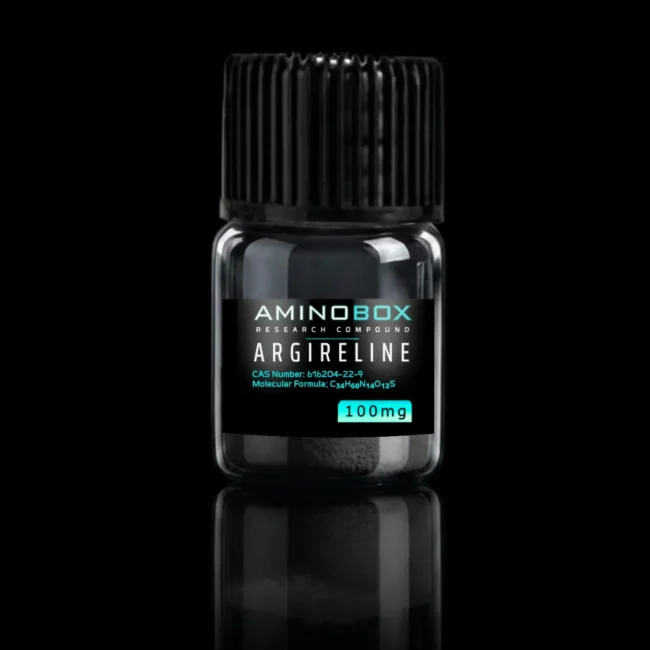

Argireline | Acetyl Hexapeptide-8


Argireline for dermal smoothness, and skin-aging mechanisms associated with repetitive muscular microcontraction.
$59.00
In stock
Guaranteed Safe Checkout


Research Data
Primary Effect Over Time
Literature
Cellular Ratio
Comparative Metric
Activity Profile
Activity Profile
Mechanism
Cellular Pathway
01
Competitive SNAP-25 Displacement
02
Neurotransmitter Release Inhibition
03
Expression Line Attenuation
Metabolic Network
Biosynthesis Map
Sequence Analysis
Amino Acid Sequences
Single-letter residue map colored by physicochemical property class. Hover any residue for full name and position.
BPC-157
G
E
P
P
P
G
K
P
A
D
D
A
G
L
V
TB-500
L
K
K
T
E
T
Q
■ Hydrophobic
■ Polar
■ Positively Charged
■ Negatively Charged
■ Glycine
Research Focus
Research Coverage
Product Data
Compound Identity
| Product Name | Argireline | Acetyl Hexapeptide-8 |
| Functional Class | Dermatics |
| Form | Lyophilized |
| Purity | 99%+ |
| Content | 5mg |
| Count | 1 vial |
| Research Use | Research Grade |
Specifications
Technical Specs
| CAS Number | See COA |
| Molecular Weight | See COA |
| Molecular Formula | See COA |
| PubChem CID | See COA |
| Appearance | White to off-white powder |
| Storage | 2-8C preferred |
Formulation Reference
Anatomy of a Peptide
A reference guide to the components of a lyophilized research peptide — from the active sequence to the excipients, solvents, buffers, and stabilizers used in formulation.
Active Peptide 2 items
Synthetic Amino Acid Sequence
The primary chain of amino acids synthesized via solid-phase peptide synthesis (SPPS). Defined by sequence length and molecular weight.
Peptide Modifications
Acetylation (N-terminus), amidation (C-terminus), PEGylation, or cyclization applied to improve stability, receptor binding, or half-life.
Excipients 4 items
Mannitol
Sugar alcohol bulking agent that forms an elegant lyophilized cake, aids reconstitution, and provides structural matrix during freeze-drying.
Trehalose
Non-reducing disaccharide that stabilizes peptide secondary structure by replacing water molecules through hydrogen bonding during dehydration.
Sucrose
Disaccharide used as a lyoprotectant and tonicity agent. Forms an amorphous glassy matrix that immobilizes the peptide and prevents aggregation.
Glycine
Amino acid bulking agent used in lyophilization. Crystallizes to provide mechanical strength to the freeze-dried cake structure.
Reconstitution Solvents 4 items
Bacteriostatic Water (BAC Water)
Sterile water containing 0.9% benzyl alcohol as a preservative. Preferred for multi-dose vials — inhibits microbial growth after initial puncture.
Sterile Water for Injection
USP-grade water, pyrogen-free, without preservatives. Used for single-dose preparations or when benzyl alcohol sensitivity is a concern.
Acetic Acid Solution (0.1–1%)
Dilute acid used for peptides with poor aqueous solubility at neutral pH. Protonates basic residues to improve dissolution.
Sodium Chloride 0.9%
Isotonic saline diluent. Provides physiological osmolality (~308 mOsm/L) and can improve stability of certain charged peptides.
Buffer Systems 4 items
Phosphate Buffered Saline (PBS)
Maintains pH 7.2–7.4. Composed of sodium phosphate dibasic, potassium phosphate monobasic, NaCl, and KCl. Mimics physiological ionic strength.
Acetate Buffer
Effective pH range 3.7–5.6. Composed of acetic acid and sodium acetate. Ideal for acidic peptides and those requiring lower pH for solubility.
Citrate Buffer
Effective pH range 3.0–6.2. Offers strong buffering capacity and metal-chelating properties. Used when oxidation-sensitive residues (Met, Cys) are present.
Histidine Buffer
Effective pH range 5.5–7.0. Low ionic strength, minimal interaction with peptides. Increasingly preferred in modern biopharmaceutical formulations.
Lyoprotectants & Cryoprotectants 3 items
Trehalose / Sucrose (Lyoprotectant)
Protect peptide conformation during the drying phase of lyophilization by forming hydrogen bonds that substitute for water molecules around the peptide.
Glycerol (Cryoprotectant)
Polyol that depresses the freezing point and reduces ice crystal formation, preventing mechanical damage to peptide structure during freezing steps.
Polyethylene Glycol (PEG)
Hydrophilic polymer that provides steric stabilization, reduces aggregation, and can serve as both cryoprotectant and solubility enhancer.
Preservatives & Antimicrobials 3 items
Benzyl Alcohol (0.9%)
Aromatic alcohol preservative in bacteriostatic water. Acts as antimicrobial agent by disrupting microbial cell membranes. Standard for multi-use vials.
Methyl / Propyl Parabens
Broad-spectrum antimicrobial preservatives effective against fungi and bacteria. Used in some peptide formulations where benzyl alcohol is incompatible.
Phenol (0.5%)
Bacteriostatic preservative used in certain injectable peptide formulations. Also acts as a conformational stabilizer for some peptide structures.
Counter Ions & Salt Forms 3 items
Trifluoroacetate (TFA)
Most common counter ion from RP-HPLC purification. Forms TFA salt with basic residues (Lys, Arg, His). May affect bioassay results and cell toxicity.
Acetate
Milder alternative to TFA obtained via ion exchange. Lower cytotoxicity, preferred for cell-based research assays and in vivo studies.
Hydrochloride (HCl)
Chloride salt form, sometimes used for improved stability or specific solubility profiles. Common in pharmaceutical-grade peptide preparations.
Chelating Agents 2 items
EDTA (Disodium)
Chelates divalent metal ions (Cu²⁺, Fe²⁺, Zn²⁺) that catalyze oxidative degradation of methionine and cysteine residues in peptides.
Citric Acid
Natural chelator with moderate metal-binding capacity. Dual function as buffer component and oxidation inhibitor in peptide formulations.
Antioxidants & Stabilizers 3 items
L-Methionine
Free methionine added as a sacrificial antioxidant. Preferentially oxidizes before methionine residues within the peptide chain.
Ascorbic Acid
Water-soluble antioxidant that scavenges reactive oxygen species. Used at low concentrations to prevent oxidative peptide degradation.
Polysorbate 20 / 80
Non-ionic surfactants that prevent surface adsorption and aggregation of peptides at air-liquid and container-liquid interfaces.
Preparation Tool
Reconstitution Calculator
Enter your target working concentration to calculate the exact solvent volume needed for this vial.
mg
Solvent Volume Required
—
Recommended solvents
Bacteriostatic Water
Sterile Water for Injection
Acetic Acid 0.1%
Sodium Chloride 0.9%
Product Specs
Solubility Profile
| Water | Highly soluble |
| Acidified Water | Highly soluble |
| DMSO | Highly soluble |
| Ethanol | Moderate |
| Lipid solvents | Poor compatibility |
Product Specs
Storage Specs
| Lyophilized | 2–8°C preferred |
| Long-term | −20°C recommended |
| Light Sensitivity | Moderate |
| Moisture | High sensitivity |
| Stability | Stable when dry |
| Container | Sterile sealed vial |
Literature
Research Citations
Catalogue Pathway
Related Systems
Use this for internal linking, adjacent products, and quick route-back buttons.
Important Notice
Research Use Only
AminoBox products are supplied for research, analytical, and laboratory use only. Product information is provided for educational and technical reference and does not constitute medical advice. Products are not intended to diagnose, treat, cure, or prevent any disease.
About This Data
Chart Explanation
What this chart is about
Research context
Research Outcome
Chemical Specifications
| Specification | Details |
|---|---|
| Product Name | Argireline® |
| INCI Name | Acetyl Hexapeptide-8 |
| Alternative Names | Acetyl Hexapeptide-3, Ac-EEMQRR-NH₂ |
| Peptide Classification | Synthetic Hexapeptide |
| Quantity | 100mg |
| CAS Number | 616204-22-9 |
| EC Number | 801-648-4 |
| Molecular Formula | C₃₄H₆₀N₁₄O₁₂S |
| Molecular Weight | 888.96–889.00 g/mol |
| Amino Acid Sequence | Ac-Glu-Glu-Met-Gln-Arg-Arg-NH₂ |
| Sequence Abbreviation | Ac-EEMQRR-NH₂ |
| Appearance | White to Off-White Lyophilized Powder |
| Purity | ≥95% (HPLC) |
| Solubility | Water Soluble |
| Source | Synthetic Peptide |
| Grade | Cosmetic Research Grade |
| Storage | Store at -20°C, protected from light and moisture |
| Intended Use | Cosmetic Formulation & Laboratory Research Only |
| Preservatives | None |
| Carrier Additives | None |
| Sterility | Non-Sterile |
| Country of Manufacture | Varies by Batch |
Sources for molecular identity, sequence, CAS number, and molecular weight are consistent across peptide reference databases and cosmetic ingredient records.
Physical Properties
| Property | Specification |
|---|---|
| Physical Form | Lyophilized Powder |
| Color | White to Off-White |
| Odor | Odorless |
| Water Solubility | Soluble |
| Ethanol Solubility | Slightly Soluble |
| Recommended pH Range | 4.5 – 7.0 |
| Moisture Content | ≤8% |
| Peptide Content | ≥95% |
| Heavy Metals | Meets Cosmetic Research Standards |
| Microbial Limits | Tested Per Batch |
Cosmetic Research Profile
| Category | Research Focus |
|---|---|
| Primary Function | Expression Line & Wrinkle Appearance Reduction |
| Mechanism Studied | SNARE Complex Modulation |
| Target Pathway | SNAP-25 Related Signaling |
| Research Interest | Dynamic Facial Line Appearance |
| Formulation Type | Serums, Creams, Cosmetic Peptide Blends |
| Skin-Care Category | Anti-Aging Cosmetic Ingredient |
| Peptide Family | Neurocosmetic Peptide |
| Application Area | Forehead, Crow’s Feet, Glabellar Lines |
| Research Domain | Cosmetic Science & Skin Appearance Research |
Packaging Information
| Attribute | Details |
|---|---|
| Net Content | 100mg |
| Container Type | Laboratory Glass Vial |
| Seal Type | Screw Cap |
| Storage Condition | Frozen (-20°C) Recommended |
| Shipping Condition | Ambient or Cold Chain Depending on Transit Duration |
| Shelf Life | 24 Months Unopened When Properly Stored |
| Reconstitution | Cosmetic Research Use Only |
| Handling | Minimize Freeze-Thaw Cycles |
Research Areas Commonly Associated
| Focus | Description |
|---|---|
| Neurocosmetic Signaling | Investigation of neurotransmitter-related cosmetic pathways |
| Expression Line Research | Studies involving dynamic wrinkle appearance |
| Peptide Cosmetic Formulations | Multi-peptide anti-aging systems |
| SNARE Complex Research | Cosmetic applications involving SNAP-25 analogs |
| Topical Peptide Delivery | Formulation and skin-application studies |
| Skin Appearance Optimization | Cosmetic research targeting visible aging markers |
| Anti-Wrinkle Formulation Science | Development of peptide-enhanced cosmetic products |
Scientific Summary
| Attribute | Summary |
|---|---|
| Classification | Synthetic Acetylated Hexapeptide |
| INCI Designation | Acetyl Hexapeptide-8 |
| Common Name | Argireline® |
| Core Research Interest | Neurocosmetic peptide signaling |
| Primary Cosmetic Application | Appearance of expression lines and wrinkles |
| Key Structural Feature | SNAP-25 Mimetic Hexapeptide Sequence |
| Molecular Weight | 888.96 g/mol |
| Formula | C₃₄H₆₀N₁₄O₁₂S |
The Science Behind Argireline™
Scientific References – Argireline™ (Acetyl Hexapeptide-8)
| Title | Focus | Link |
|---|---|---|
| A Synthetic Hexapeptide (Argireline®) with Antiwrinkle Activity | Landmark study evaluating the anti-wrinkle activity and cosmetic applications of Acetyl Hexapeptide-8 | https://pubmed.ncbi.nlm.nih.gov/12477084/ |
| Small Peptides Patterned After the N-Terminal Domain of SNAP-25 Inhibit SNARE Complex Assembly and Regulated Exocytosis | Foundational mechanistic research demonstrating SNARE complex modulation and neurotransmitter signaling effects | https://pubmed.ncbi.nlm.nih.gov/14717617/ |
| In Vitro Skin Penetration of Acetyl Hexapeptide-8 from a Cosmetic Formulation | Investigation of topical skin penetration and peptide delivery characteristics | https://pubmed.ncbi.nlm.nih.gov/24521005/ |
| Safety Assessment of Acetyl Hexapeptide-8 and Acetyl Hexapeptide-8 Amide as Used in Cosmetics | Comprehensive review of cosmetic safety, toxicology, and formulation use | https://www.cir-safety.org/sites/default/files/AcetylHexapeptide-8.pdf |
| Role of Topical Peptides in Preventing or Treating Aged Skin | Review of cosmetic peptide technologies used in anti-aging skincare formulations | https://pubmed.ncbi.nlm.nih.gov/19493333/ |
| Preparation and Stability of Cosmetic Formulations Containing an Anti-Aging Peptide | Evaluation of formulation stability and peptide compatibility in cosmetic products | https://pubmed.ncbi.nlm.nih.gov/17728999/ |
| Cosmeceutical Peptides in Anti-Aging Skin Care | Overview of peptide-based skincare ingredients and their cosmetic applications | https://pubmed.ncbi.nlm.nih.gov/20620757/ |
| Cosmetic Applications of Biomimetic Peptides in Skin Rejuvenation | Analysis of biomimetic peptide technology and skin-aging research pathways | https://pubmed.ncbi.nlm.nih.gov/40030563/ |
| Acetyl Hexapeptide-8 in Cosmeceuticals: Skin Permeability and Efficacy Review | Comprehensive review of Argireline’s permeability, efficacy, and formulation science | https://pubmed.ncbi.nlm.nih.gov/40444507/ |
| Neurocosmetics and the Future of Cosmetic Peptide Science | Examination of neurotransmitter-associated cosmetic ingredients and neurocosmetic innovations | https://www.mdpi.com/2079-9284/10/5/140 |