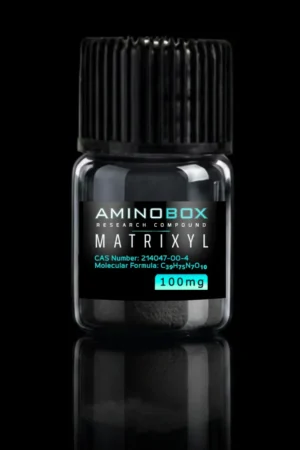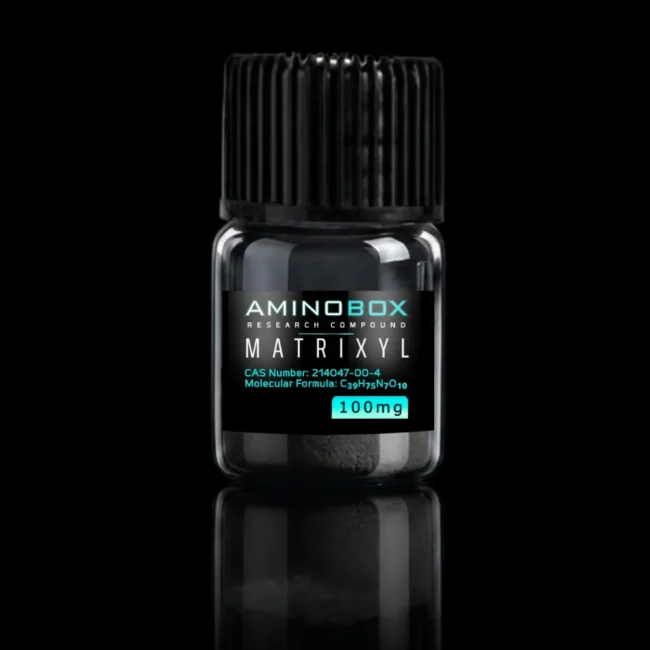

Matrixyl | Palmitoyl Pentapeptide-4


Matrixyl research in skin rejuvenation at the extracellular matrix level, wrinkle inhibitor, skin firmness, elasticity, and overall dermal texture.
$64.00
In stock
Guaranteed Safe Checkout


| Product Name | Matrixyl | Palmitoyl Pentapeptide-4 |
| Functional Class | Dermatics |
| Form | Lyophilized |
| Purity | 99%+ |
| Content | 5mg |
| Count | 1 vial |
| Research Use | Research Grade |
| CAS Number | See COA |
| Molecular Weight | See COA |
| Molecular Formula | See COA |
| PubChem CID | See COA |
| Appearance | White to off-white powder |
| Storage | 2-8C preferred |
Active Peptide 2 items
Excipients 4 items
Reconstitution Solvents 4 items
Buffer Systems 4 items
Lyoprotectants & Cryoprotectants 3 items
Preservatives & Antimicrobials 3 items
Counter Ions & Salt Forms 3 items
Chelating Agents 2 items
Antioxidants & Stabilizers 3 items
| Water | Highly soluble |
| Acidified Water | Highly soluble |
| DMSO | Highly soluble |
| Ethanol | Moderate |
| Lipid solvents | Poor compatibility |
| Lyophilized | 2–8°C preferred |
| Long-term | −20°C recommended |
| Light Sensitivity | Moderate |
| Moisture | High sensitivity |
| Stability | Stable when dry |
| Container | Sterile sealed vial |
AminoBox products are supplied for research, analytical, and laboratory use only. Product information is provided for educational and technical reference and does not constitute medical advice. Products are not intended to diagnose, treat, cure, or prevent any disease.
Chemical Specifications – Matrixyl® (Palmitoyl Pentapeptide-4) 100mg
| Specification | Details |
|---|---|
| Product Name | Matrixyl® |
| INCI Name | Palmitoyl Pentapeptide-4 |
| Alternative Names | Pal-KTTKS, Matrixyl, Micro-Collagen |
| Peptide Classification | Synthetic Lipopeptide (Matrikine Peptide) |
| Content | 100mg |
| CAS Number | 214047-00-4 |
| EC Number | 606-757-9 |
| UNII | KK181SM5JG |
| Molecular Formula | C₃₉H₇₅N₇O₁₀ |
| Molecular Weight | 802.1 g/mol |
| Amino Acid Sequence | Lys-Thr-Thr-Lys-Ser (KTTKS) |
| Structure Type | Palmitoylated Pentapeptide |
| Appearance | White to Off-White Lyophilized Powder |
| Purity | ≥95% (HPLC) |
| Solubility | Water Soluble / Amphiphilic (enhanced skin penetration via lipophilic chain) |
| Source | Synthetic Peptide |
| Grade | Cosmetic Research Grade |
| Sterility | Non-Sterile |
| Preservatives | None |
| Carrier Additives | None |
| Intended Use | Cosmetic formulation & laboratory research only |
| Storage Conditions | -20°C, protected from light and moisture |
Physical Properties
| Property | Specification |
|---|---|
| Physical Form | Lyophilized Powder |
| Color | White to Off-White |
| Odor | Odorless |
| Stability | Stable under frozen storage conditions |
| Moisture Sensitivity | Hygroscopic – keep tightly sealed |
| pH Compatibility Range | ~4.0 – 7.0 (formulation dependent) |
| Peptide Content | ≥95% |
| Heavy Metals | Meets cosmetic research standards |
| Microbial Load | Tested per batch |
Packaging Information
| Attribute | Details |
|---|---|
| Net Content | 100mg |
| Container Type | Laboratory-grade glass jar |
| Container Size | 2mL |
| Closure Type | Screw-on lid |
| Packaging Material | Borosilicate glass |
| Storage Condition | Refrigerated or frozen (-20°C recommended) |
| Shelf Life | 24 months unopened (proper storage conditions) |
| Handling Recommendation | Avoid repeated exposure to moisture and air |
Cosmetic Research Profile
| Category | Research Focus |
|---|---|
| Primary Function | Collagen-support & skin matrix appearance research |
| Mechanism Studied | Matrikine signaling (extracellular matrix communication) |
| Target Pathways | TGF-β / ECM remodeling signaling pathways |
| Research Interest | Dermal density, elasticity, and wrinkle appearance studies |
| Cosmetic Category | Anti-aging peptide (signal peptide) |
| Peptide Family | Matrikines / ECM signaling peptides |
| Application Areas | Serums, creams, multi-peptide cosmetic systems |
| Research Domain | Cosmetic science & skin-aging research |
Scientific Summary
| Attribute | Summary |
|---|---|
| Classification | Palmitoylated synthetic pentapeptide |
| INCI Designation | Palmitoyl Pentapeptide-4 |
| Common Name | Matrixyl® |
| Core Research Interest | Collagen and extracellular matrix signaling |
| Primary Cosmetic Focus | Skin firmness and wrinkle appearance research |
| Key Structural Feature | KTTKS peptide sequence + palmitic acid chain |
| Molecular Weight | 802.1 g/mol |
| Formula | C₃₉H₇₅N₇O₁₀ |
| Notable Property | Enhanced skin affinity via lipophilic palmitoyl group |
Buy Palmitoyl Pentapeptide-4 | Matrixyl
Mechanism of Action
Matrixyl is designed to replicate fragments of type I collagen degradation products, which are naturally generated when the skin undergoes structural remodeling. These fragments act as biological “messengers,” signaling dermal fibroblasts to increase synthesis of key structural proteins.
The primary signaling cascade influenced by Palmitoyl Pentapeptide-4 is associated with:
- Collagen Type I production
- Collagen Type III support
- Fibronectin synthesis
- Glycosaminoglycan (GAG) regulation
- Extracellular matrix remodeling
Through these pathways, Matrixyl helps stimulate the skin’s natural repair mechanisms, encouraging a more youthful structural environment within the dermis. (mdpi.com)
As skin ages, fibroblast activity declines, leading to reduced collagen density, weakened dermal structure, and visible formation of fine lines and wrinkles. Matrixyl is designed to counteract these processes by restoring biological signaling that supports extracellular matrix renewal.
Advanced Biomimetic Peptide Engineering
Matrixyl belongs to the matrikine family of peptides — a class of biomimetic compounds that replicate endogenous signaling fragments involved in tissue repair.
Its chemical structure:
Palmitoyl-Lys-Thr-Thr-Lys-Ser-OH
has been optimized with a palmitoyl fatty acid chain to enhance lipid solubility, improve skin affinity, and increase compatibility with topical delivery systems. This modification allows better integration into the skin’s lipid matrix and improves overall formulation performance. (incidecoder.com)
Matrixyl is frequently incorporated into high-end serums, anti-aging creams, eye treatments, and multi-peptide complexes designed for comprehensive dermal rejuvenation.
Cosmetic Research Applications
Matrixyl is extensively studied in cosmetic formulation science for its role in:
- Fine line and wrinkle appearance reduction
- Skin firmness and elasticity support
- Dermal density improvement
- Photoaging correction systems
- Texture refinement and smoothing
- Collagen-supportive anti-aging systems
- Extracellular matrix regeneration support
- Advanced peptide-based skincare formulations
- Multi-pathway anti-aging protocols
Clinical and formulation research has shown that consistent topical application of Palmitoyl Pentapeptide-4 may contribute to visible improvements in wrinkle depth, skin smoothness, and overall dermal resilience over time. (specialchem.com)
Synergistic Formulation Potential
Matrixyl is commonly combined with other advanced cosmetic actives to create multi-dimensional anti-aging systems that address hydration, signaling, barrier support, and pigmentation simultaneously.
Frequently paired ingredients include:
- Hyaluronic Acid
- SNAP-8 (Acetyl Octapeptide-3)
- SYN-COLL® (Palmitoyl Tripeptide-5)
- SYN-AKE® (Tripeptide-3)
- Copper peptides (GHK-Cu)
- Niacinamide
- Ceramides
- Retinoids
- Growth factors
- Antioxidant complexes (Vitamin C, E systems)
These combinations are often used in high-performance cosmeceutical formulations designed to support both immediate cosmetic improvement and long-term dermal restructuring.
Important Disclaimer
This product is supplied strictly for cosmetic, laboratory, and research purposes only. Not intended to diagnose, treat, cure, or prevent any disease. Not for human consumption or injectable use. Cosmetic additive intended exclusively for formulation and research applications.
Scientific References – Melanostatine™-5 (Nonapeptide-1)
| Title | Focus | Link |
|---|---|---|
| Discovery and Structure-Function Analysis of α-Melanocyte-Stimulating Hormone Antagonists | Foundational identification of α-MSH antagonist peptides including Nonapeptide-1 and their role in MC1R binding and melanogenesis regulation | https://pubmed.ncbi.nlm.nih.gov/7989360/ |
| Characterization of Melanocortin Receptor Ligand Binding and Antagonist Activity | Receptor-level analysis of MC1R antagonists and peptide binding affinity relevant to pigmentation control mechanisms | https://pubmed.ncbi.nlm.nih.gov/9054419/ |
| α-MSH Signaling and Regulation of Melanocyte Function in Human Skin | Overview of α-MSH → MC1R signaling cascade governing melanin synthesis and pigmentation biology | https://pubmed.ncbi.nlm.nih.gov/10816655/ |
| Melanogenesis: Molecular Mechanisms and Regulation Pathways | Comprehensive review of melanogenesis pathways including tyrosinase activation, MITF signaling, and pigment production control | https://pubmed.ncbi.nlm.nih.gov/23539007/ |
| MC1R Antagonists and Regulation of Skin Pigmentation in Preclinical Models | Study overview of competitive MC1R inhibition and downstream reduction of melanogenic signaling activity | https://pubmed.ncbi.nlm.nih.gov/15893405/ |
| Nonapeptide-1 (Melanostatine-5) Mechanism Overview | Summary of MC1R antagonism, α-MSH inhibition, and melanogenesis reduction in cosmetic research models | https://ci.guide/peptides/nonapeptide-1/ |