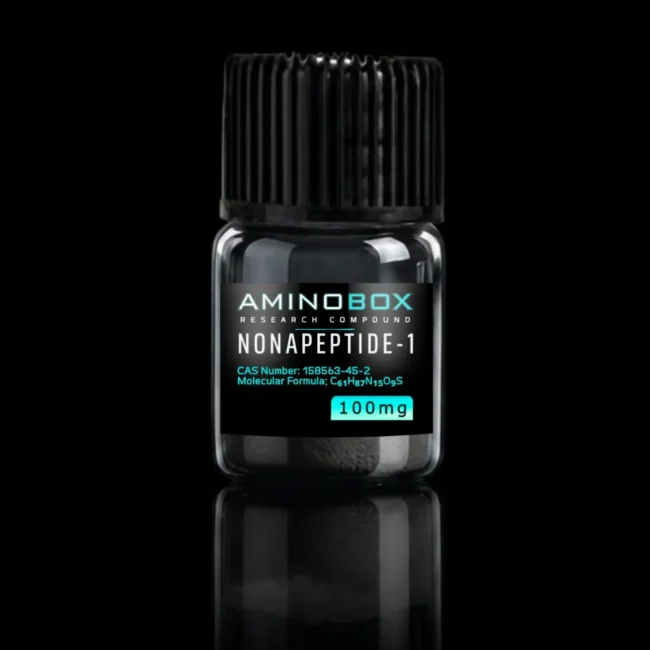

Melanostatine-5 | Nonapeptide-1


Melanostatine-5 Nonapeptide-1 visibly improves uneven skin tone, discoloration, and hyperpigmentation through targeted modulation of melanogenesis.
$64.00
In stock
Guaranteed Safe Checkout


| Product Name | Melanostatine-5 | Nonapeptide-1 |
| Functional Class | Dermatics |
| Form | Lyophilized |
| Purity | 99%+ |
| Content | 5mg |
| Count | 1 vial |
| Research Use | Research Grade |
| CAS Number | See COA |
| Molecular Weight | See COA |
| Molecular Formula | See COA |
| PubChem CID | See COA |
| Appearance | White to off-white powder |
| Storage | 2-8C preferred |
Active Peptide 2 items
Excipients 4 items
Reconstitution Solvents 4 items
Buffer Systems 4 items
Lyoprotectants & Cryoprotectants 3 items
Preservatives & Antimicrobials 3 items
Counter Ions & Salt Forms 3 items
Chelating Agents 2 items
Antioxidants & Stabilizers 3 items
| Water | Highly soluble |
| Acidified Water | Highly soluble |
| DMSO | Highly soluble |
| Ethanol | Moderate |
| Lipid solvents | Poor compatibility |
| Lyophilized | 2–8°C preferred |
| Long-term | −20°C recommended |
| Light Sensitivity | Moderate |
| Moisture | High sensitivity |
| Stability | Stable when dry |
| Container | Sterile sealed vial |
AminoBox products are supplied for research, analytical, and laboratory use only. Product information is provided for educational and technical reference and does not constitute medical advice. Products are not intended to diagnose, treat, cure, or prevent any disease.
Chemical Specifications
| Specification | Details |
|---|---|
| Product Name | Melanostatine™-5 |
| INCI Name | Nonapeptide-1 |
| Alternative Names | Melanostatine-5, White 05, Neptide-1 |
| Peptide Classification | Synthetic Biomimetic Nonapeptide |
| Quantity | 100mg |
| CAS Number | 158563-45-2 |
| Molecular Formula | C₆₁H₈₇N₁₅O₉S |
| Molecular Weight | 1206.5 g/mol |
| Amino Acid Sequence | H-Met-Pro-D-Phe-Arg-D-Trp-Phe-Lys-Pro-Val-NH₂ |
| Sequence Length | 9 Amino Acids (Nonapeptide) |
| Appearance | White to Off-White Lyophilized Powder |
| Purity | ≥95% (HPLC) |
| Solubility | Water Soluble |
| Source | Synthetic Peptide |
| Grade | Cosmetic Research Grade |
| Preservatives | None |
| Carrier Additives | None |
| Sterility | Non-Sterile |
| Intended Use | Cosmetic Formulation & Laboratory Research Only |
| Storage | Store at -20°C, protected from light and moisture |
Physical Properties
| Property | Specification |
|---|---|
| Physical Form | Lyophilized Powder |
| Color | White to Off-White |
| Odor | Odorless |
| Water Solubility | Soluble |
| Recommended Storage Temperature | -20°C |
| Moisture Sensitivity | Hygroscopic – Keep Sealed |
| Peptide Content | ≥95% |
| Heavy Metals | Meets Cosmetic Research Standards |
| Microbial Limits | Tested Per Batch |
| Handling | Minimize Moisture Exposure After Opening |
Cosmetic Research Profile
| Category | Research Focus |
|---|---|
| Primary Function | Skin Brightening & Pigmentation Research |
| Mechanism Studied | α-MSH (Alpha-Melanocyte-Stimulating Hormone) Antagonism |
| Target Receptor | MC1R (Melanocortin-1 Receptor) |
| Research Interest | Hyperpigmentation & Uneven Skin Tone |
| Cosmetic Category | Brightening Peptide |
| Peptide Family | Biomimetic Signaling Peptide |
| Application Area | Facial Serums, Spot Treatments, Brightening Formulations |
| Research Domain | Cosmetic Science & Pigmentation Research |
Packaging Information
| Attribute | Details |
|---|---|
| Net Content | 100mg |
| Container Type | Glass Cosmetic Jar |
| Container Size | 2mL |
| Closure Type | Screw-On Lid |
| Packaging Material | Laboratory-Grade Glass |
| Storage Condition | Frozen (-20°C) Recommended |
| Shelf Life | 24 Months Unopened When Properly Stored |
| Handling Recommendation | Keep Tightly Closed and Protected from Moisture |
Research Areas Commonly Associated
| Focus | Description |
|---|---|
| Melanogenesis Research | Investigation of melanin production pathways |
| MC1R Signaling Studies | Research involving melanocortin receptor activity |
| Hyperpigmentation Research | Cosmetic studies targeting uneven pigmentation |
| Skin Tone Research | Investigations involving visible skin-brightening mechanisms |
| Tyrosinase Pathway Research | Studies related to melanin synthesis regulation |
| Biomimetic Peptide Science | Signal-mimicking cosmetic peptide technologies |
| Advanced Cosmetic Formulation | Brightening serums and multi-peptide systems |
Scientific Summary
| Attribute | Summary |
|---|---|
| Classification | Synthetic Biomimetic Nonapeptide |
| INCI Designation | Nonapeptide-1 |
| Common Name | Melanostatine™-5 |
| Primary Cosmetic Interest | Skin Brightening & Pigmentation Research |
| Target Pathway | α-MSH / MC1R Signaling |
| Mechanism Category | Melanocortin Receptor Antagonist |
| Molecular Weight | 1206.5 g/mol |
| Formula | C₆₁H₈₇N₁₅O₉S |
| Key Research Focus | Cosmetic regulation of melanin-production signaling pathways |
Buy Melanostatine-5
Mechanism of Action
Melanogenesis — the biological process responsible for melanin synthesis — is primarily regulated by melanocyte activity within the epidermis. One of the key signaling molecules involved in this process is α-Melanocyte Stimulating Hormone (α-MSH), which binds to melanocortin-1 receptors (MC1R) located on melanocytes. Activation of these receptors initiates intracellular signaling cascades that stimulate tyrosinase activity and increase melanin production. (mdpi.com)
Nonapeptide-1 is engineered to function as a competitive antagonist of α-MSH signaling. By interfering with α-MSH binding at the MC1R receptor level, Melanostatine®-5 may help reduce downstream melanogenic activity involved in excessive pigmentation formation. (specialchem.com)
This peptide-mediated modulation mechanism makes Nonapeptide-1 particularly attractive within cosmetic brightening systems because it targets pigment signaling pathways upstream rather than relying exclusively on direct melanocyte suppression or exfoliative turnover.
Research discussions suggest this mechanism may contribute to improvements in:
- Visible hyperpigmentation
- Uneven skin tone
- Post-inflammatory discoloration
- Sun-associated pigmentation appearance
- Age-related dark spots
- Surface dullness and tone irregularity
Advanced Biomimetic Peptide Engineering
Melanostatine®-5 belongs to a specialized class of biomimetic regulatory peptides developed to emulate naturally occurring signaling fragments involved in cellular communication pathways. Its peptide sequence was specifically optimized for topical cosmetic use and integration into high-performance brightening formulations.
The active structure is commonly identified as:
Nonapeptide-1
A synthetic nine-amino acid peptide engineered for melanogenesis-modulating cosmetic applications. Its molecular architecture was designed to provide improved topical compatibility while supporting targeted interaction with pigmentation-associated signaling systems. (incidecoder.com)
Due to its highly specialized signaling activity, Nonapeptide-1 is frequently incorporated into premium cosmetic systems focused on skin luminosity optimization and complexion refinement.
Cosmetic Research Applications
Melanostatine®-5 is widely researched in cosmetic and dermatological formulation environments for applications involving:
- Brightening-focused skincare systems
- Hyperpigmentation appearance reduction
- Uneven skin tone correction
- Photoaging-related discoloration
- Post-inflammatory discoloration support
- Cosmetic melanin-regulation systems
- Radiance-enhancement formulations
- Advanced peptide complexion technologies
- Tone-balancing anti-aging systems
Supplier-sponsored cosmetic studies and formulation reports have suggested improvements in visible pigmentation irregularities and skin brightness following sustained topical application over several weeks. Research interest continues to focus on peptide-based melanogenesis regulation as a more sophisticated alternative to traditional depigmenting technologies. (specialchem.com)
Synergistic Formulation Potential
Nonapeptide-1 is frequently formulated alongside complementary cosmetic actives targeting multiple dimensions of skin appearance including hydration, antioxidant protection, barrier integrity, and surface renewal.
Common formulation pairings include:
- Niacinamide
- Tranexamic acid
- Alpha arbutin
- Kojic acid derivatives
- Vitamin C systems
- Hyaluronic acid
- Licorice root extract
- Retinoid technologies
- Epidermal renewal peptides
- Ceramide complexes
Within advanced brightening formulations, Melanostatine®-5 is often utilized as a regulatory peptide component designed to complement broader skin tone optimization strategies while minimizing irritation commonly associated with harsher depigmenting systems. (reddit.com)
Stability & Formulation Considerations
As a peptide-based cosmetic active, formulation stability is influenced by variables including pH range, oxidation exposure, preservative compatibility, water activity, and manufacturing methodology. Nonapeptide-1 is commonly utilized in water-based serums, emulsions, brightening creams, hydrogel masks, and peptide concentrates.
Modern cosmetic laboratories frequently explore encapsulation technologies, liposomal carriers, and nano-delivery systems to optimize epidermal penetration and maintain peptide integrity throughout formulation shelf life. (mdpi.com)
Important Disclaimer
This product is supplied strictly for cosmetic, laboratory, and research purposes only. Not intended to diagnose, treat, cure, or prevent any disease. Not for human consumption or injectable use. Cosmetic additive intended exclusively for formulation and research applications.