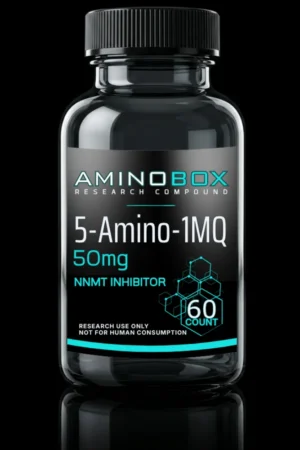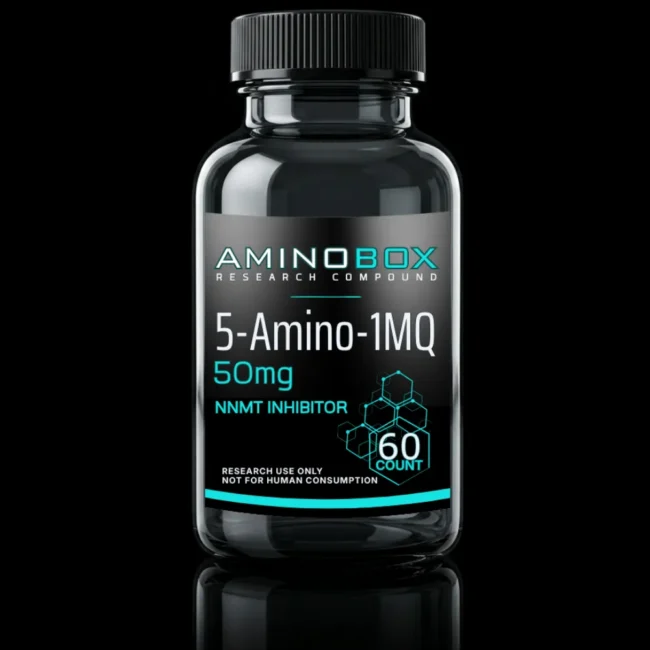

5-Amino-1MQ Encap


5-Amino-1MQ Capsules for cellular energy, methylation dynamics, mitochondrial efficiency, nicotinamide metabolism, and metabolic balance.
$129.00
In stock
Guaranteed Safe Checkout


| Product Name | 5-Amino-1MQ Encap |
| Functional Class | Synthetics |
| Form | Lyophilized |
| Purity | 99%+ |
| Content | 5mg |
| Count | 1 capsule |
| Research Use | Research Grade |
| CAS Number | See COA |
| Molecular Weight | See COA |
| Molecular Formula | See COA |
| PubChem CID | See COA |
| Appearance | White to off-white powder |
| Storage | 2-8C preferred |
| Water | Highly soluble |
| Acidified Water | Highly soluble |
| DMSO | Highly soluble |
| Ethanol | Moderate |
| Lipid solvents | Poor compatibility |
| Lyophilized | 2–8°C preferred |
| Long-term | −20°C recommended |
| Light Sensitivity | Moderate |
| Moisture | High sensitivity |
| Stability | Stable when dry |
| Container | Sterile sealed vial |
AminoBox products are supplied for research, analytical, and laboratory use only. Product information is provided for educational and technical reference and does not constitute medical advice. Products are not intended to diagnose, treat, cure, or prevent any disease.
Product Composition
| Property | Specification |
|---|---|
| Product Name | 5-Amino-1MQ Capsules |
| Alternate Names | 5-Amino-1-methylquinolinium, NNMT inhibitor |
| Capsule Content | 50mg |
| Package Size | 60 Capsules |
| Compound Class | Synthetic quinolinium-based small molecule |
| Physical Form | Encapsulated powder |
| Appearance | White to off-white crystalline powder |
| Purity | Typically ≥98% (research grade, vendor dependent) |
| Research Category | Metabolic regulation / NNMT inhibition / NAD⁺ pathway research |
Molecular Information
| Property | Specification |
|---|---|
| Molecular Formula | C10H11N2⁺ (commonly as salt form, e.g., iodide or chloride) |
| Molecular Weight | ~159.21 g/mol (free cation) |
| CAS Number | 42464-96-0 |
| PubChem CID | 950107 |
| Compound Type | Quinolinium-derived small molecule |
| Stereochemistry | Achiral |
Structural Classification
| Category | Description |
|---|---|
| Compound Type | Methylquinolinium derivative |
| Functional Class | Nicotinamide N-methyltransferase (NNMT) inhibitor |
| Biological Focus | Cellular energy metabolism and NAD⁺ salvage pathway regulation |
| Mechanistic Focus | Inhibition of nicotinamide methylation → NAD⁺ conservation |
| Chemical Family | Pyridinium/quinolinium cationic small molecule |
Mechanism Research Profile
| Research Focus | Description |
|---|---|
| NNMT Inhibition | Selectively inhibits nicotinamide N-methyltransferase (NNMT), reducing conversion of nicotinamide to 1-MNA |
| NAD⁺ Preservation | Supports higher intracellular NAD⁺ availability via reduced nicotinamide clearance pathways |
| Metabolic Regulation | Studied in preclinical models for effects on adipose metabolism and energy expenditure |
| Mitochondrial Activity | Indirectly associated with improved mitochondrial function via NAD⁺-dependent signaling pathways |
| Glucose Handling | Investigated in animal models for insulin sensitivity and metabolic flexibility pathways |
Research Areas Commonly Associated
| Research Area | Focus |
|---|---|
| Metabolic Research | Fat oxidation and energy balance |
| Longevity Biology | NAD⁺ depletion and cellular aging pathways |
| Mitochondrial Function | ATP production and oxidative metabolism |
| Epigenetic Regulation | Methylation cycle and SAM utilization |
| Endocrine Metabolism | Glucose and insulin signaling models |
Solubility Profile
| Solvent | Solubility |
|---|---|
| Water | Highly soluble |
| Acidified Water | Highly soluble |
| DMSO | Highly soluble |
| Ethanol | Moderate solubility |
| Lipid solvents | Poor compatibility |
Storage Specifications
| Parameter | Recommendation |
|---|---|
| Capsule Storage | 15–25°C (cool, dry environment) |
| Long-term Storage | 2–8°C preferred |
| Light Sensitivity | Moderate |
| Moisture Sensitivity | High |
| Stability | Stable in dry encapsulated form |
| Container Type | Sealed opaque capsule bottle |
Technical Characteristics
| Feature | Notes |
|---|---|
| Delivery Format | Encapsulated powder (50mg per capsule, 60-count bottle) |
| Structural Advantage | Small cationic molecule enables efficient cellular uptake |
| Bioactivity Profile | NNMT inhibition → NAD⁺ pathway modulation |
| Configuration | Synthetic quinolinium-derived compound |
| Stability Profile | High stability in dry form |
| Research Use | Laboratory research only |
5-Amino-1MQ Capsules | 50mg
Unlike conventional stimulant-based metabolic compounds, 5-Amino-1MQ Capsules are being investigated through a fundamentally different biochemical framework centred around intracellular enzymatic regulation rather than adrenergic nervous system activation. This distinction has contributed substantially to its growing presence within experimental longevity, metabolic, and mitochondrial research discussions. (pubmed.ncbi.nlm.nih.gov)
The compound is classified as an NNMT inhibitor and remains investigational, with current scientific understanding derived primarily from preclinical models, mechanistic biochemical studies, and early-stage metabolic research environments.
Understanding NNMT (Nicotinamide N-Methyltransferase)
To understand the scientific significance of 5-Amino-1MQ Capsules, it is important to first understand the biological role of NNMT.
NNMT is a cytosolic enzyme responsible for catalyzing the methylation of nicotinamide (NAM), a form of vitamin B3 and an essential precursor within NAD⁺ metabolism. Specifically, NNMT transfers a methyl group from S-adenosylmethionine (SAM) to nicotinamide, producing:
- 1-Methylnicotinamide (1-MNA)
- S-adenosylhomocysteine (SAH)
This process appears relatively simple biochemically, yet it intersects with several highly important physiological systems including:
- NAD⁺ homeostasis
- Cellular energy metabolism
- Methyl donor utilization
- Epigenetic regulation
- Mitochondrial function
- Adipocyte metabolic signaling
Over the past decade, elevated NNMT expression has been observed in multiple metabolically active tissues, particularly adipose tissue, where researchers began investigating its relationship to systemic energy balance and obesity-associated metabolic dysfunction. (nature.com)
The Relationship Between NNMT & Cellular Energy Metabolism
NNMT occupies a unique position at the intersection of two critically important biological systems:
1. NAD⁺ Metabolism
Nicotinamide serves as a precursor for NAD⁺ (Nicotinamide Adenine Dinucleotide), one of the most essential molecules involved in cellular respiration and mitochondrial ATP production.
NAD⁺ participates directly in:
- Oxidative phosphorylation
- Electron transport chain activity
- Cellular redox balance
- Sirtuin signaling pathways
- DNA repair systems
- Mitochondrial metabolic efficiency
Because NNMT consumes nicotinamide, researchers theorize that elevated NNMT activity may influence the availability of nicotinamide pools relevant to NAD⁺ biosynthesis pathways. (pubmed.ncbi.nlm.nih.gov)
2. Methylation Economy
NNMT also consumes methyl groups from SAMe (S-adenosylmethionine), one of the body’s primary methyl donors.
Methylation pathways are fundamentally important for:
- Epigenetic gene regulation
- Neurotransmitter synthesis
- Cellular signaling
- DNA methylation
- Lipid metabolism
- Detoxification pathways
Researchers have therefore become increasingly interested in how NNMT activity may influence broader metabolic and epigenetic systems simultaneously.
Mechanism of Research Interest: NNMT Inhibition
5-Amino-1MQ Capsules are studied primarily for its ability to inhibit NNMT activity.
By reducing NNMT-mediated nicotinamide methylation, researchers theorize the compound may influence:
- Intracellular nicotinamide availability
- NAD⁺ salvage pathway dynamics
- Cellular energy expenditure signaling
- Adipocyte metabolic behavior
- Mitochondrial activity pathways
- Lipid metabolism signaling
Importantly, these mechanisms remain areas of active investigation rather than fully established clinical conclusions.
Preclinical models have generated significant scientific interest after observations suggesting NNMT inhibition may alter adipocyte metabolic programming and energy utilization patterns. (nature.com)
Adipocyte & Metabolic Research
One of the primary reasons 5-Amino-1MQ Capsules has attracted attention within metabolic research communities involves the emerging understanding of adipose tissue as an active endocrine and metabolic organ rather than passive energy storage.
Research literature suggests elevated NNMT expression may be associated with:
- Reduced metabolic flexibility
- Altered adipocyte energy expenditure
- Dysregulated mitochondrial activity
- Impaired nicotinamide utilization
- Changes in methyl donor balance
Experimental NNMT inhibition models have therefore been explored for their potential influence on:
- Adipocyte metabolic activity
- Energy utilization signaling
- Lipid oxidation pathways
- Cellular respiration
- Metabolic efficiency
These findings have contributed to growing interest in NNMT as a novel metabolic regulatory target. (pubmed.ncbi.nlm.nih.gov)
Mitochondrial & Longevity Research Interest
Because NAD⁺ metabolism is deeply connected to mitochondrial performance and sirtuin signaling, 5-Amino-1MQ Capsules have also become increasingly discussed within broader longevity and mitochondrial optimization research communities.
NAD⁺ is critically important for:
- SIRT1 activation
- Mitochondrial biogenesis
- Cellular stress adaptation
- DNA repair pathways
- Oxidative metabolism
- Cellular resilience signaling
As interest in NAD⁺ biology has expanded substantially in modern longevity science, compounds capable of influencing nicotinamide metabolism have attracted considerable experimental attention. (nature.com)
Researchers continue exploring whether NNMT modulation may indirectly influence broader metabolic resilience and mitochondrial signaling systems.
Structural & Pharmacological Characteristics
5-Amino-1MQ Capsules belongs to a category of small-molecule enzyme inhibitors developed through medicinal chemistry approaches targeting NNMT catalytic activity.
Unlike peptide-based research compounds, small molecules such as 5-Amino-1MQ Capsules generally demonstrate:
- Greater oral stability
- Improved gastrointestinal survivability
- Longer systemic persistence
- Higher passive membrane permeability
- More conventional pharmacokinetic profiles
These properties have contributed to increasing interest in oral capsule delivery systems for experimental NNMT research compounds.
Current State of Research
Despite substantial excitement within metabolic research circles, it is important to emphasize that 5-Amino-1MQ Capsules remains investigational.
Current evidence is primarily derived from:
- In vitro biochemical studies
- Animal-model research
- Mechanistic metabolic experiments
- Early-stage preclinical investigations
Large-scale human clinical data remains extremely limited, and many proposed mechanisms remain incompletely understood.
Scientific interest surrounding NNMT continues to evolve rapidly as researchers further investigate its role in metabolic regulation, mitochondrial biology, and systemic energy homeostasis. (pubmed.ncbi.nlm.nih.gov)
Research Community Discussion
Within metabolic and longevity-focused research communities, 5-Amino-1MQ Capsules are frequently discussed alongside broader topics involving:
- NAD⁺ metabolism
- Sirtuin signaling
- Mitochondrial efficiency
- Energy expenditure pathways
- Adipocyte biology
- Epigenetic regulation
- Metabolic flexibility
- Cellular resilience research
Community discussions often focus heavily on mechanistic theory and emerging biochemical literature, though much of this remains exploratory and should not be interpreted as established clinical evidence. (reddit.com)
Important Research Disclaimer
This product is supplied strictly for laboratory, analytical, and research purposes only. Not intended to diagnose, treat, cure, or prevent any disease. Not approved for human consumption. 5-Amino-1MQ Capsules remain an investigational compound with limited human clinical data available. All biological activity references are derived primarily from preclinical and experimental research environments.
Scientific References – 5-Amino-1MQ (NNMT Inhibitor Research)
| Ref # | Title | Journal | Focus | Link |
|---|---|---|---|---|
| 1 | Nicotinamide N-methyltransferase (NNMT) as a metabolic regulator in obesity and metabolic disease | Nature Reviews Endocrinology | NNMT role in metabolism, obesity, energy balance | https://pubmed.ncbi.nlm.nih.gov/31467406/ |
| 2 | NNMT links energy balance to obesity and diabetes via epigenetic and metabolic regulation | Nature Communications | NNMT metabolic signaling, adipose tissue regulation | https://pubmed.ncbi.nlm.nih.gov/29116074/ |
| 3 | Nicotinamide N-methyltransferase inhibition improves metabolic flexibility in obesity models | Cell Metabolism | Metabolic flexibility, mitochondrial energy usage | https://pubmed.ncbi.nlm.nih.gov/33479499/ |
| 4 | NNMT inhibition as a therapeutic strategy for metabolic disease | Journal of Medicinal Chemistry | Small-molecule NNMT inhibitors, drug development | https://pubmed.ncbi.nlm.nih.gov/29424630/ |
| 5 | Chemical probes targeting NNMT reveal metabolic and epigenetic regulation mechanisms | ACS Chemical Biology | Mechanistic NNMT inhibition, methylation pathways | https://pubmed.ncbi.nlm.nih.gov/33016692/ |
| 6 | NNMT regulates cellular energy expenditure and adipose tissue function | Nature Communications | Energy expenditure, adipocyte metabolism | https://pubmed.ncbi.nlm.nih.gov/28796244/ |