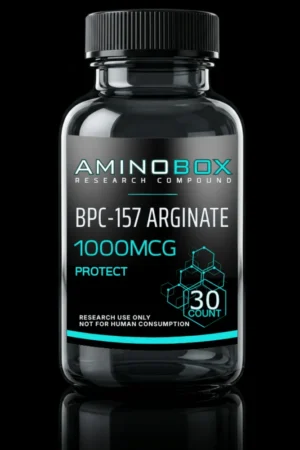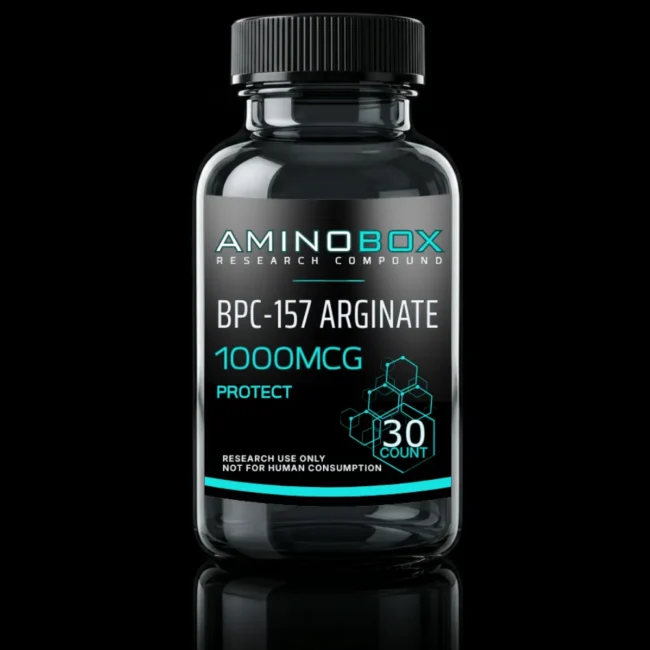

BPC-157 Arginate


BPC-157 Arginate is an advanced oral peptide proven for tissue-repair, gastrointestinal integrity, angiogenic modulation, and cellular recovery.
$76.00
In stock
Guaranteed Safe Checkout


| Product Name | BPC-157 Arginate |
| Functional Class | Peptidics |
| Form | Lyophilized |
| Purity | 99%+ |
| Content | 5mg |
| Count | 1 vial |
| Research Use | Research Grade |
| CAS Number | See COA |
| Molecular Weight | See COA |
| Molecular Formula | See COA |
| PubChem CID | See COA |
| Appearance | White to off-white powder |
| Storage | 2-8C preferred |
Active Peptide 2 items
Excipients 4 items
Reconstitution Solvents 4 items
Buffer Systems 4 items
Lyoprotectants & Cryoprotectants 3 items
Preservatives & Antimicrobials 3 items
Counter Ions & Salt Forms 3 items
Chelating Agents 2 items
Antioxidants & Stabilizers 3 items
| Water | Highly soluble |
| Acidified Water | Highly soluble |
| DMSO | Highly soluble |
| Ethanol | Moderate |
| Lipid solvents | Poor compatibility |
| Lyophilized | 2–8°C preferred |
| Long-term | −20°C recommended |
| Light Sensitivity | Moderate |
| Moisture | High sensitivity |
| Stability | Stable when dry |
| Container | Sterile sealed vial |
AminoBox products are supplied for research, analytical, and laboratory use only. Product information is provided for educational and technical reference and does not constitute medical advice. Products are not intended to diagnose, treat, cure, or prevent any disease.
Product Composition
| Property | Specification |
|---|---|
| Product Name | BPC-157 Arginate |
| Alternate Names | Body Protection Compound-157 (Arginate salt), Pentadecapeptide BPC-157 Arginate |
| Capsule Content | 1000 mcg (1 mg) |
| Package Size | 30 Capsules |
| Compound Class | Synthetic gastric pentadecapeptide (arginine-stabilized salt form) |
| Physical Form | Encapsulated powder |
| Appearance | White to off-white powder |
| Purity | Typically ≥98% (research grade, supplier dependent) |
| Research Category | Tissue repair / gut protection / regenerative signaling research compound |
Molecular Information
| Property | Specification |
|---|---|
| Molecular Formula | C62H98N16O22 (parent peptide BPC-157) |
| Molecular Weight | ~1419.6 g/mol |
| CAS Number | 137525-51-0 |
| PubChem CID | 9941957 |
| Compound Type | Pentadecapeptide (15 amino acids) |
| Salt Form | Arginate (stabilized oral delivery variant) |
| Stereochemistry | All-L amino acid peptide sequence |
Structural Classification
| Category | Description |
|---|---|
| Compound Type | Gastric-derived synthetic peptide |
| Functional Class | Cytoprotective / angiogenic signaling peptide |
| Biological Focus | Tissue repair and gastrointestinal integrity pathways |
| Mechanistic Focus | Angiogenesis, fibroblast migration, nitric oxide modulation |
| Chemical Family | Pentadecapeptide (protein fragment derivative) |
Mechanism Research Profile
| Research Focus | Description |
|---|---|
| Tissue Repair Signaling | Studied for acceleration of tendon, muscle, and ligament repair in preclinical models |
| Angiogenesis | Promotes formation of new blood vessels for tissue recovery |
| Gastrointestinal Protection | Investigated for protective effects on gastric and intestinal lining |
| Fibroblast Activity | Supports collagen synthesis and extracellular matrix remodeling |
| Nitric Oxide Modulation | Influences NO signaling pathways in vascular repair models |
Research Areas Commonly Associated
| Research Area | Focus |
|---|---|
| Regenerative Biology | Soft tissue and musculoskeletal repair |
| Gastrointestinal Research | Ulcer and mucosal healing models |
| Vascular Biology | Angiogenesis and microcirculation |
| Inflammation Research | Cytokine modulation and tissue stress response |
| Wound Healing Science | Fibroblast and collagen repair pathways |
Solubility Profile
| Solvent | Solubility |
|---|---|
| Sterile Water | Highly soluble |
| Bacteriostatic Water | Compatible |
| Saline | Soluble |
| DMSO | Limited compatibility |
| Organic solvents | Not soluble |
Storage Specifications
| Parameter | Recommendation |
|---|---|
| Capsule Storage | 2–8°C preferred |
| Long-term Storage | -20°C recommended for stability |
| Light Sensitivity | Moderate |
| Moisture Sensitivity | High |
| Stability | Stable in dry encapsulated form |
| Container Type | Sealed opaque capsule bottle |
Technical Characteristics
| Feature | Notes |
|---|---|
| Delivery Format | Encapsulated powder (1000 mcg per capsule, 30-count bottle) |
| Structural Advantage | Arginate salt improves stability and oral resilience compared to acetate form |
| Bioactivity Profile | Cytoprotective peptide signaling molecule |
| Configuration | Linear 15-amino-acid peptide |
| Stability Profile | Higher stability in arginate oral formulations |
| Research Use | Laboratory research only |
BPC-157 Arginate | 1000mcg
Originally derived from a protective protein sequence identified in human gastric juice, BPC-157 has become one of the most widely studied experimental regenerative peptides in modern peptide literature. Research interest surrounding the compound has expanded considerably due to its unusually broad range of activity observed across musculoskeletal, gastrointestinal, vascular, neurological, and connective-tissue models in preclinical settings.
Unlike many peptide compounds that demonstrate poor oral survivability due to rapid enzymatic degradation, BPC-157 exhibits an unusual resistance to gastric acid and digestive enzymatic breakdown. This property has made oral administration—particularly in the arginate form—a major area of investigation within peptide formulation science.
What Is BPC-157?
BPC-157 (Body Protection Compound-157) is a synthetic peptide consisting of 15 amino acids:
Gly-Glu-Pro-Pro-Pro-Gly-Lys-Pro-Ala-Asp-Asp-Ala-Gly-Leu-Val
The compound was first investigated by researchers studying endogenous protective compounds found within gastric secretions. Early experimental work observed that fragments derived from gastric proteins appeared to participate in cytoprotective and tissue-preserving mechanisms within the gastrointestinal system. Subsequent research expanded into broader regenerative and recovery-focused applications.
The peptide’s unusually stable structure is believed to be partially attributable to its proline-rich amino acid sequence, particularly the triple-proline motif located near the N-terminal region. These structural characteristics appear to provide resistance against enzymatic cleavage and acidic degradation pathways that typically destroy orally administered peptides.
The Significance of the Arginate Salt Form
BPC-157 Arginate differs from traditional BPC-157 acetate preparations through the use of an L-arginine counterion rather than acetate. While the active peptide sequence itself remains identical, the arginate form was developed specifically to improve physicochemical stability and oral compatibility.
Research discussions surrounding the arginate formulation suggest several theoretical formulation advantages:
- Improved pH buffering characteristics
- Enhanced aqueous stability
- Reduced peptide aggregation
- Improved resistance to acid-catalyzed degradation
- Greater stability during storage and reconstitution
- Enhanced compatibility with oral delivery systems
The arginine counterion produces a more neutral microenvironment compared to acetate-based forms, potentially minimizing peptide degradation pathways such as hydrolysis and aspartate isomerization.
Within peptide formulation science, salt selection can significantly affect peptide integrity, shelf stability, and oral survivability—particularly for compounds exposed to gastric conditions. The arginate format is therefore viewed primarily as a formulation optimization strategy rather than a pharmacological alteration of the peptide itself.
Mechanism of Research Interest
BPC-157 is studied as a highly pleiotropic peptide, meaning it appears to influence multiple biological systems simultaneously within experimental models. Although its complete mechanism remains incompletely characterized, preclinical investigations suggest involvement in several interconnected signaling pathways associated with tissue protection and repair.
Angiogenesis & Vascular Signaling
One of the most significant areas of research surrounding BPC-157 involves angiogenic regulation—the biological process responsible for formation and remodeling of blood vessels.
Experimental data suggests BPC-157 may influence pathways associated with:
- VEGF (Vascular Endothelial Growth Factor) signaling
- Nitric oxide modulation
- Endothelial repair activity
- Microvascular circulation
- Tissue perfusion dynamics
These pathways are critically important in tissue remodeling and recovery environments because adequate vascularization is essential for nutrient transport, oxygen delivery, and extracellular matrix regeneration.
Gastrointestinal Research Applications
BPC-157’s origins within gastric-protective research remain one of its defining characteristics. Unlike most peptides, BPC-157 demonstrates remarkable stability in gastric environments, with research literature noting functional persistence within human gastric juice for extended periods.
This has made oral BPC-157 Arginate particularly interesting within gastrointestinal research environments focused on:
- Gastric mucosal integrity
- Intestinal barrier function
- Epithelial recovery pathways
- Gut-lining protection mechanisms
- Experimental inflammatory models
- Gastrointestinal tissue repair signaling
Because orally administered BPC-157 directly contacts gastrointestinal tissue surfaces prior to systemic absorption, many researchers theorize that localized GI interaction may represent one of the most important mechanisms associated with oral formulations.
Musculoskeletal & Connective Tissue Research
BPC-157 has also attracted considerable attention in experimental models involving connective tissue and musculoskeletal recovery pathways.
Preclinical investigations have explored its relationship to:
- Tendon remodeling pathways
- Ligament recovery signaling
- Skeletal muscle regeneration
- Fibroblast migration activity
- Collagen organization processes
- Musculoskeletal vascularization
Research models involving tendon-to-bone healing, muscle trauma, ligament injury, and connective tissue stress have contributed substantially to BPC-157’s growing presence within regenerative peptide research discussions.
Neuroprotective & Cellular Research Interest
Emerging literature has additionally explored BPC-157’s interaction with neurological and cellular signaling systems.
Areas of ongoing investigation include:
- Dopaminergic signaling pathways
- Nitric oxide regulation
- Neurovascular integrity
- Cellular oxidative stress modulation
- Experimental neuroprotection models
- Brain-gut axis signaling
Although these mechanisms remain preliminary and incompletely understood, the peptide’s apparent multi-system activity profile continues to generate significant scientific interest.
Advanced Peptide Stability Characteristics
BPC-157 possesses several unusual physicochemical properties that distinguish it from many conventional peptides:
- Resistance to gastric acid degradation
- Resistance to pepsin cleavage
- Stability within low-pH environments
- Polyproline-associated protease resistance
- Absence of oxidation-sensitive amino acids such as cysteine and methionine
These structural properties have made BPC-157 one of the rare peptide compounds considered potentially suitable for oral administration without highly specialized protective encapsulation technologies.
Research Community Discussion
Within peptide research communities and anecdotal experimental discussions, oral BPC-157 Arginate is frequently referenced in relation to gastrointestinal-focused peptide protocols and long-duration recovery research approaches. Community discussions often highlight the distinction between oral GI-targeted applications and injectable systemic delivery strategies, though these observations remain anecdotal and not clinically validated.
Important Research Disclaimer
This product is supplied strictly for laboratory, analytical, and research purposes only. Not intended to diagnose, treat, cure, or prevent any disease. Not approved for human consumption. BPC-157 remains an investigational research compound with limited human clinical data available. All references to biological activity are derived primarily from preclinical and experimental research environments.
Scientific References – BPC-157 arginate (Stable Gastric Pentadecapeptide)
| Ref # | Title | Journal | Focus | Link |
|---|---|---|---|---|
| 1 | Stable Gastric Pentadecapeptide BPC-157: Prompt Particular Activation of Collateral Pathways | Current Medical Chemistry | Mechanisms of action, vascular and systemic signaling pathways | https://pubmed.ncbi.nlm.nih.gov/36200148/ |
| 2 | Regeneration or Risk? A Narrative Review of BPC-157 for Musculoskeletal Healing | Journal of Clinical Medicine / Review Literature | Musculoskeletal regeneration, safety concerns, preclinical evidence | https://pubmed.ncbi.nlm.nih.gov/40789979/ |
| 3 | Gastric pentadecapeptide BPC 157 and its role in accelerating musculoskeletal soft tissue healing | Cell & Tissue Research | Tendon/ligament repair, soft tissue healing models | https://pubmed.ncbi.nlm.nih.gov/30915550/ |
| 4 | Occluded Superior Mesenteric Artery and Vein: Therapy with BPC-157 | Biomedicines | Vascular protection, ischemia models, systemic circulation effects | https://pubmed.ncbi.nlm.nih.gov/34356860/ |
| 5 | Counteraction of perforated cecum lesions in rats using BPC-157 | World Journal of Gastroenterology | Gastrointestinal protection, NO-system involvement | https://pubmed.ncbi.nlm.nih.gov/30622376/ |
| 6 | Pentadecapeptide BPC-157 in experimental inflammatory bowel disease and fistula healing | Journal of Pharmacological Sciences | GI repair models, wound/fistula healing | https://pubmed.ncbi.nlm.nih.gov/18818478/ |
| 7 | Multifunctionality and Possible Medical Application of BPC-157: Literature & Patent Review | Pharmaceuticals (Basel) | Broad review of mechanisms, patents, and applications | https://pubmed.ncbi.nlm.nih.gov/40005999/ |