
Spermidine


Spermidine is widely known for longevity biology, tissue regeneration, and structural cellular resilience, including skin and hair.
$66.00
In stock
Guaranteed Safe Checkout


| Product Name | Spermidine |
| Functional Class | Synthetics |
| Form | Lyophilized |
| Purity | 99%+ |
| Content | 5mg |
| Count | 1 capsule |
| Research Use | Research Grade |
| CAS Number | See COA |
| Molecular Weight | See COA |
| Molecular Formula | See COA |
| PubChem CID | See COA |
| Appearance | White to off-white powder |
| Storage | 2-8C preferred |
| Water | Highly soluble |
| Acidified Water | Highly soluble |
| DMSO | Highly soluble |
| Ethanol | Moderate |
| Lipid solvents | Poor compatibility |
| Lyophilized | 2–8°C preferred |
| Long-term | −20°C recommended |
| Light Sensitivity | Moderate |
| Moisture | High sensitivity |
| Stability | Stable when dry |
| Container | Sterile sealed vial |
AminoBox products are supplied for research, analytical, and laboratory use only. Product information is provided for educational and technical reference and does not constitute medical advice. Products are not intended to diagnose, treat, cure, or prevent any disease.
Product Composition
| Property | Specification |
|---|---|
| Product Name | Spermidine |
| Alternate Names | Polyamine, N-(3-aminopropyl)-1,4-diaminobutane |
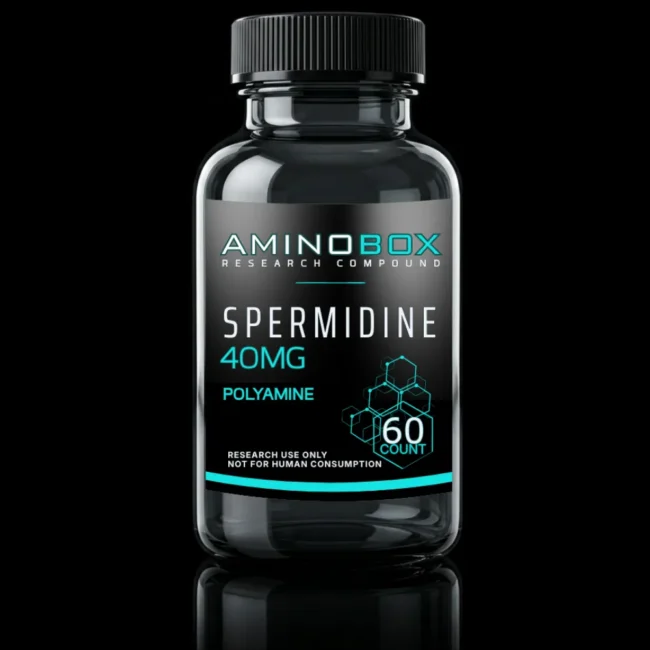
| Capsule Content | 40mg |
| Package Size | 60 Capsules |
| Compound Class | Natural polyamine compound (biogenic amine) |
| Physical Form | Encapsulated powder |
| Appearance | White to off-white powder (capsule fill) |
| Purity | Typically ≥98% (source-dependent; often wheat germ extract standardized) |
| Research Category | Cellular longevity / autophagy / metabolic regulation research |
Molecular Information
| Property | Specification |
|---|---|
| Molecular Formula | C7H19N3 |
| Molecular Weight | ~145.25 g/mol |
| CAS Number | 124-20-9 |
| PubChem CID | 1102 |
| Compound Type | Aliphatic polyamine |
| Stereochemistry | Achiral |
Structural Classification
| Category | Description |
|---|---|
| Compound Type | Natural polyamine (biogenic amine) |
| Functional Class | Cellular signaling & autophagy-related metabolite |
| Biological Focus | Cellular renewal and growth regulation |
| Mechanistic Focus | Autophagy activation and epigenetic regulation pathways |
| Chemical Family | Polyamine family (putrescine → spermidine → spermine pathway) |
Mechanism Research Profile
| Research Focus | Description |
|---|---|
| Autophagy Activation | Studied for induction of cellular cleanup and recycling pathways |
| Cellular Longevity | Associated with lifespan extension signals in model organisms |
| DNA Stability | Involved in chromatin stabilization and DNA-protein interactions |
| Mitochondrial Function | Linked to improved mitochondrial efficiency in preclinical models |
| Anti-Aging Pathways | Investigated in nutrient-sensing and cellular maintenance systems |
Research Areas Commonly Associated
| Research Area | Focus |
|---|---|
| Longevity Biology | Aging and lifespan regulation pathways |
| Cellular Autophagy | Lysosomal recycling and cellular cleanup |
| Metabolic Health | Energy balance and stress resistance |
| Neurobiology | Brain aging and cognitive maintenance research |
| Epigenetics | Chromatin structure and gene expression regulation |
Solubility Profile
| Solvent | Solubility |
|---|---|
| Sterile Water | Highly soluble |
| Bacteriostatic Water | Compatible |
| DMSO | Highly soluble |
| Ethanol | Moderately soluble |
| Lipid-based solvents | Limited compatibility |
Storage Specifications
| Parameter | Recommendation |
|---|---|
| Capsule Storage | 15–25°C (cool, dry environment) |
| Long-term Storage | 2–8°C recommended |
| Light Sensitivity | Low to moderate |
| Moisture Sensitivity | High |
| Stability | Stable in dry encapsulated form |
| Container Type | Sealed opaque capsule bottle |
Technical Characteristics
| Feature | Notes |
|---|---|
| Delivery Format | Encapsulated powder (40mg per capsule, 60-count bottle) |
| Structural Advantage | Small polyamine structure enables broad cellular distribution |
| Configuration | Naturally occurring biogenic amine |
| Stability Profile | High stability in dry form |
| Research Use | Laboratory research only |
Spermidine is a naturally occurring biogenic polyamine found ubiquitously in all living organisms, where it plays a fundamental role in regulating cellular growth, nucleic acid stability, and intracellular homeostasis.In modern biomedical research, spermidine has gained significant attention due to its involvement in autophagy regulation, protein quality control (proteostasis), mitochondrial maintenance, and cellular aging pathways.
Mechanism of Action (Cellular Biology Context)
Spermidine does not act through a single receptor pathway. Instead, it functions as a global intracellular regulatory molecule, influencing multiple structural and metabolic systems.
Key biological roles include:
- Regulation of autophagy (cellular recycling processes)
- Stabilization of DNA, RNA, and ribosomal structures
- Modulation of protein synthesis and degradation balance (proteostasis)
- Support of mitochondrial integrity and energy metabolism pathways
- Influence on epigenetic and gene expression regulation systems
These mechanisms are foundational to its role in cellular aging and tissue maintenance research.
Skin Health & Aging Research Context
Spermidine has gained increasing attention in dermatological and cellular aging research due to its association with autophagy activation and structural cellular renewal processes.
Reduction in Visible Aging Markers (Preclinical & Mechanistic Data)
In experimental models, enhanced autophagy and improved proteostasis are associated with:
- Reduced accumulation of damaged cellular proteins
- Improved dermal cellular turnover efficiency
- Support for smoother extracellular matrix organization
These processes are linked in research contexts to reduced appearance of fine lines and improved skin texture over time.
Skin Elasticity & Structural Integrity
Skin elasticity is largely dependent on the integrity of:
- Collagen networks
- Elastin fibers
- Dermal fibroblast function
Spermidine is studied for its potential role in supporting:
- Cellular maintenance of dermal fibroblasts
- Reduction of oxidative stress-related structural degradation
- Improved cellular recycling efficiency in skin tissue models
This has led to interest in spermidine as a cellular maintenance factor for skin firmness and elasticity, though human supplementation data remains limited.
Hair Biology & Follicle Research Context
Spermidine has also been investigated in hair biology due to its role in cell proliferation, follicular cycling, and stem-cell-associated signaling pathways.
Hair Growth Cycle Regulation (Experimental Models)
Research suggests spermidine may influence the hair follicle cycle, particularly:
- Prolongation of the anagen (growth) phase in experimental systems
- Improved follicular cellular energy balance
- Support for sustained hair shaft production in model studies
These mechanisms are still under investigation and are not clinically established as a treatment for hair loss.
Hair Shaft Elongation (Preclinical Observations)
In laboratory models, spermidine has been associated with:
- Increased keratinocyte proliferation activity
- Enhanced hair shaft elongation dynamics
- Improved follicular structural maintenance under stress conditions
Stem Cell & Follicular Biology Signaling
Some dermatological research has identified associations between spermidine and markers of epithelial stem cell activity, including:
- Expression of keratin-associated stem cell markers (e.g., K15, K19 in research models)
- Support for follicular stem cell maintenance pathways
- Cellular renewal processes in hair follicle environments
⚠️ These findings are based on cellular and molecular biology research, not established clinical hair growth therapy.
Longevity & Cellular Maintenance Research
Beyond skin and hair, spermidine is widely studied in aging biology due to its role in:
- Autophagy activation and cellular recycling
- Reduction of age-related protein aggregation
- Maintenance of mitochondrial function
- Improved stress resistance in model organisms
- Support of long-term cellular homeostasis
These mechanisms form the basis of its classification as a longevity-associated metabolic regulator.
Research Applications
Spermidine is commonly investigated in:
- Cellular aging and longevity science
- Dermatological aging and skin biology
- Hair follicle and stem cell research
- Autophagy and lysosomal biology
- Mitochondrial function and metabolic stability
- Protein folding and proteostasis systems
- Epigenetic regulation and gene expression research
Important Notice
This product is supplied strictly for laboratory research, analytical use, and scientific investigation purposes only. It is not intended for human consumption, medical use, or therapeutic application.
Spermidine is a naturally occurring biological molecule with extensive research in cellular aging, skin biology, and follicular systems; however, its supplementation effects in humans are still under active scientific investigation and not fully established clinically.
Scientific References – Spermidine
| Ref # | Title | Journal | Focus | Link |
|---|---|---|---|---|
| 1 | Nutritional aspects of spermidine and its role in aging and longevity | Annual Review of Nutrition | Overview of spermidine in aging biology, autophagy, lifespan | https://pubmed.ncbi.nlm.nih.gov/32634331/ |
| 2 | A spermidine-based nutritional supplement prolongs the anagen phase of hair follicles in humans | Dermatology Practical & Conceptual | Human trial: hair growth cycle / anagen prolongation | https://pubmed.ncbi.nlm.nih.gov/29214104/ |
| 3 | Spermidine induces cytoprotective autophagy and reduces oxidative stress in stem cells | Cellular and Molecular Life Sciences | Autophagy activation and cellular stress resistance | https://pubmed.ncbi.nlm.nih.gov/34099041/ |
| 4 | Spermidine-induced recovery of human dermal structure and skin barrier function | Communications Biology (Nature) | Skin barrier repair, dermal structure, microbiome link | https://pubmed.ncbi.nlm.nih.gov/33608630/ |
| 5 | N1-methylspermidine prolongs anagen and regulates epithelial stem cell function in hair follicles | Archives of Dermatological Research | Hair follicle stem cells, growth phase regulation | https://pubmed.ncbi.nlm.nih.gov/26216444/ |
| 6 | Relation of skin polyamines to hair growth and follicle cycling in animal models | Journal of Investigative Dermatology | Polyamines and hair follicle biology | https://pubmed.ncbi.nlm.nih.gov/11348473/ |
| 7 | Spermidine and autophagy: implications for cellular aging and disease prevention | Nature Cell Biology (review literature context) | Autophagy mechanisms and aging pathways | https://pubmed.ncbi.nlm.nih.gov/25009421/ |