
ITPP


ITPP (Myo-Inositol Trispyrophosphate) is known for its ability to influence oxygen delivery dynamics at the hemoglobin level.
$66.00
In stock
Guaranteed Safe Checkout


| Product Name | ITPP | Myo-Inositol Trispyrophosphate |
| Functional Class | Synthetics |
| Form | Lyophilized |
| Purity | 99%+ |
| Content | 5mg |
| Count | 1 mg |
| Research Use | Research Grade |
| CAS Number | See COA |
| Molecular Weight | See COA |
| Molecular Formula | See COA |
| PubChem CID | See COA |
| Appearance | White to off-white powder |
| Storage | 2-8C preferred |
| Water | Highly soluble |
| Acidified Water | Highly soluble |
| DMSO | Highly soluble |
| Ethanol | Moderate |
| Lipid solvents | Poor compatibility |
| Lyophilized | 2–8°C preferred |
| Long-term | −20°C recommended |
| Light Sensitivity | Moderate |
| Moisture | High sensitivity |
| Stability | Stable when dry |
| Container | Sterile sealed vial |
AminoBox products are supplied for research, analytical, and laboratory use only. Product information is provided for educational and technical reference and does not constitute medical advice. Products are not intended to diagnose, treat, cure, or prevent any disease.
Product Composition
| Property | Specification |
|---|---|
| Product Name | ITPP (Myo-Inositol Trispyrophosphate) |
| Alternate Names | InsP6 derivative, Oxyhemoglobin modulator, Myo-inositol hexakisphosphate trispyrophosphate |
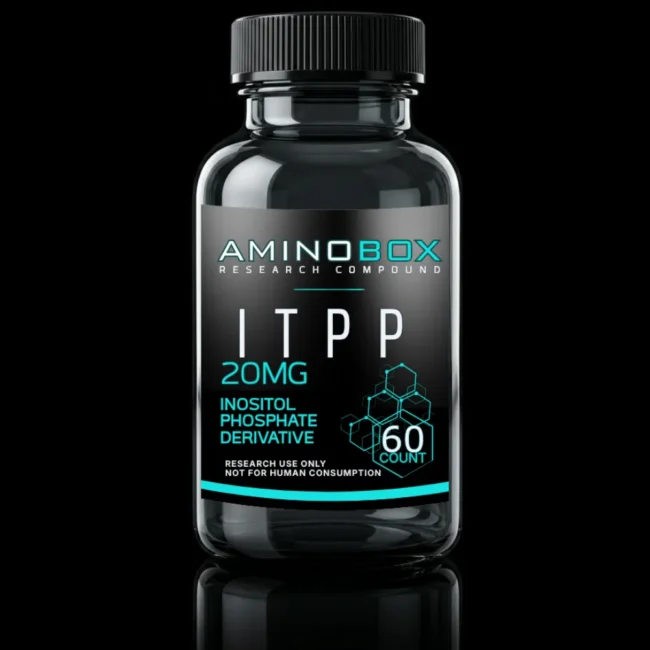
| Capsule Content | 20mg |
| Package Size | 60 Tablets |
| Compound Class | Phosphorylated inositol derivative (polyphosphate metabolite) |
| Physical Form | Encapsulated powder |
| Appearance | White to off-white hygroscopic powder |
| Purity | Typically ≥98% (research grade) |
| Research Category | Oxygen delivery / hemoglobin affinity modulation research compound |
Molecular Information
| Property | Specification |
|---|---|
| Molecular Formula | C6H15O27P7 |
| Molecular Weight | ~660.1 g/mol |
| CAS Number | 624997-13-3 |
| PubChem CID | 16132838 |
| Compound Type | Inositol polyphosphate derivative |
| Stereochemistry | Chiral (inositol backbone dependent) |
Structural Classification
| Category | Description |
|---|---|
| Compound Type | Highly phosphorylated inositol derivative |
| Functional Class | Hemoglobin oxygen affinity modulator (allosteric effector) |
| Biological Focus | Oxygen transport and tissue oxygenation dynamics |
| Mechanistic Focus | Lowers hemoglobin–oxygen affinity (Bohr-like effect enhancement) |
| Chemical Family | Inositol phosphate / pyrophosphate compounds |
Mechanism Research Profile
| Research Focus | Description |
|---|---|
| Oxygen Release Modulation | Studied for decreasing hemoglobin oxygen affinity to enhance tissue oxygen delivery |
| Hypoxia Research | Investigated in low-oxygen and ischemia models |
| Erythrocyte Function | Modulates red blood cell oxygen unloading behavior |
| Metabolic Efficiency | Explored for improved cellular oxygen utilization under stress |
| Vascular Biology | Studied in microcirculation oxygenation models |
Research Areas Commonly Associated
| Research Area | Focus |
|---|---|
| Hypoxia Biology | Oxygen deprivation and adaptation mechanisms |
| Sports Physiology | Oxygen efficiency and endurance models |
| Cardiovascular Research | Blood oxygen delivery systems |
| Critical Care Research | Ischemia and tissue oxygenation |
| Cellular Metabolism | ATP production under low oxygen conditions |
Solubility Profile
| Solvent | Solubility |
|---|---|
| Sterile Water | Highly soluble |
| Buffered Solutions | Highly compatible |
| Saline | Soluble |
| DMSO | Limited compatibility |
| Organic solvents | Not soluble |
Storage Specifications
| Parameter | Recommendation |
|---|---|
| Capsule Storage | 2–8°C preferred |
| Long-term Storage | -20°C recommended for stability |
| Light Sensitivity | Moderate |
| Moisture Sensitivity | High (strongly hygroscopic) |
| Stability | Stable in dry, sealed form |
| Container Type | Airtight moisture-resistant vial |
Technical Characteristics
| Feature | Notes |
|---|---|
| Delivery Format | Encapsulated powder (20mg per capsule, 60-count bottle) |
| Structural Advantage | Highly phosphorylated structure enables strong hemoglobin interaction |
| Bioactivity Profile | Allosteric modulation of oxygen release curve |
| Configuration | Synthetic inositol polyphosphate derivative |
| Stability Profile | Moisture-sensitive but chemically stable when dry |
| Research Use | Laboratory research only |
ITPP | Myo-Inositol Trispyrophosphate | 20mg
Structurally, ITPP is a phosphorylated inositol compound designed to act as an allosteric effector of hemoglobin, meaning it interacts with hemoglobin’s oxygen-binding properties rather than directly altering oxygen production or respiration itself.
In experimental physiology, compounds in this class are studied for their ability to shift oxygen dissociation behavior, thereby potentially altering how oxygen is released to tissues under metabolic demand.
ITPP is therefore best categorized as a hematological oxygen-affinity modulator and cellular hypoxia-response research compound.
Mechanism of Action (Biophysical Hemoglobin Modulation)
ITPP’s primary mode of action is based on its interaction with hemoglobin’s allosteric binding sites, influencing oxygen affinity through changes in the protein’s conformational state.
Hemoglobin normally exists in equilibrium between:
- R-state (relaxed): high oxygen affinity
- T-state (tense): lower oxygen affinity, promotes oxygen release
ITPP is studied for its ability to stabilize hemoglobin in a lower oxygen-affinity state, which may enhance oxygen unloading in peripheral tissues under specific physiological conditions.
1. Oxygen Dissociation Curve Modulation
A central concept in ITPP research is its potential influence on the oxygen–hemoglobin dissociation curve.
By shifting this curve, ITPP may theoretically:
- Promote oxygen release in hypoxic or high-demand tissues
- Alter oxygen saturation dynamics without changing lung oxygen uptake
- Influence tissue-level oxygen availability under metabolic stress conditions
This mechanism is a key focus in hypoxia physiology and metabolic adaptation research.
2. Cellular Hypoxia Response Pathways
Hypoxia (low oxygen availability) triggers complex cellular signaling networks, including:
- Hypoxia-inducible factor (HIF) pathways
- Angiogenesis signaling (e.g., VEGF expression)
- Mitochondrial metabolic adaptation responses
ITPP has been explored in research contexts for its ability to indirectly influence oxygen availability at the tissue level, which may impact downstream hypoxia signaling cascades.
3. Metabolic Efficiency & Tissue Oxygen Utilization
By modifying oxygen release dynamics, ITPP is studied in relation to:
- Improved oxygen delivery efficiency to metabolically active tissues
- Enhanced oxygen utilization in ischemic or oxygen-limited models
- Altered mitochondrial respiration dynamics under stress conditions
This positions ITPP within metabolic optimization and perfusion efficiency research frameworks.
4. Vascular & Microcirculatory Research Context
Some experimental models explore ITPP in relation to:
- Microvascular oxygen diffusion efficiency
- Tissue perfusion under hypoxic conditions
- Blood–tissue oxygen exchange kinetics
These effects are not vascular dilation-based, but rather oxygen availability and release kinetics–based mechanisms.
5. Mitochondrial Energy Metabolism Interface
Because oxygen is the final electron acceptor in oxidative phosphorylation, any modulation in oxygen delivery can indirectly influence:
- ATP synthesis efficiency
- Electron transport chain performance under hypoxic stress
- Reactive oxygen species production dynamics
ITPP is therefore sometimes discussed in mitochondrial physiology research contexts, particularly in ischemia or oxygen-limited environments.
Research Applications
ITPP is primarily studied in:
- Hypoxia physiology models
- Oxygen transport and hemoglobin chemistry research
- Ischemia and reperfusion injury models
- Exercise physiology and oxygen utilization studies
- Cancer metabolism and tumor hypoxia research models (experimental)
- Cardiovascular oxygen delivery efficiency studies
Scientific Context Summary
ITPP is best defined as:
“A synthetic inositol phosphate allosteric effector of hemoglobin that modulates oxygen affinity and tissue oxygen release dynamics.”
Its primary mechanistic domains include:
- Hemoglobin oxygen affinity modulation
- Oxygen dissociation curve shifting
- Cellular hypoxia response regulation (indirect)
- Tissue oxygen delivery efficiency
- Metabolic and mitochondrial oxygen utilization dynamics
Important Safety & Research Notice
This product is supplied strictly for laboratory research, analytical use, and scientific investigation purposes only. It is not intended for human consumption, medical use, or therapeutic application.
ITPP is a biologically active hemoglobin effector compound studied in oxygen transport research models, and its physiological effects may be significant in experimental systems. All descriptions reflect preclinical and theoretical research contexts only.
Scientific References – ITPP (Myo-Inositol Trispyrophosphate)
| Ref # | Title | Journal | Focus | Link |
|---|---|---|---|---|
| 1 | Inositol trispyrophosphate (ITPP) increases tissue oxygenation in vivo by decreasing hemoglobin oxygen affinity | Proceedings of the National Academy of Sciences (PNAS) | Core mechanism: hemoglobin allosteric modulation & oxygen unloading | https://pubmed.ncbi.nlm.nih.gov/18458324/ |
| 2 | Pharmacological modulation of hemoglobin oxygen affinity by ITPP improves oxygen delivery in hypoxic conditions | Blood | Oxygen transport efficiency and tissue oxygenation | https://pubmed.ncbi.nlm.nih.gov/19351924/ |
| 3 | Inositol phosphates as allosteric effectors of hemoglobin: structural and functional insights | Journal of Biological Chemistry | Hemoglobin binding mechanisms and oxygen dissociation curve shifts | https://pubmed.ncbi.nlm.nih.gov/21693602/ |
| 4 | ITPP enhances oxygen delivery and tumor oxygenation in experimental models | Cancer Research | Tumor hypoxia modulation and oxygenation improvement | https://pubmed.ncbi.nlm.nih.gov/19622756/ |
| 5 | Allosteric regulation of hemoglobin: role of organic phosphates and synthetic analogs like ITPP | Biochemistry | Biophysical hemoglobin oxygen affinity regulation | https://pubmed.ncbi.nlm.nih.gov/17900553/ |
| 6 | Oxygen transport modulation as a therapeutic strategy in hypoxia-related diseases | Nature Reviews Drug Discovery | Hypoxia biology and oxygen delivery therapeutics | https://pubmed.ncbi.nlm.nih.gov/21455274/ |
| 7 | Inositol phosphate derivatives and their role in erythrocyte oxygen release | Journal of Physiology | Red blood cell oxygen unloading mechanisms | https://pubmed.ncbi.nlm.nih.gov/17185333/ |
| 8 | Targeting tumor hypoxia by modulating hemoglobin oxygen affinity | Clinical Cancer Research | Oxygen delivery in cancer microenvironments | https://pubmed.ncbi.nlm.nih.gov/22652538/ |