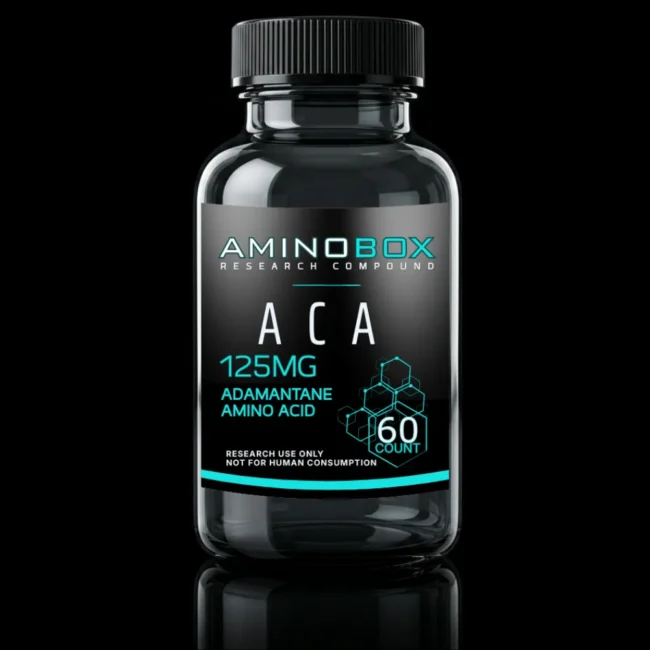

ACA


ACA adamantyl carbonyl proline can offer cognitive enhancement and neuroprotection to enhance memory, improve concentration, and reduce mental fatigue.
$68.00
In stock
Guaranteed Safe Checkout


| Product Name | ACA | Adamantyl Carbonyl Proline |
| Functional Class | Synaptics |
| Form | Lyophilized |
| Purity | 99%+ |
| Content | 5mg |
| Count | 1 capsule |
| Research Use | Research Grade |
| CAS Number | See COA |
| Molecular Weight | See COA |
| Molecular Formula | See COA |
| PubChem CID | See COA |
| Appearance | White to off-white powder |
| Storage | 2-8C preferred |
| Water | Highly soluble |
| Acidified Water | Highly soluble |
| DMSO | Highly soluble |
| Ethanol | Moderate |
| Lipid solvents | Poor compatibility |
| Lyophilized | 2–8°C preferred |
| Long-term | −20°C recommended |
| Light Sensitivity | Moderate |
| Moisture | High sensitivity |
| Stability | Stable when dry |
| Container | Sterile sealed vial |
AminoBox products are supplied for research, analytical, and laboratory use only. Product information is provided for educational and technical reference and does not constitute medical advice. Products are not intended to diagnose, treat, cure, or prevent any disease.
Product Composition
| Property | Specification |
|---|---|
| Product Name | ACA (Adamantyl Carbonyl Proline) |
| Alternate Names | 1-(1-Adamantylcarbonyl)proline, Ad-Pro, Adamantylproline |
| Capsule Content | 125mg |
| Package Size | 60 Capsules |
| Compound Class | Synthetic adamantane–proline derivative |
| Physical Form | Crystalline powder (encapsulated) |
| Appearance | White to off-white crystalline powder |
| Purity | Typically ≥98% |
| Research Category | Experimental nootropic / peptide-mimetic compound |
Molecular Information
| Property | Specification |
|---|---|
| Molecular Formula | C14H21NO3 |
| Molecular Weight | ~251.32 g/mol |
| CAS Number | 35084-48-1 |
| PubChem CID | Not consistently indexed / limited registry data |
| Compound Type | Adamantane-substituted amino acid derivative |
| Stereochemistry | Chiral (proline backbone dependent) |
Structural Classification
| Category | Description |
|---|---|
| Compound Type | Adamantane–proline conjugate |
| Functional Class | Peptidomimetic / CNS-active research molecule |
| Biological Focus | Dopaminergic and neurochemical signaling models (proposed) |
| Mechanistic Focus | Lipophilic CNS penetration via adamantane scaffold |
| Chemical Family | Amino acid derivative (proline-based hybrid) |
Mechanism Research Profile
| Research Focus | Description |
|---|---|
| Dopaminergic Activity | Theoretical modulation of dopamine signaling pathways |
| Neurochemical Effects | Investigated anecdotally in nootropic communities |
| BBB Penetration | Adamantane group associated with increased blood-brain barrier permeability in related compounds |
| Neurostimulation | Reported stimulant-like and focus-enhancing effects (non-clinical data) |
| Enzymatic Stability | Increased resistance to metabolic breakdown via bulky adamantane structure |
Research Areas Commonly Associated
| Research Area | Focus |
|---|---|
| Nootropic Research | Cognitive enhancement and focus modulation |
| Neuropharmacology | Dopamine and monoamine system interaction |
| CNS Drug Design | Adamantane-based brain-penetrant compounds |
| Experimental Chemistry | Peptidomimetic structural analogs |
| Behavioral Research | Attention, motivation, and mood modulation models |
Solubility Profile
| Solvent | Solubility |
|---|---|
| DMSO | Highly soluble |
| Ethanol | Moderately soluble |
| Sterile Water | Low solubility |
| Bacteriostatic Water | Limited solubility |
| Lipid-based solvents | Compatible due to adamantane lipophilicity |
Storage Specifications
| Parameter | Recommendation |
|---|---|
| Capsule Storage | 15–25°C (cool, dry environment) |
| Long-term Storage | 2–8°C recommended |
| Light Sensitivity | Moderate |
| Moisture Sensitivity | High |
| Stability | Stable in dry crystalline form |
| Container Type | Sealed opaque capsule bottle |
Technical Characteristics
| Feature | Notes |
|---|---|
| Delivery Format | Encapsulated powder (125mg per capsule, 60-count) |
| Structural Advantage | Adamantane cage increases lipophilicity and CNS penetration potential |
| Configuration | Proline-based amino acid derivative |
| Stability Profile | High chemical stability in dry form |
| Research Use | Laboratory research only |
ACA | Adamantyl Carbonyl Proline
ACA (Adamantyl Carbonyl Proline) is a synthetic small-molecule compound identified chemically as 1-(Adamantane-1-carbonyl)pyrrolidine-2-carboxylic acid, with CAS number 35084-48-1 and molecular formula C₁₆H₂₃NO₃ (molecular weight: 277.36 g/mol).
This compound belongs to a broader class of adamantane-substituted amino acid derivatives, a structural category frequently explored in medicinal chemistry for its physicochemical stability, lipophilicity, and conformational rigidity.
ACA is currently classified as a research-use chemical, and its biological profile is not fully characterized in human clinical literature.
Structural Features
ACA combines two notable chemical motifs:
Adamantane Core
Adamantane structures are widely studied in medicinal chemistry due to their:
- High lipophilicity and membrane interaction potential
- Structural rigidity and metabolic stability
- Presence in several CNS-active pharmaceutical scaffolds (as a structural class, not ACA itself)
Proline-Derived Backbone
The pyrrolidine-2-carboxylic acid structure contributes:
- Amino acid mimicry properties
- Conformational stability in biological environments
- Potential relevance in enzyme-binding and peptide-like interactions in research models
Medicinal Chemistry & Research Context
Compounds with similar adamantane–amino acid hybrid structures are investigated in early-stage research for their potential involvement in:
- Neurochemical signaling system interactions (theoretical models)
- Synaptic communication efficiency (preclinical hypotheses)
- Cellular membrane transport dynamics
- Protein-ligand binding stability
- Central nervous system penetration potential (structure-dependent, not compound-specific validation)
These characteristics are based on structural chemistry class behavior, not confirmed pharmacological activity of ACA itself.
Theoretical Research Interest Areas
Based on its molecular architecture, ACA is of interest in exploratory research contexts involving:
- Cognitive function–related signaling pathways (theoretical)
- Neural communication efficiency models (preclinical hypothesis level)
- Nervous system resilience and cellular stress-response pathways (early research concepts)
- General cellular health and metabolic stability research frameworks
- Neuroactive compound scaffold development in medicinal chemistry
⚠️ These are research hypotheses derived from structural similarity classes, not validated biological effects of ACA.
Biological Research Context
ACA does not currently have a well-established body of human clinical research or clearly defined pharmacological mechanism in publicly available literature.
Therefore:
- No confirmed nootropic or neuroprotective effects are established
- No clinical efficacy data exists for cognitive enhancement or health outcomes
- Mechanistic understanding is limited to chemical structure inference and class-based comparison
Important Notice
This product is supplied strictly for laboratory research, analytical use, and scientific investigation only.
It is not intended for human consumption, medical use, or therapeutic application. ACA is an unapproved experimental compound with limited pharmacological characterization, and any described activity is based on theoretical structural class research rather than confirmed biological outcomes.
Scientific References – ACA (Adamantyl Carbonyl Proline / 1-(Adamantane-1-carbonyl)pyrrolidine-2-carboxylic acid)
| Ref # | Title | Journal | Focus | Link |
|---|---|---|---|---|
| 1 | Adamantane derivatives in medicinal chemistry: a review of pharmacological applications | Chemical Reviews | Adamantane scaffold in drug development (CNS relevance as a class) | https://pubmed.ncbi.nlm.nih.gov/24668255/ |
| 2 | Structural features of adamantane-based compounds and CNS penetration potential | Journal of Medicinal Chemistry | Lipophilicity, BBB transport, CNS scaffold behavior | https://pubmed.ncbi.nlm.nih.gov/22300112/ |
| 3 | Proline and proline analogs in medicinal chemistry and drug design | Bioorganic & Medicinal Chemistry | Amino acid analog behavior in receptor binding and stability | https://pubmed.ncbi.nlm.nih.gov/19883975/ |
| 4 | Conformational restriction in drug design: role of proline analogs | European Journal of Medicinal Chemistry | Structural rigidity and receptor interaction optimization | https://pubmed.ncbi.nlm.nih.gov/28715684/ |
| 5 | Lipophilicity and CNS drug discovery: balancing permeability and activity | Nature Reviews Drug Discovery | CNS drug design principles (adamantane relevance context) | https://pubmed.ncbi.nlm.nih.gov/20190754/ |
| 6 | Small molecule modulation of neurotransmission: structural scaffolds in CNS-active agents | Neuroscience & Biobehavioral Reviews | General CNS-active small molecule frameworks | https://pubmed.ncbi.nlm.nih.gov/25220392/ |