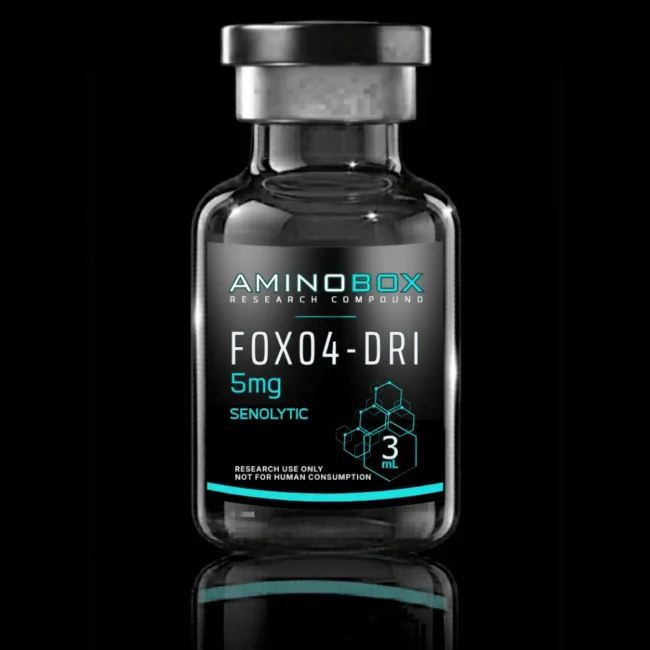

FOXO4-DRI
Senolytic research peptide


FOXO4–DRI for Cellular Senescence, Biological Aging, Chronic Inflammation, Age-associated Functional Decline.
$125.00
In stock
Guaranteed Safe Checkout


| Product Name | FOXO4-DRI |
| Functional Class | FOXO4-p53 Interaction Disruptor |
| Form | Lyophilized |
| Purity | ≥98% |
| Content | 10mg |
| Count | 1 vial |
| Research Use | For in vitro and laboratory research use only. Not for human consumption. |
| CAS Number | 1392278-76-0 |
| Molecular Weight | ~2800 g/mol |
| Molecular Formula | D-amino acid peptide (~C120H180N30O30) |
| PubChem CID | See COA |
| Appearance | White lyophilized powder |
| Storage | –20°C long-term |
Active Peptide 2 items
Excipients 4 items
Reconstitution Solvents 4 items
Buffer Systems 4 items
Lyoprotectants & Cryoprotectants 3 items
Preservatives & Antimicrobials 3 items
Counter Ions & Salt Forms 3 items
Chelating Agents 2 items
Antioxidants & Stabilizers 3 items
| Water | Highly soluble |
| Acidified Water | Highly soluble |
| DMSO | Highly soluble |
| Ethanol | Moderate |
| Lipid solvents | Poor compatibility |
| Lyophilized | 2–8°C preferred |
| Long-term | −20°C recommended |
| Light Sensitivity | Moderate |
| Moisture | High sensitivity |
| Stability | Stable when dry |
| Container | Sterile sealed vial |
AminoBox products are supplied for research, analytical, and laboratory use only. Product information is provided for educational and technical reference and does not constitute medical advice. Products are not intended to diagnose, treat, cure, or prevent any disease.
Product Composition
| Property | Specification |
|---|---|
| Product Name | FOXO4-DRI |
| Alternate Names | FOXO4 D-Retro-Inverso Peptide |
| Peptide Content | 5mg |
| Peptide Class | Synthetic retro-inverso peptide |
| Physical Form | Lyophilized powder |
| Appearance | White to off-white powder |
| Purity | Typically ≥98% |
| Research Category | Senolytic & longevity research |
Molecular Information
| Property | Specification |
|---|---|
| Molecular Formula | C228H388N86O64 |
| Molecular Weight | ~5358 g/mol |
| CAS Number | 2460055-10-9 |
| PubChem CID | 167312269 |
| Peptide Configuration | All D-enantiomer retro-inverso peptide |
| Sequence | LTLRKEPASEIAQSILEAYSQNGWANRRSGGKRPPPRRRQRRKKRG |
| Compound Type | Synthetic senolytic peptide |
Structural Classification
| Category | Description |
|---|---|
| Compound Type | Synthetic retro-inverso peptide |
| Functional Class | Senolytic signaling peptide |
| Biological Focus | Cellular senescence research |
| Mechanistic Focus | FOXO4-p53 interaction disruption |
| Chemical Family | D-amino acid peptide analogue |
Mechanism Research Profile
| Research Focus | Description |
|---|---|
| FOXO4-p53 Interaction | Investigated for disruption of FOXO4 binding to p53 |
| Senescent Cell Research | Explored in selective senescent cell apoptosis models |
| Cellular Aging | Studied in longevity and age-associated dysfunction research |
| SASP Research | Investigated in senescence-associated secretory phenotype pathways |
| Tissue Homeostasis | Researched in regenerative biology models |
Research Areas Commonly Associated
| Research Area | Focus |
|---|---|
| Longevity Biology | Cellular aging pathways |
| Senolytic Research | Senescent cell clearance |
| Regenerative Biology | Tissue resilience research |
| Cellular Maintenance | Damaged cell turnover pathways |
| Healthy Aging Research | Age-associated biological signaling |
Solubility Profile
| Solvent | Solubility |
|---|---|
| Sterile Water | Moderately soluble |
| Bacteriostatic Water | Compatible for reconstitution |
| DMSO | Soluble |
| Buffered Solutions | Compatible |
Storage Specifications
| Parameter | Recommendation |
|---|---|
| Lyophilized Storage | -20°C preferred |
| Reconstituted Storage | 2–8°C refrigerated |
| Light Sensitivity | Moderate |
| Moisture Sensitivity | High |
| Stability | Stable as dry lyophilized peptide |
| Container Type | Sterile sealed vial |
Technical Characteristics
| Feature | Notes |
|---|---|
| Delivery Format | Lyophilized peptide |
| Structural Advantage | Increased enzymatic resistance |
| Configuration | D-retro-inverso peptide design |
| Stability Profile | Enhanced resistance to proteolytic degradation |
| Research Use | Laboratory research only |
FOX04-DRI | 5mg
FOXO4-DRI is an investigational cell-penetrating peptide designed to disrupt the interaction between FOXO4 (Forkhead box O4) and p53, two key regulatory proteins involved in cellular senescence and programmed cell death resistance.
FOXO4-DRI is engineered as a D-retro-inverso (DRI) peptide, a structural modification that enhances resistance to enzymatic degradation while mimicking the functional binding domain required to competitively inhibit FOXO4–p53 interaction.
Biological Background: Cellular Senescence
Cellular senescence is a state in which cells:
- permanently stop dividing
- resist apoptosis (cell death)
- secrete pro-inflammatory factors (SASP: senescence-associated secretory phenotype)
While senescence is a protective mechanism against cancer, accumulation of senescent cells is strongly associated with:
- tissue aging
- reduced regenerative capacity
- chronic inflammatory signaling
- fibrosis and organ dysfunction
FOXO4–p53 interaction is one of the mechanisms that helps senescent cells avoid apoptosis, allowing them to persist in tissues.
Mechanism of Action
1. FOXO4–p53 Interaction Disruption
FOXO4 binds to the tumor suppressor protein p53 in senescent cells, effectively:
- preventing apoptosis initiation
- stabilizing senescent cell survival
- maintaining dysfunctional cellular populations
FOXO4-DRI is designed to:
competitively inhibit FOXO4 binding to p53. This allows p53 to relocate within the cell and reactivate apoptotic pathways in senescent cells.
2. Senolytic Activity (Selective Senescent Cell Clearance)
Research describes FOXO4-DRI as a senolytic agent, meaning it may selectively target and promote removal of senescent cells without broadly affecting healthy proliferating cells.
Observed mechanisms in preclinical models include:
- activation of p53-dependent apoptosis
- reduction of senescent cell burden in tissues
- improved tissue regenerative capacity
- decreased inflammatory signaling markers
3. Tissue Function and Aging Pathways
Senescent cell accumulation contributes to:
- reduced stem cell function
- extracellular matrix degradation
- chronic inflammatory signaling (SASP)
- impaired tissue repair response
By reducing senescent cell persistence, FOXO4-DRI is studied in relation to:
- improved tissue homeostasis
- enhanced regenerative signaling environments
- reduced inflammatory load in aging tissues
4. Apoptotic Reactivation via p53 Pathway
p53 is a central regulator of:
- DNA damage response
- apoptosis
- genomic stability
In senescent cells, FOXO4 binding prevents p53 from executing apoptotic signaling. FOXO4-DRI may restore:
- nuclear export of p53
- apoptotic pathway activation
- programmed clearance of dysfunctional cells
5. Longevity and Geroscience Research Interest
FOXO4-DRI is widely studied in the context of:
- senescent cell clearance strategies
- aging biology interventions
- tissue rejuvenation models
- inflammation reduction pathways
It is frequently discussed alongside:
- other senolytic compounds
- NAD+ metabolism research
- mitochondrial dysfunction models
- regenerative medicine pathways
Research Applications
FOXO4-DRI is primarily investigated in:
- Cellular senescence clearance studies
- Aging and longevity research models
- Fibrosis and tissue dysfunction research
- p53 pathway regulation studies
- Inflammaging and cytokine signaling research
- Regenerative biology and tissue repair studies
Scientific Significance
FOXO4-DRI is notable because it targets a protein–protein interaction mechanism rather than enzymatic inhibition or receptor activation.
Its mechanism is centered on:
- senescent cell survival pathways
- apoptotic resistance signaling
- FOXO4–p53 nuclear interaction
This places it in a unique class of:
senescence-modulating peptide therapeutics under preclinical investigation
Scientific Summary
FOXO4-DRI is best described as:
“A D-retro-inverso senolytic peptide designed to disrupt FOXO4–p53 binding and promote selective apoptosis of senescent cells in aging-related research models.”
Primary mechanistic domains include:
- FOX04–dri interaction inhibition
- Senescent cell apoptosis activation
- p53 nuclear signaling restoration
- Cellular senescence modulation
- Inflammaging reduction pathways
- Tissue regeneration environment improvement
Important Notice
This product is supplied strictly for:
- laboratory research
- analytical use
- scientific investigation purposes only
It is not intended for human consumption, medical use, or therapeutic application.FOXO4-DRI is an investigational senolytic peptide studied in preclinical aging and cellular senescence research models only.
Scientific References – FOXO4-DRI (Senolytic Peptide)
| Study Title | Journal | Research Focus | Link |
|---|---|---|---|
| The disordered p53 transactivation domain is the target of FOXO4 and the senolytic compound FOXO4-DRI | Nature Communications | Structural mechanism of FOXO4–p53 interaction and FOXO4-DRI binding | https://www.nature.com/articles/s41467-025-60844-9 |
| FOXO4-DRI selectively induces apoptosis in senescent cells | Senolytic Literature | Senescent cell clearance via FOXO4–p53 disruption | https://pubmed.ncbi.nlm.nih.gov/33996787/ |
| Senescent cell clearance improves tissue function in aging models | Frontiers in Bioengineering and Biotechnology | Cellular senescence removal and tissue regeneration effects | https://pmc.ncbi.nlm.nih.gov/articles/PMC8116695/ |
| FOXO transcription factors in cellular homeostasis and aging | Nature Reviews Molecular Cell Biology | FOXO protein family and aging pathways | https://pubmed.ncbi.nlm.nih.gov/23299709/ |
| p53: mechanisms of tumor suppression and apoptosis regulation | Nature Reviews Cancer | Role of p53 in apoptosis and cellular stress response | https://pubmed.ncbi.nlm.nih.gov/15029241/ |
| Cellular senescence: mechanisms and role in disease | Nature Reviews Molecular Cell Biology | Senescence biology and SASP inflammatory signaling | https://pubmed.ncbi.nlm.nih.gov/24336961/ |
| FOXO proteins and stress resistance in aging | Cell Metabolism | FOXO signaling in longevity and stress adaptation | https://pubmed.ncbi.nlm.nih.gov/20640039/ |
| Senolytic strategies for the aging process | Nature Medicine | Therapeutic senolytics and aging intervention strategies | https://pubmed.ncbi.nlm.nih.gov/30552884/ |
| Tumor suppressor p53 in cellular senescence and aging | Science | p53 regulation in senescence and apoptosis | https://pubmed.ncbi.nlm.nih.gov/20075235/ |
| Targeting senescent cells for age-related diseases | Nature Aging | Senolytic therapy concepts and aging biology | https://pubmed.ncbi.nlm.nih.gov/33149223/ |