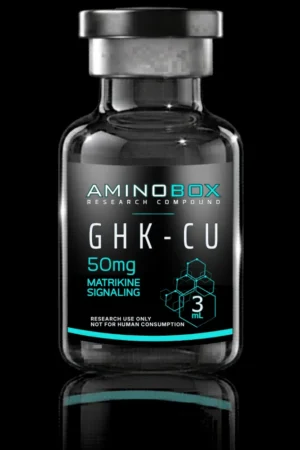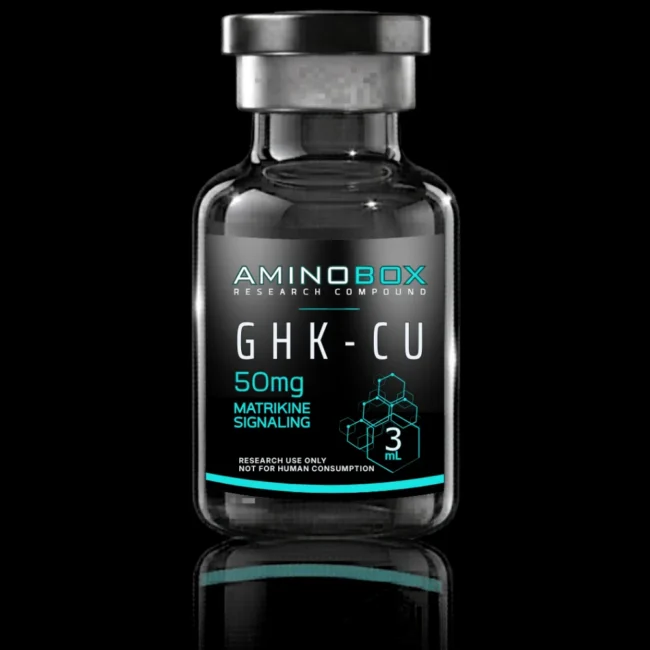

GHK-cu
Cosmetic/regenerative peptide


GHK-Cu (r its role in extracellular matrix modulation, tissue remodeling, and cellular signaling pathways associated with repair and regeneration processes.
$41.00
In stock
Guaranteed Safe Checkout


| Product Name | GHK-Cu Copper Tripeptide-1 (Lyophilized) |
| Functional Class | Wound Healing & Collagen Synthesis Promoter |
| Form | Lyophilized |
| Purity | ≥98% |
| Content | 200mg |
| Count | 1 vial |
| Research Use | For in vitro and laboratory research use only. Not for human consumption. |
| CAS Number | 89030-95-5 |
| Molecular Weight | 403.91 g/mol |
| Molecular Formula | C14H23CuN6O4 |
| PubChem CID | 73988 |
| Appearance | Blue to blue-green powder |
| Storage | 2–8°C / Protect from light |
Active Peptide 2 items
Excipients 4 items
Reconstitution Solvents 4 items
Buffer Systems 4 items
Lyoprotectants & Cryoprotectants 3 items
Preservatives & Antimicrobials 3 items
Counter Ions & Salt Forms 3 items
Chelating Agents 2 items
Antioxidants & Stabilizers 3 items
| Water | Highly soluble |
| Acidified Water | Highly soluble |
| DMSO | Highly soluble |
| Ethanol | Moderate |
| Lipid solvents | Poor compatibility |
| Lyophilized | 2–8°C preferred |
| Long-term | −20°C recommended |
| Light Sensitivity | Moderate |
| Moisture | High sensitivity |
| Stability | Stable when dry |
| Container | Sterile sealed vial |
AminoBox products are supplied for research, analytical, and laboratory use only. Product information is provided for educational and technical reference and does not constitute medical advice. Products are not intended to diagnose, treat, cure, or prevent any disease.
Product Composition
| Property | Specification |
|---|---|
| Product Name | GHK-Cu |
| Alternate Names | Copper Peptide GHK-Cu, Copper Tripeptide-1, Prezatide Copper |
| Peptide Content | 50mg | 60 Capsules |
| Peptide Class | Copper-binding tripeptide |
| Physical Form | Lyophilized powder |
| Appearance | Blue to blue-green lyophilized powder |
| Purity | Typically ≥98% |
| Research Category | Regenerative & dermatological peptide research |
Molecular Information
| Property | Specification |
|---|---|
| Full Chemical Name | Glycyl-L-Histidyl-L-Lysine Copper Complex |
| Molecular Formula | C14H24CuN6O4 |
| Molecular Weight | ~403.93 g/mol |
| CAS Number | 49557-75-7 |
| PubChem CID | 139035031 |
| Amino Acid Sequence | Gly–His–Lys (GHK) |
| Peptide Length | 3 amino acids |
| Copper Configuration | Copper(II) peptide complex |
| Compound Type | Naturally occurring copper-binding tripeptide |
GHK-Cu is widely described as a naturally occurring copper complex of the tripeptide glycyl-L-histidyl-L-lysine.
Structural Classification
| Category | Description |
|---|---|
| Compound Type | Copper-chelating tripeptide |
| Functional Class | Regenerative signaling peptide |
| Biological Focus | Tissue remodeling and extracellular matrix research |
| Mechanistic Focus | Copper transport and cellular signaling pathways |
| Chemical Family | Bioactive copper peptide complex |
Mechanism Research Profile
| Research Focus | Description |
|---|---|
| Collagen Signaling | Investigated in extracellular matrix and collagen pathway models |
| Tissue Remodeling | Studied in regenerative biology research |
| Copper Transport | Explored for copper-binding and delivery mechanisms |
| Oxidative Stress Pathways | Investigated in antioxidant signaling models |
| Cellular Communication | Studied in gene signaling and repair pathway research |
Research literature commonly investigates GHK-Cu in tissue remodeling, collagen signaling, and regenerative pathway models.
Research Areas Commonly Associated
| Research Area | Focus |
|---|---|
| Dermatological Research | Skin remodeling and extracellular matrix pathways |
| Hair Follicle Research | Scalp and follicular signaling |
| Longevity Biology | Cellular resilience and regenerative signaling |
| Connective Tissue Research | Collagen and elastin pathway studies |
| Regenerative Biology | Tissue repair signaling research |
Solubility Profile
| Solvent | Solubility |
|---|---|
| Water | Freely soluble |
| Bacteriostatic Water | Compatible for reconstitution |
| Sterile Water | Soluble |
| Acetic Acid Solutions | Commonly utilized in research preparations |
| DMSO | Soluble |
GHK-Cu is generally characterized as highly water soluble and hydrophilic.
Storage Specifications
| Parameter | Recommendation |
|---|---|
| Lyophilized Storage | -20°C preferred |
| Reconstituted Storage | 2–8°C refrigerated |
| Light Sensitivity | Moderate |
| Moisture Sensitivity | High |
| Stability | Stable in lyophilized dry form |
| Container Type | Sterile amber vial |
Technical Characteristics
| Feature | Notes |
|---|---|
| Delivery Format | Lyophilized peptide complex |
| Hydrophilicity | Highly hydrophilic |
| Metal Binding | Strong affinity for Cu²⁺ |
| Structural Stability | Enhanced via copper chelation |
| Characteristic Color | Blue/blue-green due to copper complex |
| Research Use | Laboratory research only |
GHK-Cu (Copper Tripeptide-1) | 50mg Research Grade Peptide
Molecular Identity and Structural Biochemistry
GHK-Cu is a naturally occurring endogenous tripeptide–metal complex composed of glycyl-L-histidyl-L-lysine bound to a Cu²⁺ ion. Its biological activity is fundamentally dependent on its coordination chemistry, where copper is chelated primarily through the histidine imidazole nitrogen and peptide backbone donor atoms.
The GHK peptide exhibits a uniquely high affinity constant for copper ions, forming a stable complex that effectively modulates copper redox cycling while preventing free ionic copper-mediated oxidative reactions.
Biophysical and Redox Chemistry Characteristics
Copper in its unbound state readily participates in Fenton-like reactions, generating reactive oxygen species (ROS). In contrast, chelation within the GHK structure significantly alters its electrochemical behavior:
- Copper is stabilized in a low redox-activity coordination state
- Electron transfer is constrained by ligand field effects
- The peptide acts as a buffering ligand system, reducing free Cu²⁺ catalytic reactivity
- Complex demonstrates an altered redox potential compared to free ionic copper
This modulation is critical, as it shifts copper from a potentially pro-oxidative free ion state into a regulated biochemical cofactor configuration, enabling controlled participation in enzymatic and signaling pathways.
Molecular Signaling and Gene Regulatory Effects
Transcriptomic analyses in fibroblast and epithelial cell models demonstrate that GHK-Cu influences large-scale gene expression remodeling, affecting pathways associated with extracellular matrix turnover, cellular stress response, and morphogenetic signaling.
Reported gene expression modulations include:
- Upregulation of extracellular matrix structural genes (e.g., COL1A1, COL3A1)
- Modulation of metalloproteinase balance (MMP and TIMP expression ratios)
- Activation of antioxidant response elements (ARE-linked pathways)
- Regulation of TGF-β–associated signaling cascades
- Influence on integrin-mediated adhesion signaling networks
These changes suggest that GHK-Cu operates not as a single-pathway ligand, but as a pleiotropic regulatory tripeptide influencing transcriptional networks rather than isolated enzymatic targets.
Extracellular Matrix Biochemistry and Structural Protein Dynamics
GHK-Cu has been shown in multiple in vitro systems to affect extracellular matrix homeostasis through modulation of both synthesis and degradation pathways.
Observed biochemical effects include:
- Increased transcriptional activity of fibrillar collagen genes (Type I and III predominance)
- Enhanced synthesis of sulfated glycosaminoglycans (GAGs), particularly dermatan sulfate and chondroitin sulfate analog pathways
- Regulation of elastin-associated gene clusters
- Modulation of matrix metalloproteinase activity (notably MMP-1, MMP-2, MMP-9)
- Adjustment of collagen crosslinking enzyme expression (lysyl oxidase pathways indirectly influenced)
These effects collectively indicate a remodeling equilibrium shift in extracellular matrix turnover kinetics, rather than a unidirectional anabolic or catabolic action.
Copper-Dependent Enzymatic and Cofactor Interactions
Copper is a required cofactor in multiple enzymatic systems, and GHK-Cu provides a biologically compatible delivery and buffering mechanism for copper-dependent enzymology.
Key copper-dependent systems influenced indirectly include:
- Cytochrome c oxidase (mitochondrial electron transport chain)
- Superoxide dismutase (Cu/Zn-SOD antioxidant enzyme system)
- Lysyl oxidase (collagen and elastin crosslinking enzyme)
- Dopamine β-hydroxylase (catecholamine metabolism pathways)
GHK-Cu is believed to facilitate non-toxic copper exchange kinetics, allowing copper transfer to apoenzymes without promoting free radical generation.
Systems Biology and Transcriptomic Scope
High-throughput gene expression analyses (microarray and RNA-seq datasets) suggest that GHK-Cu may regulate several hundred to over a thousand genes depending on exposure conditions and cell type.
Functional gene clusters influenced include:
- Cellular stress response and heat-shock protein networks
- Angiogenesis-related signaling pathways (VEGF-associated expression patterns)
- DNA repair and genomic stability regulation pathways
- Cell cycle regulatory checkpoints (cyclin-dependent kinase modulation patterns)
- Immune modulation and cytokine signaling cascades
This broad-spectrum modulation has led to classification of GHK as a matrikine signaling peptide with systemic regulatory potential at the transcriptome level.
Age-Associated Decline and Endogenous Role
Quantitative biochemical analyses indicate that circulating levels of GHK decline significantly with chronological aging. This reduction correlates with:
- Decreased tissue regenerative signaling capacity
- Reduced extracellular matrix turnover efficiency
- Lowered antioxidant gene expression responsiveness
- Altered copper homeostasis dynamics
The peptide is therefore frequently studied in the context of age-associated dysregulation of extracellular matrix maintenance and cellular repair signaling fidelity.
Scientific Reference Table
| Research Focus | Primary Study | Link |
|---|---|---|
| GHK-Cu gene expression regulation (systems biology analysis) | Pickart et al., transcriptomic profiling of GHK-Cu | https://pubmed.ncbi.nlm.nih.gov/29986520/ |
| Broad genomic remodeling effects of GHK | Gene expression modulation in fibroblast models | https://pubmed.ncbi.nlm.nih.gov/26236730/ |
| Extracellular matrix synthesis regulation (collagen/GAG) | Dermal fibroblast matrix synthesis response to GHK | https://pubmed.ncbi.nlm.nih.gov/1522753/ |
| Oxidative stress gene regulation mechanisms | Antioxidant response pathway activation by GHK | https://www.mdpi.com/2079-9284/2/3/236 |
| Aging-associated gene expression reversal trends | GHK effects on age-dysregulated gene clusters | https://pubmed.ncbi.nlm.nih.gov/35083444/ |
| Copper peptide biochemistry and coordination chemistry | Copper-binding peptide structural analysis | https://pubmed.ncbi.nlm.nih.gov/28212278/ |
| Foundational identification and biochemical characterization | Original GHK discovery and copper-binding studies | https://pubmed.ncbi.nlm.nih.gov/29986520/ |