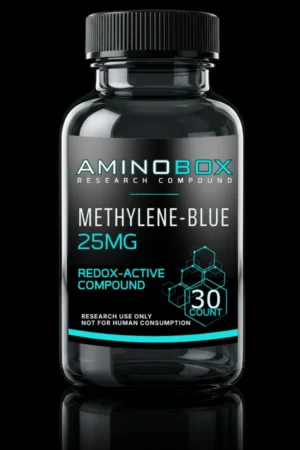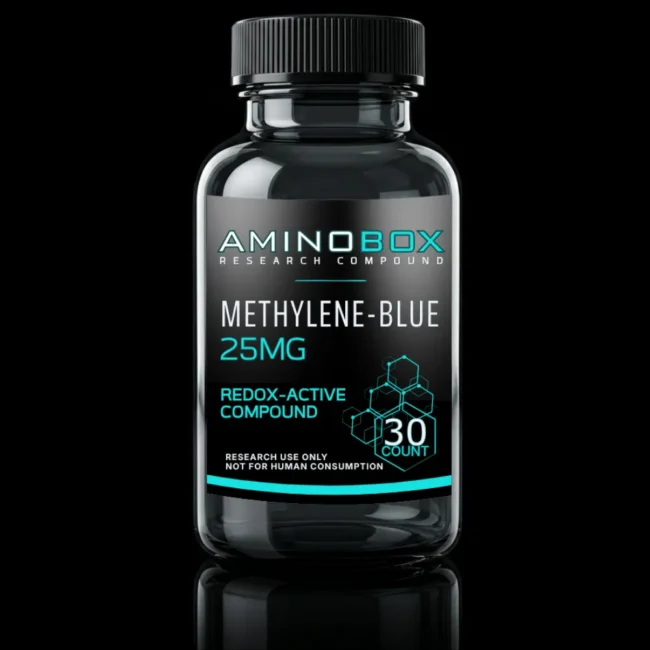

Methylene Blue


Buy Methylene Blue for cellular respiration pathways, mitochondrial electron transport systems, and oxidative stress modulation mechanisms.
$54.00
In stock
Guaranteed Safe Checkout


| Product Name | Methylene Blue |
| Functional Class | Synthetics |
| Form | Lyophilized |
| Purity | 99%+ |
| Content | 5mg |
| Count | 1 capsule |
| Research Use | Research Grade |
| CAS Number | See COA |
| Molecular Weight | See COA |
| Molecular Formula | See COA |
| PubChem CID | See COA |
| Appearance | White to off-white powder |
| Storage | 2-8C preferred |
| Water | Highly soluble |
| Acidified Water | Highly soluble |
| DMSO | Highly soluble |
| Ethanol | Moderate |
| Lipid solvents | Poor compatibility |
| Lyophilized | 2–8°C preferred |
| Long-term | −20°C recommended |
| Light Sensitivity | Moderate |
| Moisture | High sensitivity |
| Stability | Stable when dry |
| Container | Sterile sealed vial |
AminoBox products are supplied for research, analytical, and laboratory use only. Product information is provided for educational and technical reference and does not constitute medical advice. Products are not intended to diagnose, treat, cure, or prevent any disease.
Chemical Specifications – Methylene Blue Capsules
| Specification | Details |
|---|---|
| Product Name | Methylene Blue Capsules |
| Active Ingredient | Methylthioninium Chloride (Methylene Blue) |
| Chemical Name | 3,7-Bis(dimethylamino)-phenothiazin-5-ium chloride |
| Common Synonyms | Methylene Blue, Methylthioninium Chloride, Basic Blue 9 |
| CAS Number | 61-73-4 |
| PubChem CID | 6099 |
| Molecular Formula | C₁₆H₁₈ClN₃S |
| Molecular Weight | 319.85 g/mol |
| Chemical Classification | Phenothiazine Dye / Redox-Active Compound |
| Physical Appearance | Dark Green Crystalline Powder (Blue in Solution) |
| Solubility | Freely Soluble in Water |
| Source | Synthetic Compound |
| Grade | Research Grade |
| Purity | Batch Dependent (Refer to COA) |
| Intended Use | Laboratory Research & Analytical Applications Only |
Methylene blue is a synthetic phenothiazine compound with well-documented redox properties and a long history in both laboratory and clinical research. Its molecular structure allows it to participate in reversible oxidation-reduction reactions, making it a subject of investigation in mitochondrial, neurobiological, and cellular energy research.
Physical Properties
| Property | Specification |
|---|---|
| Physical Form | Encapsulated Powder |
| Capsule Count | 30 Capsules |
| Color | Dark Green Powder / Deep Blue Solution |
| Odor | Characteristic, Mild |
| Water Solubility | High |
| Chemical Stability | Stable Under Proper Storage Conditions |
| Light Sensitivity | Protect From Excessive Light Exposure |
| Storage Conditions | Cool, Dry Environment |
| Moisture Sensitivity | Store Tightly Sealed |
Research Classification
| Category | Research Focus |
|---|---|
| Primary Classification | Redox-Active Research Compound |
| Research Domains | Mitochondrial Biology |
| Biological Interest | Cellular Energy Metabolism |
| Investigational Area | Oxidative Stress Research |
| Systems Studied | Electron Transport Chain Function |
| Research Applications | Neurobiology & Cellular Bioenergetics |
| Mechanistic Interest | Electron Carrier Activity |
Methylene blue has been investigated for its ability to participate in electron transfer reactions and its interactions with mitochondrial energy systems, particularly within models examining oxidative stress, bioenergetics, and cellular metabolism.
Packaging Information
| Attribute | Details |
|---|---|
| Presentation | 30 Capsules |
| Container Type | HDPE Capsule Bottle |
| Closure Type | Screw-On Lid |
| Tamper Protection | Safety Seal |
| Storage Recommendation | Protect From Heat, Moisture, and Light |
| Shelf Life | Refer to Product Label |
Scientific Summary
| Attribute | Summary |
|---|---|
| Classification | Synthetic Phenothiazine Compound |
| Chemical Family | Thiazine Dye |
| Molecular Weight | 319.85 g/mol |
| Formula | C₁₆H₁₈ClN₃S |
| CAS Number | 61-73-4 |
| Research Interest | Mitochondrial Function & Cellular Bioenergetics |
| Key Characteristic | Redox-Active Electron Carrier |
| Primary Research Areas | Neurobiology, Oxidative Stress, Cellular Energy Metabolism |
Structural Characteristics
Methylene Blue is a heterocyclic aromatic compound with a positively charged central structure that enables it to interact directly with electron-rich biological systems. Its redox-active nature allows it to alternate between oxidized and reduced states, which is central to its biochemical behavior.
This property is the basis for its investigation in cellular respiration and mitochondrial electron transport systems.
Mechanism of Action (Research Context)
Methylene Blue is primarily studied for its role in redox cycling and electron transport modulation within biological systems.
1. Mitochondrial Electron Transport Support (Research Model)
Mitochondria generate cellular energy (ATP) through the electron transport chain. Methylene Blue has been shown in experimental systems to act as an alternative electron carrier, potentially assisting electron flow under conditions of mitochondrial stress.
This has led to research interest in:
- Cellular energy efficiency
- Mitochondrial respiration support
- Oxidative phosphorylation dynamics
2. Redox Cycling & Oxidative Stress Modulation
Methylene Blue can undergo reversible reduction and oxidation, enabling it to participate in redox cycling processes.
In laboratory models, this has been associated with:
- Modulation of reactive oxygen species (ROS) balance
- Cellular oxidative stress response regulation
- Electron scavenging and redistribution behavior
It is important to note that these effects are dose-dependent and context-specific, and not universally protective under all conditions.
3. Neurochemical & Brain Energy Research Interest
Methylene Blue has been investigated in neuroscience research due to the high energy demands of brain tissue.
Areas of scientific interest include:
- Neuronal mitochondrial efficiency
- Synaptic energy metabolism
- Brain glucose utilization pathways
- Oxidative stress in neurodegenerative models
These studies remain largely preclinical or early translational research, with ongoing investigation into cognitive and neuroprotective implications.
4. Nitric Oxide & Vascular Research
Methylene Blue is also known to interact with nitric oxide (NO) signaling pathways. In clinical medicine, this property is utilized in specific emergency settings under controlled conditions.
In research contexts, it has been studied for:
- Vascular tone regulation
- Nitric oxide synthase inhibition pathways
- Blood flow modulation mechanisms
Clinical & Scientific Context
Unlike many investigational compounds, Methylene Blue has:
- Established medical use in specific approved indications (e.g., methemoglobinemia treatment under clinical supervision)
- Extensive pharmacological literature spanning over a century
- Well-documented redox and mitochondrial interactions
However, its use in:
- cognitive enhancement
- neuroprotection in aging
- performance optimization
remains experimental and not clinically established for general use.
Research Applications
Methylene Blue is commonly studied in:
- Mitochondrial biology research
- Cellular energy metabolism studies
- Oxidative stress models
- Neurodegeneration research frameworks
- Redox pharmacology
- Vascular physiology studies
- Cellular respiration experiments
Safety & Research Limitations
While extensively studied, Methylene Blue requires careful contextual interpretation:
- Biological effects are dose-dependent and biphasic (low vs high dose effects differ significantly)
- Interactions with serotonergic systems are documented in pharmacology literature
- Clinical use is restricted to specific medical indications
- Research outcomes vary depending on experimental conditions
As such, it should be considered a pharmacologically active research compound with established medical history but complex systemic effects.
Methylene Blue Facts
1. Antioxidant Properties
Methylene blue acts as a potent antioxidant, neutralizing reactive oxygen species (ROS) and reducing oxidative stress in cells. Oxidative stress is a key contributor to skin aging, leading to wrinkles, fine lines, and loss of elasticity. By mitigating oxidative damage, methylene blue may help maintain youthful skin.
2. Enhanced Mitochondrial Function
It has been shown to improve mitochondrial efficiency in skin cells. Mitochondria are responsible for energy production, and their decline is associated with aging. Enhanced mitochondrial function can lead to increased cellular energy (ATP), promoting healthier and more resilient skin cells.
3. Promotion of Collagen and Elastin Production
Methylene blue may stimulate the synthesis of collagen and elastin—proteins crucial for skin firmness and elasticity. Increased levels of these proteins can reduce the appearance of wrinkles and improve skin texture.
4. Cellular Longevity
Research suggests that methylene blue can extend the lifespan of human skin cells in vitro. By delaying cellular senescence (the process by which cells age and lose function), it may contribute to prolonged skin vitality.
5. Anti-Inflammatory Effects
Its anti-inflammatory properties can help reduce skin inflammation, which is associated with aging and various skin conditions. Reducing inflammation can lead to a clearer complexion and improved skin health.
6. Protection Against UV Damage
Methylene blue may offer protective effects against ultraviolet (UV) radiation. UV exposure is a major factor in premature skin aging, causing DNA damage and photoaging. By protecting against UV-induced damage, methylene blue can help preserve skin integrity.
7. Improved Wound Healing
Studies indicate that methylene blue can promote wound healing by enhancing tissue regeneration. This property can be beneficial for repairing skin damage and maintaining a youthful appearance.
your mental prowess with our high-quality Methylene Blue supplement, carefully crafted to promote brain wellness and enhance cognitive abilities.
Important Notice
This product is supplied strictly for laboratory research, analytical use, and scientific investigation purposes only. It is not intended for human consumption, medical use, or therapeutic application outside approved clinical settings.
Methylene Blue is a pharmacologically active compound with established medical applications in specific contexts, and all information provided here relates to research literature and biochemical mechanisms rather than consumer use or therapeutic claims.
Scientific References – Methylene Blue
| Ref # | Title | Journal | Focus | Link |
|---|---|---|---|---|
| 1 | Methylene blue acts as a mitochondrial electron cycler in cells | Journal of Biological Chemistry | Electron transport chain support, mitochondrial respiration | https://pubmed.ncbi.nlm.nih.gov/16103124/ |
| 2 | Methylene blue in the treatment of methemoglobinemia | Critical Care Medicine | Clinical pharmacology, approved medical use | https://pubmed.ncbi.nlm.nih.gov/20339356/ |
| 3 | Methylene blue enhances mitochondrial function and brain energy metabolism | Neuroscience Letters | Neuronal metabolism, ATP production, brain energy | https://pubmed.ncbi.nlm.nih.gov/21645594/ |
| 4 | Mitochondrial dysfunction in neurodegenerative diseases and therapeutic strategies | Nature Reviews Neuroscience | Mitochondrial dysfunction in brain disorders | https://pubmed.ncbi.nlm.nih.gov/18852688/ |
| 5 | Methylene blue as a metabolic modulator in cellular redox biology | Free Radical Biology & Medicine | Redox cycling, oxidative stress modulation | https://pubmed.ncbi.nlm.nih.gov/23017717/ |
| 6 | Methylene blue and cognitive enhancement: effects on memory and brain function | Psychopharmacology | Memory, cognition, early human/animal studies | https://pubmed.ncbi.nlm.nih.gov/17013641/ |
| 7 | Nitric oxide inhibition by methylene blue: vascular and biochemical effects | American Journal of Physiology | NO pathway modulation, vascular tone | https://pubmed.ncbi.nlm.nih.gov/10980192/ |