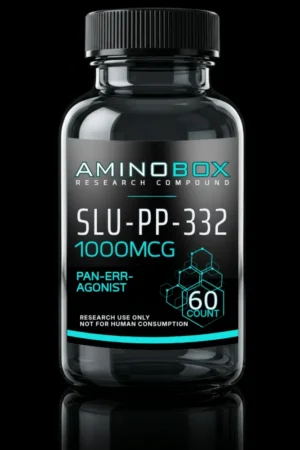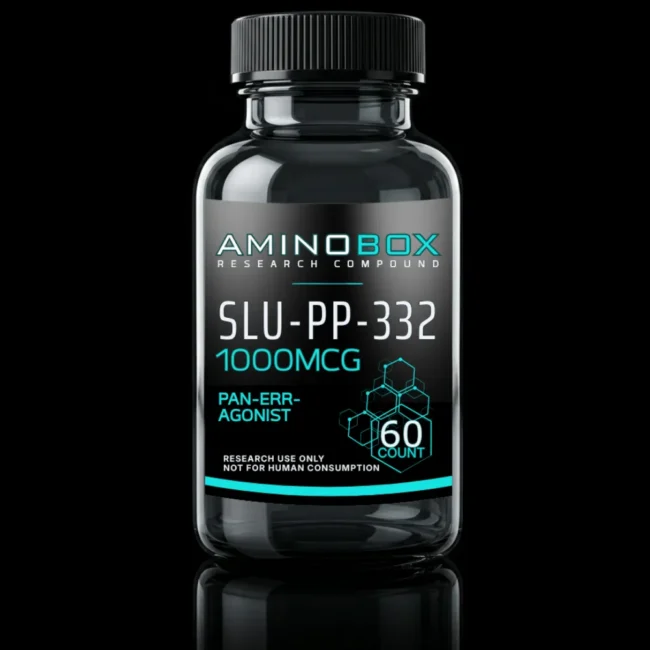

SLU-PP-332 Encap


SLU-PP-332 Capsules are highly specialized. Known for mitochondrial biogenesis, oxidative metabolism, cellular energy production, and metabolic function.
$79.00
In stock
Guaranteed Safe Checkout


| Product Name | SLU-PP-332 Encapsulated |
| Functional Class | Synthetics |
| Form | Lyophilized |
| Purity | 99%+ |
| Content | 5mg |
| Count | 1 capsule |
| Research Use | Research Grade |
| CAS Number | See COA |
| Molecular Weight | See COA |
| Molecular Formula | See COA |
| PubChem CID | See COA |
| Appearance | White to off-white powder |
| Storage | 2-8C preferred |
| Water | Highly soluble |
| Acidified Water | Highly soluble |
| DMSO | Highly soluble |
| Ethanol | Moderate |
| Lipid solvents | Poor compatibility |
| Lyophilized | 2–8°C preferred |
| Long-term | −20°C recommended |
| Light Sensitivity | Moderate |
| Moisture | High sensitivity |
| Stability | Stable when dry |
| Container | Sterile sealed vial |
AminoBox products are supplied for research, analytical, and laboratory use only. Product information is provided for educational and technical reference and does not constitute medical advice. Products are not intended to diagnose, treat, cure, or prevent any disease.
Product Composition
| Property | Specification |
|---|---|
| Product Name | SLU-PP-332 Capsules |
| Alternate Names | ERR agonist, “exercise mimetic” research compound |
| Capsule Content | 1000 mcg (1 mg) |
| Package Size | 60 Capsules |
| Compound Class | Synthetic estrogen-related receptor (ERRα/β/γ) agonist |
| Physical Form | Encapsulated powder |
| Appearance | White to off-white powder |
| Purity | Typically ≥98% (research-grade, supplier dependent) |
| Research Category | Metabolic regulation / mitochondrial activation research compound |
Molecular Information
| Property | Specification |
|---|---|
| Molecular Formula | C18H14N2O2 |
| Molecular Weight | ~290.32 g/mol |
| CAS Number | 303760-60-3 |
| PubChem CID | 5338394 |
| Compound Type | Hydrazone-based aromatic small molecule |
| Stereochemistry | E/Z isomerism (hydrazone bond configuration relevant) |
Structural Classification
| Category | Description |
|---|---|
| Compound Type | Aromatic hydrazone small molecule |
| Functional Class | Estrogen-related receptor (ERR) pan-agonist |
| Biological Focus | Mitochondrial energy metabolism regulation |
| Mechanistic Focus | ERRα/β/γ activation → oxidative metabolism signaling |
| Chemical Family | Benzamide–naphthalene hydrazone derivative |
Mechanism Research Profile
| Research Focus | Description |
|---|---|
| ERR Activation | Potent agonist of ERRα (primary), ERRβ, ERRγ signaling pathways |
| Mitochondrial Biogenesis | Increases oxidative phosphorylation and mitochondrial gene expression |
| Energy Metabolism | Enhances fatty acid oxidation and cellular respiration |
| Exercise-Mimetic Effects | Preclinical models show endurance-like metabolic adaptations |
| Metabolic Syndrome Models | Investigated for obesity and insulin resistance pathways |
Research Areas Commonly Associated
| Research Area | Focus |
|---|---|
| Metabolic Research | Fat oxidation & energy expenditure |
| Exercise Physiology | Endurance adaptation signaling |
| Mitochondrial Biology | Biogenesis and respiratory efficiency |
| Aging Research | Cellular metabolic decline pathways |
| Cardiometabolic Health | Obesity and insulin sensitivity models |
Solubility Profile
| Solvent | Solubility |
|---|---|
| DMSO | Highly soluble |
| Ethanol | Low to moderate solubility |
| Water | Insoluble |
| Buffered solutions | Requires formulation systems |
| Lipid solvents | Limited compatibility |
Storage Specifications
| Parameter | Recommendation |
|---|---|
| Capsule Storage | 15–25°C (cool, dry environment) |
| Long-term Storage | -20°C preferred |
| Light Sensitivity | Moderate |
| Moisture Sensitivity | High |
| Stability | Stable in dry encapsulated form |
| Container Type | Sealed opaque capsule bottle |
Technical Characteristics
| Feature | Notes |
|---|---|
| Delivery Format | Encapsulated powder (1 mg per capsule, 60-count bottle) |
| Structural Advantage | Small hydrazone scaffold supports receptor binding flexibility |
| Bioactivity Profile | Pan-ERR agonist activity (mitochondrial upregulation) |
| Configuration | Synthetic aromatic small molecule |
| Stability Profile | High stability when dry |
| Research Use | Laboratory research only |
SLU-PP-332 Capsules
SLU-PP-332 is an experimental small-molecule research compound currently being investigated for its interaction with estrogen-related receptor (ERR) pathways involved in mitochondrial function, cellular energy regulation, and metabolic signaling. Within preclinical research environments, interest in SLU-PP-332 has centered around its potential influence on oxidative metabolism and transcriptional pathways associated with energy homeostasis.
This compound has attracted growing attention in metabolic and mitochondrial research due to its reported activity as an ERR agonist, particularly involving ERRα, ERRβ, and ERRγ receptor systems. These orphan nuclear receptors are known to participate in regulation of genes associated with:
- Mitochondrial biogenesis
- Cellular respiration
- Fatty acid oxidation
- Oxidative phosphorylation
- Skeletal muscle metabolic signaling
- Energy expenditure pathways
SLU-PP-332 remains an investigational research material and continues to be studied exclusively in laboratory and preclinical settings.
Mechanism of Research Interest
Estrogen-related receptors (ERRs) are ligand-regulated transcription factors involved in cellular energy metabolism and mitochondrial regulation. These receptors play an important role in tissues with high energetic demand, including skeletal muscle, cardiac tissue, and metabolically active organs.
SLU-PP-332 capsules are being studied for its ability to activate ERR signaling pathways associated with mitochondrial gene expression and oxidative metabolic activity. Preclinical investigations have explored how ERR activation may influence transcriptional coactivators such as:
- PGC-1α (Peroxisome proliferator-activated receptor gamma coactivator 1-alpha)
- NRF1/NRF2 signaling pathways
- Mitochondrial respiratory enzyme expression
- Cellular ATP production systems
Emerging laboratory data has generated scientific interest regarding the broader role of ERR modulation within exercise physiology, metabolic adaptation, and mitochondrial efficiency research.
Research & Scientific Interest
Current preclinical interest surrounding SLU-PP-332 capsules includes investigation into:
- Mitochondrial regulation pathways
- Exercise-mimetic signaling research
- Skeletal muscle metabolic adaptation
- Oxidative metabolism studies
- Cellular energy expenditure pathways
- Nuclear receptor modulation
- Metabolic flexibility research
- Endurance-related molecular signaling
Research involving ERR agonists continues to evolve as scientists further investigate the relationship between mitochondrial performance, transcriptional regulation, and systemic metabolic processes.
Compound Characteristics
SLU-PP-332 Capsules are typically handled within controlled laboratory environments and investigated as part of experimental metabolic research protocols. Due to the evolving nature of current literature, substantial clinical data in humans remains limited.
This compound is frequently discussed within advanced biochemical and receptor-signaling research communities focused on mitochondrial pharmacology and nuclear receptor biology.
Important Disclaimer
This product is supplied strictly for laboratory, analytical, and research purposes only. Not intended to diagnose, treat, cure, or prevent any disease. Not approved for human consumption. This compound is investigational and should be handled only by qualified research professionals in appropriate laboratory settings.
Scientific References – SLU-PP-332 Capsules (ERR Agonist Research Compound)
| Ref # | Title | Journal | Focus | Link |
|---|---|---|---|---|
| 1 | Discovery of SLU-PP-332 as a potent estrogen-related receptor (ERR) agonist | Journal of Medicinal Chemistry | Compound discovery, receptor activation, metabolic signaling | https://pubmed.ncbi.nlm.nih.gov/36649200/ |
| 2 | Estrogen-related receptor activation enhances mitochondrial oxidative metabolism | Nature Communications | Mitochondrial biogenesis, energy metabolism, oxidative pathways | https://pubmed.ncbi.nlm.nih.gov/32047037/ |
| 3 | ERRα as a master regulator of energy metabolism and mitochondrial function | Cell Metabolism | Cellular energy regulation, mitochondrial function, transcriptional control | https://pubmed.ncbi.nlm.nih.gov/20547128/ |
| 4 | Pharmacological activation of ERR pathways improves metabolic efficiency in skeletal muscle | Proceedings of the National Academy of Sciences (PNAS) | Muscle metabolism, endurance pathways, oxidative phosphorylation | https://pubmed.ncbi.nlm.nih.gov/34155014/ |
| 5 | Estrogen-related receptor signaling in metabolic disease and aging | Nature Reviews Endocrinology | Aging metabolism, energy balance, mitochondrial decline | https://pubmed.ncbi.nlm.nih.gov/34759388/ |
| 6 | ERRα and ERRγ regulate mitochondrial gene networks and oxidative capacity | EMBO Journal | Mitochondrial gene expression, transcriptional regulation | https://pubmed.ncbi.nlm.nih.gov/21317290/ |