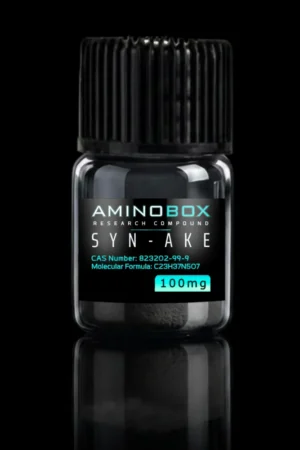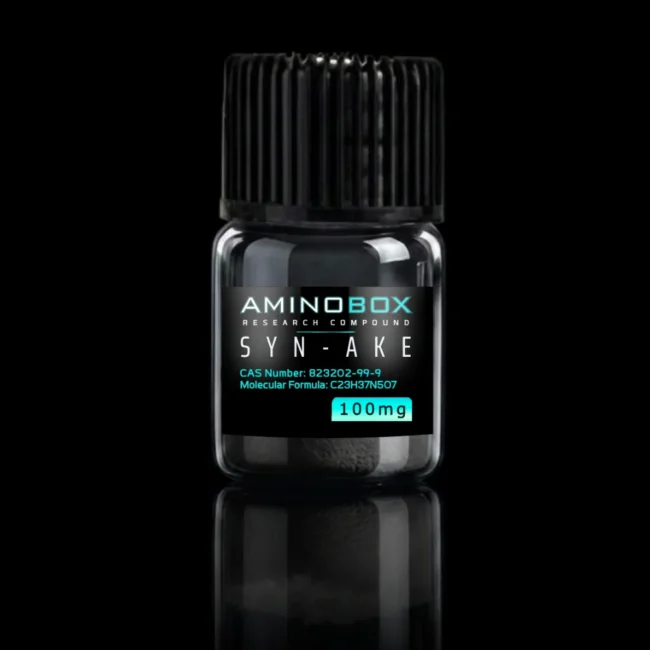

SYN-Ake


SYN-AKE is a sophisticated cosmetic active designed to mimic the wrinkle-softening effects with muscular relaxation — without invasive procedures.
$57.00
In stock
Guaranteed Safe Checkout


| Product Name | SYN-Ake |
| Functional Class | Dermatics |
| Form | Lyophilized |
| Purity | 99%+ |
| Content | 5mg |
| Count | 1 vial |
| Research Use | Research Grade |
| CAS Number | See COA |
| Molecular Weight | See COA |
| Molecular Formula | See COA |
| PubChem CID | See COA |
| Appearance | White to off-white powder |
| Storage | 2-8C preferred |
Active Peptide 2 items
Excipients 4 items
Reconstitution Solvents 4 items
Buffer Systems 4 items
Lyoprotectants & Cryoprotectants 3 items
Preservatives & Antimicrobials 3 items
Counter Ions & Salt Forms 3 items
Chelating Agents 2 items
Antioxidants & Stabilizers 3 items
| Water | Highly soluble |
| Acidified Water | Highly soluble |
| DMSO | Highly soluble |
| Ethanol | Moderate |
| Lipid solvents | Poor compatibility |
| Lyophilized | 2–8°C preferred |
| Long-term | −20°C recommended |
| Light Sensitivity | Moderate |
| Moisture | High sensitivity |
| Stability | Stable when dry |
| Container | Sterile sealed vial |
AminoBox products are supplied for research, analytical, and laboratory use only. Product information is provided for educational and technical reference and does not constitute medical advice. Products are not intended to diagnose, treat, cure, or prevent any disease.
| Product Composition | Specification |
|---|---|
| Product Name | SYN-Ake |
| Alternate Names | Dipeptide Diaminobutyroyl Benzylamide Diacetate, Snake Peptide |
| Content Amount | 100 mg |
| Compound Class | Synthetic neuropeptide analog |
| Physical Form | Lyophilized peptide powder |
| Appearance | White to off-white powder |
| Purity | Typically ≥98% (HPLC dependent) |
| Research Category | Cosmetic peptide / neuromodulatory peptide research |
| Primary Function | Expression-line and facial signaling peptide research |
| Molecular Information | Specification |
| Molecular Formula | C23H37N5O7 |
| Molecular Weight | ~495.57 g/mol |
| CAS Number | 823202-99-9 |
| PubChem CID | 71465152 |
| INCI Name | Dipeptide Diaminobutyroyl Benzylamide Diacetate |
| Compound Type | Synthetic peptide analog |
| Structural Classification | Waglerin-1 mimetic peptide |
| Sequence Classification | Neurotransmitter-inhibiting cosmetic peptide |
| Structural Classification | Description |
| Compound Type | Synthetic snake venom-inspired peptide |
| Functional Class | Neuromodulatory cosmetic peptide |
| Biological Focus | Facial muscle signaling and wrinkle research |
| Mechanistic Focus | Neuromuscular receptor modulation |
| Chemical Family | Biomimetic peptide analogs |
| Structural Inspiration | Modeled after Waglerin-1 temple viper peptide |
| Mechanism Research Profile | Description |
| Neuromuscular Signaling | Studied for reversible modulation of muscular contraction pathways |
| Expression Line Research | Investigated for cosmetic smoothing of dynamic facial lines |
| Receptor Interaction | Mimics Waglerin-1 peptide receptor-binding behavior |
| Muscle Relaxation Signaling | Explored for reduction of repetitive contraction signaling |
| Cosmetic Peptide Research | Commonly formulated into anti-aging topical systems |
| SNARE/Neuro Signaling | Associated with neurotransmitter-related cosmetic pathways |
| Research Areas Commonly Associated | Focus |
| Cosmetic Peptide Research | Fine line and wrinkle appearance studies |
| Neurocosmetic Research | Neuromuscular signaling pathways |
| Dermatological Research | Expression-line modulation |
| Anti-Aging Research | Dynamic wrinkle reduction |
| Peptide Delivery Research | Topical peptide transport systems |
| Skin Science | Surface neuromodulation and cosmetic formulation |
| Solubility Profile | Solubility |
| Water | Soluble |
| Sterile Water | Highly compatible |
| DMSO | Soluble |
| Ethanol | Limited compatibility |
| Glycols | Good compatibility |
| Lipid Systems | Moderate compatibility |
| Storage Specifications | Recommendation |
| Short-Term Storage | 2–8°C |
| Long-Term Storage | -20°C preferred |
| Light Sensitivity | Moderate |
| Moisture Sensitivity | High |
| Stability | Stable in lyophilized form |
| Reconstituted Stability | Refrigerate after mixing |
| Container Type | Sealed amber peptide vial |
| Technical Characteristics | Notes |
| Delivery Format | Lyophilized peptide powder (100 mg) |
| Structural Advantage | Designed as a stable Waglerin-1 mimetic |
| Bioactivity Profile | Cosmetic neuromodulatory signaling peptide |
| Functional Target | Neuromuscular receptor-associated pathways |
| Topical Research Use | Commonly studied in anti-aging cosmetic systems |
| Stability Profile | Stable when protected from moisture and heat |
| Research Use | Laboratory and cosmetic research only |
BUY SYN-AKE™ | Scientific Overview (Corrected & Enhanced)
Mechanism of Action (Neurocosmetic Pathway)
SYN-AKE (Dipeptide Diaminobutyroyl Benzylamide Diacetate) is a synthetic tripeptide inspired by Waglerin-1, a peptide originally isolated from Temple Viper (Tropidolaemus wagleri) venom. Research literature describes Waglerin-1 as interacting with nicotinic acetylcholine receptors (nAChRs) at the neuromuscular junction.
In cosmetic science, SYN-AKE is designed to mimic aspects of this receptor interaction in a topical context, supporting the concept of reduced micro-muscle contraction activity associated with expression lines.
(Source: https://www.mdpi.com)
Expression Line Formation & Cosmetic Rationale
Facial expression lines develop primarily from repeated contraction of facial muscles triggered by acetylcholine signaling. Over time, this repeated mechanical folding contributes to the formation of dynamic wrinkles such as:
- Forehead lines
- Glabellar lines (frown lines)
- Crow’s feet
SYN-AKE is studied in cosmetic formulation research for its ability to support a smoother skin appearance by targeting the look of contraction-related creasing, rather than altering underlying muscle structure.
(Source: https://www.specialchem.com)
Cosmetic Function (Important Clarification)
Unlike injectable neuromodulators (e.g., botulinum toxin), SYN-AKE is:
- Not a neurotoxin
- Not injectable
- Not a drug
- Designed strictly for topical cosmetic use
Its mechanism is best described as a surface-level neurocosmetic effect, intended to reduce the appearance of expression lines rather than directly inhibiting neuromuscular transmission in the way pharmaceutical agents do.
(Source: https://incidecoder.com)
Biomimetic Peptide Engineering
SYN-AKE is part of a class of biomimetic cosmetic peptides, where biological signaling pathways are modeled synthetically for topical skincare applications.
The INCI name:
Dipeptide Diaminobutyroyl Benzylamide Diacetate
This peptide was engineered for:
- Cosmetic stability in aqueous formulations
- Compatibility with emulsions and serum systems
- Incorporation into modern delivery systems (liposomes, hydrogels, microemulsions)
(Source: https://www.specialchem.com)
Cosmetic Research Applications
SYN-AKE is commonly evaluated in cosmetic formulation studies for:
- Appearance of dynamic wrinkle reduction
- Expression-line softening
- Eye area (crow’s feet) smoothing
- Forehead and glabellar line treatments
- Skin texture refinement
- Neurocosmetic anti-aging systems
- Multi-peptide synergy formulations
Industry-sponsored studies and formulation reports suggest visible improvements in the appearance of fine lines with consistent topical use, though outcomes vary based on formulation, concentration, and delivery system.
(Source: https://www.specialchem.com)
Synergistic Formulation Strategy
SYN-AKE is often combined with complementary cosmetic actives to support multi-pathway anti-aging effects:
- Acetyl Hexapeptide-8 (Argireline®)
- Acetyl Octapeptide-3 (SNAP-8)
- Palmitoyl peptides (Matrixyl® family)
- Copper peptides (GHK-Cu)
- Hyaluronic acid (hydration support)
- Niacinamide (barrier + tone support)
- Ceramides (barrier integrity)
- Retinoids (cell turnover support)
- Growth factor–mimetic ingredients
This combination approach is commonly referred to as a multi-peptide cosmetic strategy targeting hydration, texture, and the appearance of expression-related aging.
Stability & Formulation Considerations
As a peptide-based ingredient, SYN-AKE stability depends on:
- pH balance of formulation
- Preservation system compatibility
- Oxidation control
- Storage conditions
It is most commonly formulated in:
- Water-based serums
- Emulsions
- Hydrogel masks
- Encapsulated delivery systems
Advanced cosmetic systems may use:
- Liposomal encapsulation
- Nanoemulsion carriers
- Controlled-release peptide delivery systems
These technologies are designed to enhance cosmetic performance and skin compatibility, not to imply drug-like penetration or systemic activity.
(Source: https://www.mdpi.com)
SYN-AKE is a cosmetic ingredient, not a pharmaceutical agent. Its effects are evaluated in the context of appearance-based skin improvements, not medical treatment or physiological muscle paralysis.
SYN-AKE (Dipeptide Diaminobutyroyl Benzylamide Diacetate) – Reference Table
| Category | Reference / Finding | Source |
|---|---|---|
| Mechanism of Action | Mimics waglerin-1 and interacts with nicotinic acetylcholine receptors (nAChRs), reducing muscle contraction signaling involved in expression lines | Peptide Helper – SYN-AKE Research |
| Functional Classification | Synthetic tripeptide designed as a “botox-like” cosmetic peptide for expression wrinkle reduction | Peptide Helper – SYN-AKE Overview |
| Cosmetic Effect | Helps reduce appearance of dynamic wrinkles such as forehead lines and crow’s feet in topical formulations | Cosmetic Science Ingredient Review |
| Biological Pathway | Works via modulation of neuromuscular signaling at the synapse level (acetylcholine receptor interaction) | Peptide Helper – Mechanism Summary |
| Application Use | Used in topical skincare products such as serums and anti-aging creams | Cosmetic Science Ingredient Database |