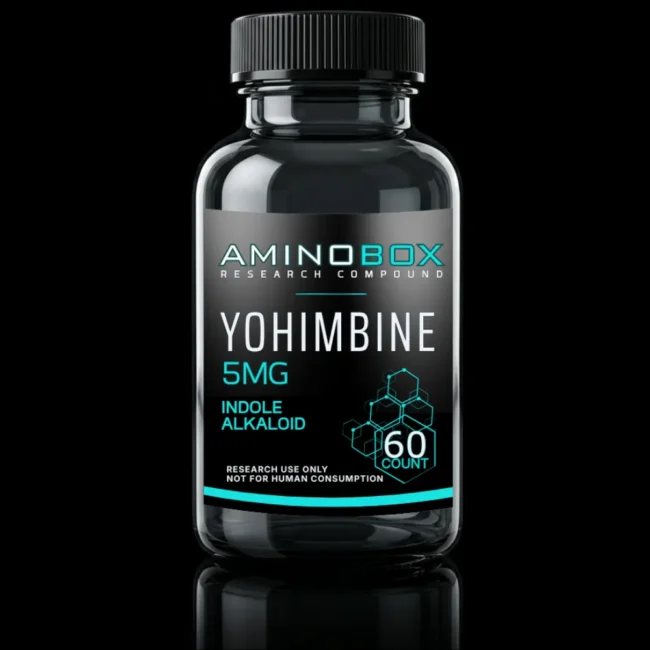

Yohimbine


Yohimbine is widely studied in metabolic mobilization, lipolysis signaling, vascular tone regulation, and central nervous system arousal pathways.
$66.00
In stock
Guaranteed Safe Checkout


| Product Name | Yohimbine |
| Functional Class | Synthetics |
| Form | Lyophilized |
| Purity | 99%+ |
| Content | 5mg |
| Count | 1 capsule |
| Research Use | Research Grade |
| CAS Number | See COA |
| Molecular Weight | See COA |
| Molecular Formula | See COA |
| PubChem CID | See COA |
| Appearance | White to off-white powder |
| Storage | 2-8C preferred |
| Water | Highly soluble |
| Acidified Water | Highly soluble |
| DMSO | Highly soluble |
| Ethanol | Moderate |
| Lipid solvents | Poor compatibility |
| Lyophilized | 2–8°C preferred |
| Long-term | −20°C recommended |
| Light Sensitivity | Moderate |
| Moisture | High sensitivity |
| Stability | Stable when dry |
| Container | Sterile sealed vial |
AminoBox products are supplied for research, analytical, and laboratory use only. Product information is provided for educational and technical reference and does not constitute medical advice. Products are not intended to diagnose, treat, cure, or prevent any disease.
Product Composition
| Property | Specification |
|---|---|
| Product Name | Yohimbine |
| Alternate Names | Yohimbine HCl (common salt form), Quebrachine |
| Capsule Content | 5mg |
| Package Size | 60 Tablets |
| Compound Class | Indole alkaloid (α2-adrenergic antagonist) |
| Physical Form | Encapsulated powder |
| Appearance | White to off-white crystalline powder |
| Purity | Typically ≥98% (HPLC grade, depends on source) |
| Research Category | Adrenergic / metabolic / lipolysis research compound |
Molecular Information
| Property | Specification |
|---|---|
| Molecular Formula | C21H26N2O3 |
| Molecular Weight | 354.4 g/mol |
| CAS Number | 146-48-5 |
| PubChem CID | 8969 |
| Compound Type | Indole-based plant alkaloid |
| Stereochemistry | Chiral (multiple stereocenters) |
Structural Classification
| Category | Description |
|---|---|
| Compound Type | Corynanthe alkaloid |
| Functional Class | Adrenergic receptor antagonist (α2-blocker) |
| Biological Focus | Sympathetic nervous system regulation |
| Mechanistic Focus | Increased norepinephrine release via α2 inhibition |
| Chemical Family | Yohimbe-derived indole alkaloids |
Mechanism Research Profile
| Research Focus | Description |
|---|---|
| Adrenergic Blockade | Blocks presynaptic α2-adrenergic receptors → increased norepinephrine signaling |
| Lipolysis Research | Studied for mobilization of fatty acids via sympathetic activation |
| Blood Flow Modulation | Investigated for vascular smooth muscle effects |
| CNS Stimulation | Increases central noradrenergic activity (dose-dependent) |
| Performance Research | Examined in energy expenditure and thermogenesis models |
Research Areas Commonly Associated
| Research Area | Focus |
|---|---|
| Metabolic Research | Fat mobilization and energy expenditure |
| Neuropharmacology | Adrenergic and dopaminergic signaling |
| Cardiovascular Physiology | Vascular tone regulation |
| Endocrine Signaling | Stress hormone modulation |
| Exercise Physiology | Sympathetic activation during fasting states |
Solubility Profile
| Solvent | Solubility |
|---|---|
| Water | Moderately soluble |
| Acidic water (HCl form) | Highly soluble |
| DMSO | Highly soluble |
| Ethanol | Moderately soluble |
| Lipid solvents | Limited compatibility |
Storage Specifications
| Parameter | Recommendation |
|---|---|
| Capsule Storage | 15–25°C (cool, dry place) |
| Long-term Storage | 2–8°C preferred |
| Light Sensitivity | Moderate |
| Moisture Sensitivity | High |
| Stability | Stable in dry form |
| Container Type | Sealed opaque capsule bottle |
Technical Characteristics
| Feature | Notes |
|---|---|
| Delivery Format | Encapsulated powder (5mg per capsule, 60-count bottle) |
| Structural Advantage | Lipophilic indole scaffold enables CNS activity |
| Bioavailability | Improved in HCl salt form |
| Configuration | Natural plant-derived alkaloid |
| Stability Profile | High stability when dry |
| Research Use | Laboratory research only |
Yohimbine | 5mg
Yohimbine is a naturally occurring indole alkaloid primarily extracted from the bark of Pausinystalia yohimbe, a West African evergreen tree traditionally used in ethnomedicine for its stimulant and aphrodisiac properties.
Mechanism of Action (Biochemical Framework)
Yohimbine’s primary biological activity is mediated through inhibition of presynaptic alpha-2 adrenergic receptors, which normally function as inhibitory regulators of norepinephrine release.
By blocking this feedback mechanism, Yohimbine may influence:
- Increased norepinephrine availability in synaptic clefts
- Enhanced sympathetic nervous system signaling tone
- Modulation of lipolytic (fat breakdown) pathways in adipose tissue
- Altered vascular smooth muscle tone and peripheral circulation dynamics
This places Yohimbine within the category of catecholaminergic modulators and sympathetic nervous system activators.
1. Adrenergic System Modulation (Core Mechanism)
Alpha-2 adrenergic receptors act as inhibitory “brakes” on norepinephrine release. Yohimbine functions as an antagonist at these receptors, leading to:
- Reduced presynaptic inhibition of norepinephrine
- Increased adrenergic signaling activity
- Heightened sympathetic nervous system output under certain conditions
This mechanism is central to its observed physiological effects in both clinical and experimental literature.
2. Lipolysis Signaling & Metabolic Mobilization
In adipose tissue biology, alpha-2 receptors are involved in regulating fat storage vs. fat mobilization signaling balance.
By antagonizing these receptors, Yohimbine is studied for its potential role in:
- Supporting lipolytic signaling pathways (fat mobilization mechanisms)
- Modulating catecholamine-driven adipocyte activity
- Influencing energy substrate utilization under sympathetic activation states
These effects are context-dependent and vary significantly based on insulin levels, metabolic state, and receptor density.
3. Central Nervous System Arousal Pathways
Yohimbine crosses the blood-brain barrier and influences central adrenergic tone.
Research literature associates it with:
- Increased central norepinephrine signaling
- Modulation of arousal and alertness pathways
- Interaction with stress-response neurocircuitry
- Influence on attention and motivational drive systems (experimental context)
These effects are tied to locus coeruleus–noradrenergic system activation.
4. Vascular & Circulatory System Effects
Alpha-adrenergic signaling also regulates vascular tone. Yohimbine’s receptor activity may influence:
- Peripheral vasoconstriction/vasodilation balance
- Blood pressure regulation dynamics in experimental models
- Genital and peripheral blood flow responses (historical pharmacological interest)
These effects are dose-dependent and highly variable across individuals.
5. Stress Axis Interaction (HPA Axis Research Context)
Due to its adrenergic activity, Yohimbine is studied in relation to:
- Hypothalamic-pituitary-adrenal (HPA) axis activation
- Cortisol release modulation under stress conditions
- Sympathetic-adrenal-medullary system stimulation
This positions Yohimbine as a compound closely linked to acute stress-response physiology.
Research Applications
Yohimbine is commonly studied in:
- Adrenergic receptor pharmacology
- Sympathetic nervous system signaling models
- Adipose tissue metabolism and lipolysis research
- Cognitive arousal and attention systems (experimental)
- Vascular physiology and blood flow regulation studies
- Stress-response neuroendocrine research
Safety & Pharmacological Context (Important)
Yohimbine is a potent adrenergic modulator, and its effects are strongly dose-sensitive. In research literature, it is associated with:
- Elevated sympathetic nervous system activity
- Increased heart rate and blood pressure in some models
- Heightened stress response signaling under certain conditions
For this reason, Yohimbine is classified as a high-activity pharmacological alkaloid, requiring careful handling in both research and experimental environments.
Scientific Summary
Yohimbine is best described as:
“A selective alpha-2 adrenergic receptor antagonist alkaloid influencing sympathetic nervous system signaling and metabolic mobilization pathways.”
Its primary mechanistic domains include:
- Adrenergic neurotransmission modulation
- Sympathetic nervous system activation
- Lipolysis signaling regulation
- Central arousal pathway stimulation
- Vascular tone and stress-response physiology
Adrenergic Signaling
- Increased norepinephrine release via presynaptic inhibition blockade
- Enhanced sympathetic nervous system activity
- CNS arousal and stress-response activation
Metabolic & Lipolytic Pathways
- Modulation of adipocyte alpha-2 receptor signaling
- Support of lipolysis under catecholamine stimulation
- Interaction with insulin-sensitive fat mobilization pathways
Cardiovascular & Neuroendocrine Effects
- Increased heart rate and blood pressure in controlled studies
- Activation of HPA axis stress response systems
- Peripheral vascular tone modulation
Clinical & Experimental Use Cases
- Body composition and fat metabolism research
- Erectile dysfunction pharmacology studies
- CNS stimulant and arousal pathway research
Important Notice
This product is supplied strictly for laboratory research, analytical use, and scientific investigation purposes only. It is not intended for human consumption, medical use, or therapeutic application.
Yohimbine is a biologically active adrenergic alkaloid with significant physiological effects in experimental systems, and all described mechanisms reflect scientific literature and pharmacological research models rather than guaranteed or approved outcomes.
Scientific References – Yohimbine (Alpha-2 Adrenergic Antagonist)
| Ref # | Title | Journal | Focus | Link |
|---|---|---|---|---|
| 1 | Yohimbine: pharmacology and clinical effects | Journal of Clinical Psychopharmacology | Core adrenergic mechanism, CNS stimulation, safety profile | https://pubmed.ncbi.nlm.nih.gov/2860427/ |
| 2 | The role of alpha-2 adrenergic receptors in human fat metabolism | Obesity Research | Lipolysis regulation and fat mobilization mechanisms | https://pubmed.ncbi.nlm.nih.gov/8698856/ |
| 3 | Effects of yohimbine on body composition and fat loss in athletes | Research Quarterly for Exercise and Sport | Human study: body composition changes under exercise conditions | https://pubmed.ncbi.nlm.nih.gov/3029516/ |
| 4 | Yohimbine and sympathetic nervous system activation in humans | Journal of Cardiovascular Pharmacology | Norepinephrine increase, cardiovascular response | https://pubmed.ncbi.nlm.nih.gov/6327490/ |
| 5 | Central and peripheral effects of yohimbine on catecholamine release | Neuroscience & Biobehavioral Reviews | CNS arousal and stress-response signaling | https://pubmed.ncbi.nlm.nih.gov/2196849/ |
| 6 | Alpha-2 adrenergic receptor antagonists and energy metabolism | American Journal of Physiology | Metabolic regulation and adipocyte signaling pathways | https://pubmed.ncbi.nlm.nih.gov/2178583/ |
| 7 | Yohimbine in erectile dysfunction: mechanism and clinical studies | Urology | Vascular tone and blood flow effects | https://pubmed.ncbi.nlm.nih.gov/1738210/ |
| 8 | Sympathoadrenal activation by yohimbine in humans | Psychopharmacology | HPA axis activation and stress hormone response | https://pubmed.ncbi.nlm.nih.gov/6118210/ |