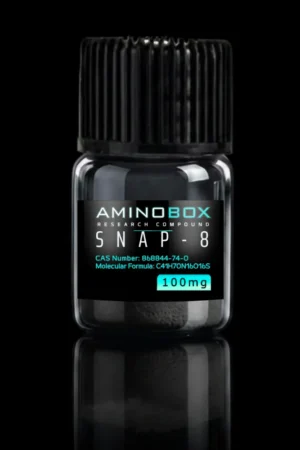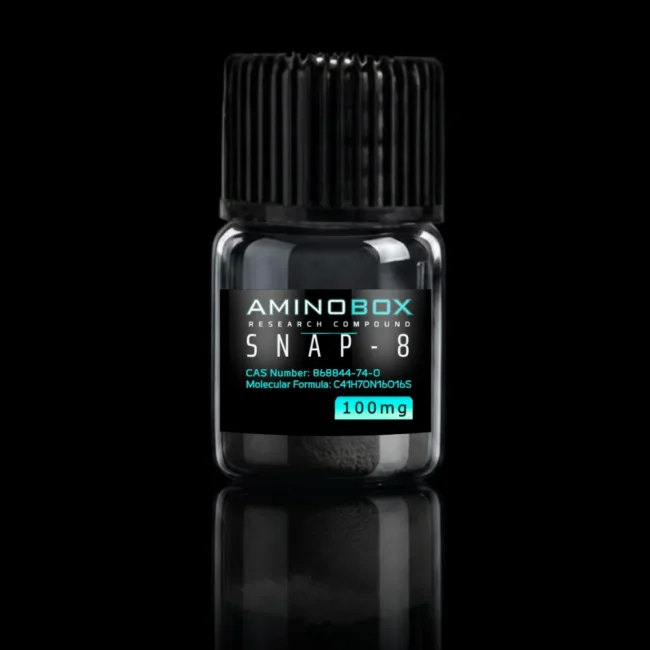

SNAP-8 | Acetyl Octapeptide-3


Acetyl Octapeptide-3 to reduce the appearance of repetitive facial tension associated with crow’s feet, forehead lines, glabellar folds, and perioral creasing.
$57.00
In stock
Guaranteed Safe Checkout


| Product Name | SNAP-8 | Acetyl Octapeptide-3 |
| Functional Class | Dermatics |
| Form | Lyophilized |
| Purity | 99%+ |
| Content | 5mg |
| Count | 1 vial |
| Research Use | Research Grade |
| CAS Number | See COA |
| Molecular Weight | See COA |
| Molecular Formula | See COA |
| PubChem CID | See COA |
| Appearance | White to off-white powder |
| Storage | 2-8C preferred |
Active Peptide 2 items
Excipients 4 items
Reconstitution Solvents 4 items
Buffer Systems 4 items
Lyoprotectants & Cryoprotectants 3 items
Preservatives & Antimicrobials 3 items
Counter Ions & Salt Forms 3 items
Chelating Agents 2 items
Antioxidants & Stabilizers 3 items
| Water | Highly soluble |
| Acidified Water | Highly soluble |
| DMSO | Highly soluble |
| Ethanol | Moderate |
| Lipid solvents | Poor compatibility |
| Lyophilized | 2–8°C preferred |
| Long-term | −20°C recommended |
| Light Sensitivity | Moderate |
| Moisture | High sensitivity |
| Stability | Stable when dry |
| Container | Sterile sealed vial |
AminoBox products are supplied for research, analytical, and laboratory use only. Product information is provided for educational and technical reference and does not constitute medical advice. Products are not intended to diagnose, treat, cure, or prevent any disease.
Product Composition
| Property | Specification |
|---|---|
| Product Name | Acetyl Octapeptide-3 |
| Alternate Names | SNAP-8, Acetyl Octapeptide-8 |
| Content Amount | 100 mg |
| Compound Class | Synthetic acetylated octapeptide |
| Physical Form | Lyophilized peptide powder |
| Appearance | White to off-white powder |
| Purity | Typically ≥98% (HPLC dependent) |
| Research Category | Cosmetic peptide / neuromodulatory peptide research |
| Primary Function | Expression-line and facial signaling peptide research |
Molecular Information
| Property | Specification |
| Molecular Formula | C41H70N16O16S |
| Molecular Weight | ~1075.16 g/mol |
| CAS Number | 868844-74-0 |
| PubChem CID | 86080331 |
| INCI Name | Acetyl Octapeptide-3 |
| Peptide Sequence | Ac-Glu-Glu-Met-Gln-Arg-Arg-Ala-Asp-NH2 |
| Sequence Abbreviation | EEMQRRAD |
| Compound Type | Acetylated signaling octapeptide |
| Structural Classification | SNAP-25 fragment analog |
Structural Classification
| Category | Description |
| Compound Type | Synthetic biomimetic octapeptide |
| Functional Class | Neuromodulatory cosmetic peptide |
| Biological Focus | Facial muscle signaling and expression line research |
| Mechanistic Focus | SNARE complex modulation |
| Chemical Family | Acetylated neuropeptide analogs |
| Structural Origin | Extended analog of Argireline (Acetyl Hexapeptide-8) |
Mechanism Research Profile
| Research Focus | Description |
| SNARE Complex Modulation | Studied for interaction with SNAP-25 signaling pathways |
| Neurotransmitter Release | Investigated for reduced vesicle fusion signaling |
| Expression Line Research | Explored for softening repetitive facial contraction patterns |
| Facial Tension Modulation | Cosmetic peptide research into localized neuromuscular activity |
| Topical Cosmetic Research | Commonly formulated into cosmetic serums and peptide creams |
| Biomimetic Activity | Mimics N-terminal SNAP-25 protein fragments |
Research Areas Commonly Associated
| Research Area | Focus |
| Cosmetic Peptide Research | Fine line and wrinkle appearance studies |
| Dermatological Research | Expression line modulation |
| Neurocosmetic Research | Neuromuscular signaling pathways |
| Peptide Delivery Research | Topical peptide transport systems |
| Anti-Aging Research | Dynamic wrinkle reduction research |
| Skin Science | Surface neuromodulation and peptide formulation |
Solubility Profile
| Solvent | Solubility |
| Water | Soluble |
| Sterile Water | Highly compatible |
| DMSO | Soluble |
| Ethanol | Limited stability |
| Glycols | Good compatibility |
| Lipid Systems | Moderate compatibility |
Storage Specifications
| Parameter | Recommendation |
| Short-Term Storage | 2–8°C |
| Long-Term Storage | -20°C preferred |
| Light Sensitivity | Moderate |
| Moisture Sensitivity | High |
| Stability | Stable in lyophilized form |
| Reconstituted Stability | Refrigerate after mixing |
| Container Type | Sealed amber peptide vial |
Technical Characteristics
| Feature | Notes |
| Delivery Format | Lyophilized peptide powder (100 mg) |
| Structural Advantage | Extended peptide chain compared to Argireline |
| Bioactivity Profile | Cosmetic neuromodulatory signaling peptide |
| Functional Target | SNAP-25 / SNARE-associated pathways |
| Topical Research Use | Commonly studied in cosmetic formulations |
| Stability Profile | Stable when protected from moisture and heat |
| Research Use | Laboratory and cosmetic research only |
Buy SNAP-8 (Acetyl Octapeptide-3)
Mechanism of Action
SNAP-8 was specifically designed to mimic a fragment of SNAP-25 (Synaptosomal-Associated Protein 25), a critical component of the SNARE protein complex involved in synaptic vesicle fusion and acetylcholine release at the neuromuscular junction.
Under normal physiological conditions, acetylcholine is released from presynaptic neurons through the coordinated assembly of SNARE proteins:
- SNAP-25
- Syntaxin
- VAMP/Synaptobrevin
This fusion process initiates muscular contraction, including the repeated micro-contractions responsible for expression wrinkles over time. SNAP-8 competitively interferes with SNARE complex assembly by mimicking portions of the SNAP-25 sequence, thereby attenuating neurotransmitter release involved in superficial facial muscle signaling.
The result is a gradual reduction in visible facial tension and dynamic wrinkle formation, producing a smoother and more relaxed skin appearance without inducing complete muscular paralysis associated with injectable neurotoxins.
Advanced Structural Engineering
Compared to traditional hexapeptide analogs, SNAP-8 incorporates two additional amino acids into its molecular architecture:
Ac-Glu-Glu-Met-Gln-Arg-Arg-Ala-Asp-NH2
This elongated sequence was engineered to improve binding affinity and increase competitive inhibition efficiency within the SNARE complex. Preclinical formulation research suggests enhanced catecholamine inhibition and improved wrinkle-softening potential compared to earlier-generation neurotransmitter-modulating peptides.
The peptide possesses a molecular weight of approximately 1075 Da and is commonly incorporated into advanced serums, emulsions, liposomal delivery systems, and peptide complexes targeting visible photoaging and repetitive-expression dermal stress.
Cosmetic Research Applications
SNAP-8 is extensively studied in cosmetic and dermatological formulation environments for its potential role in:
- Expression line reduction
- Forehead wrinkle softening
- Crow’s feet appearance improvement
- Periorbital smoothing systems
- Dynamic wrinkle modulation
- Advanced anti-aging peptide formulations
- Multi-peptide rejuvenation protocols
- Neuromodulatory cosmetic systems
Research literature and supplier-sponsored cosmetic studies have reported visible reductions in wrinkle depth and skin roughness following sustained topical application. Some formulation studies have demonstrated measurable improvements in expression-line appearance after approximately 28 days of consistent use.
Formulation Synergy
SNAP-8 is frequently combined with additional cosmetic actives to create comprehensive skin-rejuvenation systems. Common synergistic pairings include:
- Matrixyl® peptides
- Copper peptides (GHK-Cu)
- Hyaluronic acid
- Retinoid systems
- Acetyl Hexapeptide-8
- Growth factor complexes
- Barrier-repair lipids
- Biomimetic hydration technologies
Research discussions within cosmetic peptide communities suggest formulation quality, peptide concentration, and transdermal delivery systems significantly influence observable results.
Stability & Cosmetic Integration
SNAP-8 is typically utilized in water-based peptide serums, creams, gels, and microemulsion systems. Due to its peptide structure, formulation pH, preservative compatibility, and stabilization methodology are critical factors affecting peptide integrity and bioactivity.
Advanced encapsulation technologies such as liposomal delivery systems and nano-emulsions are frequently explored to improve dermal penetration and optimize topical performance.
Ingredient Specifications
Ingredient Name: Acetyl Octapeptide-3
Alternative Name: SNAP-8
Molecular Formula: C41H70N16O16S
Molecular Weight: 1075.16 g/mol
Peptide Length: 8 Amino Acids
Appearance: Lyophilized Powder
Research Category: Cosmetic Neuropeptide
Application Type: Topical Cosmetic Formulation Research Only
Important Disclaimer
This product is supplied strictly for cosmetic, laboratory, and research purposes only. Not intended to diagnose, treat, cure, or prevent any disease. Not for human consumption or injectable use. Cosmetic additive intended exclusively for formulation and research applications.
Reference Table
| Reference Source | Information Provided | Link |
| PubChem | Molecular formula, molecular weight, peptide sequence, identifiers | https://pubchem.ncbi.nlm.nih.gov/compound/Acetyl-octapeptide-3 |
| Peptide Protocol Wiki | Molecular structure and sequence analysis | https://www.peptideprotocolwiki.com/peptides/snap-8/molecule |
| PeptideInsight | SNAP-25 mechanism overview and peptide background | https://peptideinsight.com/peptides/snap-8 |
| GLPBase | Structural comparison with Argireline and cosmetic mechanism profile | https://glpbase.com/aesthetic-medicine/snap8/ |
| peptides.studio | Molecular identifiers and sequence notation | https://peptides.studio/snap-8 |
| PubChem Alternative Registry | Additional identifier and synonym references | https://pubchem.ncbi.nlm.nih.gov/compound/86080331 |