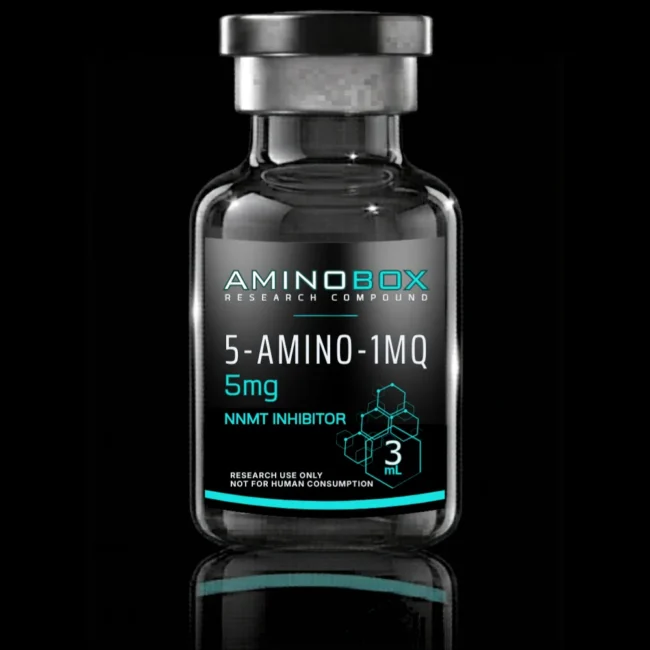
5-Amino-1MQ studies in cellular energy metabolism, sirtuin activation, and DNA repair pathway support.
$70.00
COLD-CHAIN LOGISTICS
LAB TESTED
ASSURED SHIPPING
BATCH CODING
In stock
Guaranteed Safe Checkout
By purchasing any products, you acknowledge and agree that all materials are supplied solely for scientific research, laboratory experimentation, or analytical purposes.
Form
Lyophilized
Molecular Formula
C10H11N2+
Molecular Weight
~159.21 g/mol
CAS Number
42464-96-0
PubChem CID
950107
Research Data
5-Amino-1MQ Decline
Intracellular pathway levels vs. age (% of peak)
Literature
Cellular Ratio
Biological Intersections
Relative pathway engagement
Activity Profile
5-Amino-1MQ Biochemical Profile
Mechanism
CellularPathway
01
Cellular Uptake & NNMT Binding
5-Amino-1MQ enters cells as a small cationic molecule and competitively inhibits NNMT, blocking nicotinamide methylation by SAMe.
02
NAD⁺ Precursor Preservation
By inhibiting NNMT-mediated nicotinamide clearance, 5-Amino-1MQ supports NAD+ salvage pathway availability and cellular NAD+ levels.
03
Methylation Economy & SAMe Sparing
Reducing NNMT activity conserves SAMe for cellular methylation processes, supporting epigenetic regulation and methyl group economy.
Metabolic Network
BiosynthesisMap
Sequence Analysis
Amino AcidSequences
Single-letter residue map colored by physicochemical property class. Hover any residue for full name and position.
Use this flexible comparison card for the product-specific relationship you want to show.
Product Data
CompoundIdentity
Product Name
5-Amino-1MQ
Functional Class
NNMT Inhibitor
Form
Lyophilized
Purity
99% +
Content
5mg
Count
1 vial
Research Use
For in vitro and laboratory research use only. Not for human consumption.
Specifications
TechnicalSpecs
CAS Number
42464-96-0
Molecular Weight
~159.21 g/mol
Molecular Formula
C10H11N2+
PubChem CID
950107
Appearance
White to off-white crystalline powder
Storage
2–8°C short-term / –20°C long-term
In Vitro Activity
NNMT InhibitionCurve
IC50 = 1 μM · Hill n = 1 · Assay model
Formulation Reference
Anatomy of aPeptide
A reference guide to the components of a lyophilized research peptide — from the active sequence to the excipients, solvents, buffers, and stabilizers used in formulation.
Active Peptide2 items
Synthetic Amino Acid Sequence
The primary chain of amino acids synthesized via solid-phase peptide synthesis (SPPS). Defined by sequence length and molecular weight.
Peptide Modifications
Acetylation (N-terminus), amidation (C-terminus), PEGylation, or cyclization applied to improve stability, receptor binding, or half-life.
Excipients4 items
Mannitol
Sugar alcohol bulking agent that forms an elegant lyophilized cake, aids reconstitution, and provides structural matrix during freeze-drying.
Trehalose
Non-reducing disaccharide that stabilizes peptide secondary structure by replacing water molecules through hydrogen bonding during dehydration.
Sucrose
Disaccharide used as a lyoprotectant and tonicity agent. Forms an amorphous glassy matrix that immobilizes the peptide and prevents aggregation.
Glycine
Amino acid bulking agent used in lyophilization. Crystallizes to provide mechanical strength to the freeze-dried cake structure.
💧Reconstitution Solvents4 items
Bacteriostatic Water (BAC Water)
Sterile water containing 0.9% benzyl alcohol as a preservative. Preferred for multi-dose vials — inhibits microbial growth after initial puncture.
Sterile Water for Injection
USP-grade water, pyrogen-free, without preservatives. Used for single-dose preparations or when benzyl alcohol sensitivity is a concern.
Acetic Acid Solution (0.1–1%)
Dilute acid used for peptides with poor aqueous solubility at neutral pH. Protonates basic residues to improve dissolution.
Sodium Chloride 0.9%
Isotonic saline diluent. Provides physiological osmolality (~308 mOsm/L) and can improve stability of certain charged peptides.
Buffer Systems4 items
Phosphate Buffered Saline (PBS)
Maintains pH 7.2–7.4. Composed of sodium phosphate dibasic, potassium phosphate monobasic, NaCl, and KCl. Mimics physiological ionic strength.
Acetate Buffer
Effective pH range 3.7–5.6. Composed of acetic acid and sodium acetate. Ideal for acidic peptides and those requiring lower pH for solubility.
Citrate Buffer
Effective pH range 3.0–6.2. Offers strong buffering capacity and metal-chelating properties. Used when oxidation-sensitive residues (Met, Cys) are present.
Histidine Buffer
Effective pH range 5.5–7.0. Low ionic strength, minimal interaction with peptides. Increasingly preferred in modern biopharmaceutical formulations.
Lyoprotectants & Cryoprotectants3 items
Trehalose / Sucrose (Lyoprotectant)
Protect peptide conformation during the drying phase of lyophilization by forming hydrogen bonds that substitute for water molecules around the peptide.
Glycerol (Cryoprotectant)
Polyol that depresses the freezing point and reduces ice crystal formation, preventing mechanical damage to peptide structure during freezing steps.
Polyethylene Glycol (PEG)
Hydrophilic polymer that provides steric stabilization, reduces aggregation, and can serve as both cryoprotectant and solubility enhancer.
Preservatives & Antimicrobials3 items
Benzyl Alcohol (0.9%)
Aromatic alcohol preservative in bacteriostatic water. Acts as antimicrobial agent by disrupting microbial cell membranes. Standard for multi-use vials.
Methyl / Propyl Parabens
Broad-spectrum antimicrobial preservatives effective against fungi and bacteria. Used in some peptide formulations where benzyl alcohol is incompatible.
Phenol (0.5%)
Bacteriostatic preservative used in certain injectable peptide formulations. Also acts as a conformational stabilizer for some peptide structures.
Counter Ions & Salt Forms3 items
Trifluoroacetate (TFA)
Most common counter ion from RP-HPLC purification. Forms TFA salt with basic residues (Lys, Arg, His). May affect bioassay results and cell toxicity.
Acetate
Milder alternative to TFA obtained via ion exchange. Lower cytotoxicity, preferred for cell-based research assays and in vivo studies.
Hydrochloride (HCl)
Chloride salt form, sometimes used for improved stability or specific solubility profiles. Common in pharmaceutical-grade peptide preparations.
🔗Chelating Agents2 items
EDTA (Disodium)
Chelates divalent metal ions (Cu²⁺, Fe²⁺, Zn²⁺) that catalyze oxidative degradation of methionine and cysteine residues in peptides.
Citric Acid
Natural chelator with moderate metal-binding capacity. Dual function as buffer component and oxidation inhibitor in peptide formulations.
Antioxidants & Stabilizers3 items
L-Methionine
Free methionine added as a sacrificial antioxidant. Preferentially oxidizes before methionine residues within the peptide chain.
Ascorbic Acid
Water-soluble antioxidant that scavenges reactive oxygen species. Used at low concentrations to prevent oxidative peptide degradation.
Polysorbate 20 / 80
Non-ionic surfactants that prevent surface adsorption and aggregation of peptides at air-liquid and container-liquid interfaces.
Preparation Tool
ReconstitutionCalculator
Enter your target working concentration to calculate the exact solvent volume needed for this vial.
mg
Solvent Volume Required
—
Recommended solvents
Bacteriostatic WaterSterile Water for InjectionAcetic Acid 0.1%Sodium Chloride 0.9%
AminoBox products are supplied for research, analytical, and laboratory use only. Product information is provided for educational and technical reference and does not constitute medical advice. Products are not intended to diagnose, treat, cure, or prevent any disease.
About This Data
Chart Explanation
What this chart is about
Research context
Research Outcome
Selective investigational NNMT inhibitor studied across cellular methylation, NAD+ metabolism, adipocyte energy regulation, and mitochondrial efficiency research.
5MG_VIAL LYOPHILIZED RESEARCH_USE_ONLY
Functional Class: NNMT inhibitor
Class:Quinolinium small molecule
TARGET: NNMT inhibition
PURITY: Typically ≥98%
STORAGE: 2–8°C preferred
PRODUCT COMPOSITION
Property
Specification
Product Name
5-Amino-1MQ
Alternate Names
5-Amino-1-methylquinolinium, NNMT inhibitor
Content
5mg
Package
Lyophilized vial format
Compound Class
Synthetic quinolinium-based small molecule
Physical Form
Lyophilized powder
Appearance
White to off-white crystalline powder
Research Cat.
Metabolic regulation / NNMT / NAD+
MOLECULAR DATA
Property
Specification
Formula
C10H11N2+ (halide salt)
Mol. Weight
~159.21 g/mol free base cation
CAS Number
42464-96-0
PubChem CID
950107
Compound Type
Quinolinium-derived small molecule
Stereochem.
Achiral
NNMT INHIBITOR OVERVIEW
5-Amino-1MQ is a selective investigational inhibitor of nicotinamide N-methyltransferase — an enzyme governing methylation balance, nicotinamide utilization, and cellular energy regulation.
Targets intracellular metabolic regulation over stimulant or thermogenic pathways.
WHAT IS NNMT?
Cytosolic enzyme transferring methyl groups from SAMe to nicotinamide, producing 1-methylnicotinamide.
Cellular methylation capacity
NAD+ precursor availability
Energy balance regulation
Adipocyte metabolic programming
MECHANISM PROFILE
Focus
Description
NNMT Inhibition
Reduces formation of 1-MNA
NAD+ Preservation
Limits nicotinamide clearance
Metabolic Reg.
Energy expenditure & adipose models
Mitochondrial
Supports NAD+-dependent pathways
Energy Balance
Metabolic flexibility models
SCIENTIFIC SIGNIFICANCE
Targets upstream metabolic regulatory systems rather than downstream stimulant or thermogenic pathways.
Intracellular metabolic programming
Methylation economy regulation
Adipocyte signaling pathways
Cellular energy homeostasis
NAD+ & ENERGY SYSTEMS
NNMT is closely linked to NAD+ biology through nicotinamide metabolism and salvage pathways.
Oxidative phosphorylation
Sirtuin enzyme activation
Mitochondrial biogenesis
Cellular redox balance
ADIPOSE RESEARCH
NNMT expression elevated in obesity and metabolic dysfunction models — a compelling target in adipose biology and energy metabolism research.
Fat cell energy expenditure
Adipogenesis regulation
Metabolic syndrome pathways
RESEARCH DOMAINS
Domain
Focus
Metabolic Biology
NAD+ salvage, energy flux
Epigenetics
Methylation landscape
Longevity
NAD+-dependent sirtuins
Endocrine
Insulin sensitivity models
STRUCTURAL CLASS
Category
Description
Compound Type
Methylquinolinium derivative
Functional Class
NNMT inhibitor
Bio. Focus
NAD+ salvage & energy metabolism
Chem. Family
Pyridinium/quinolinium cationic
SOLUBILITY PROFILE
Solvent
Solubility
Water
Highly soluble
Acidified Water
Highly soluble
DMSO
Highly soluble
Ethanol
Moderate
Lipid solvents
Poor compatibility
STORAGE SPECS
Parameter
Recommendation
Lyophilized
2–8°C preferred
Long-term
−20°C recommended
Light Sensitivity
Moderate
Moisture
High sensitivity
Stability
Stable when dry
Container
Sterile sealed vial
TECHNICAL NOTES
Feature
Notes
Delivery Format
Lyophilized powder, 5mg vial
Structural Adv.
Small cationic — efficient uptake
Bioactivity
NNMT inhibition & NAD+ modulation
Configuration
Synthetic quinolinium derivative
Stability
High stability when dry
Research Use
Laboratory research only
CATALOGUE PATHWAY
CATALOGUE › PEPTIDES › METABOLIC_REG
These products connect 5-Amino-1MQ to related metabolic, NAD+, and mitochondrial research systems.
NAD+ PATHWAY NAD+Related through NAD+ availability, cellular energy systems, and mitochondrial metabolism research.OPEN PRODUCT
METABOLIC SIGNALLING MOTS-CAdjacent research focus around mitochondrial signalling, metabolic flexibility, and energy regulation.OPEN PRODUCT
ENERGY EXPENDITURE SLU-PP-332Connected through metabolic research, energy expenditure models, and cellular performance pathways.OPEN PRODUCT
This product is supplied strictly for analytical and research purposes only. All statements reflect experimental and mechanistic research literature and do not constitute approved medical claims. Not intended to diagnose, treat, cure, or prevent any disease.