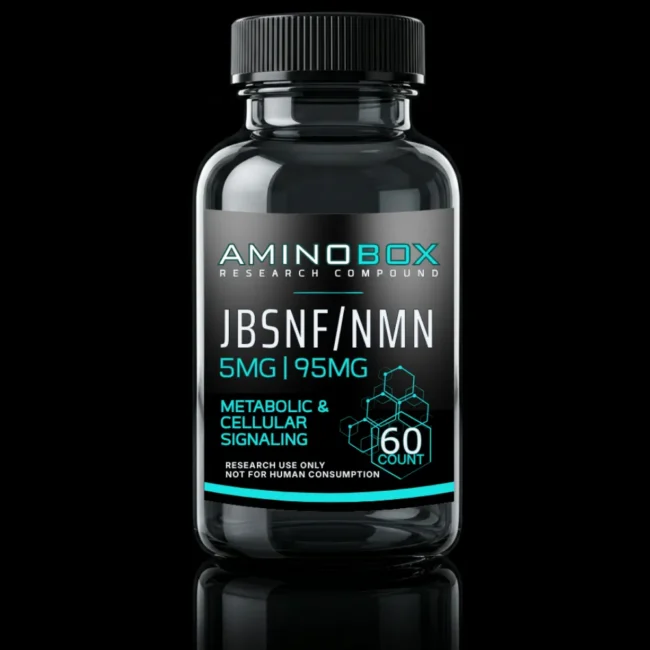
The addition of JBSNF — a proprietary adjunct research compound investigated for potential synergistic metabolic support mechanisms — positions this formulation within a growing category of experimental NAD⁺ optimization systems designed to explore broader mitochondrial and energetic signaling pathways.
Understanding NMN (β-Nicotinamide Mononucleotide)
NMN is a naturally occurring nucleotide intermediate involved in the NAD⁺ salvage pathway, the primary biological system responsible for maintaining intracellular NAD⁺ availability.
Chemically, NMN serves as a direct precursor molecule to NAD⁺ through enzymatic conversion mediated by nicotinamide phosphoribosyltransferase (NAMPT) and NMN adenylyltransferase (NMNAT) pathways. (cell.com)
NAD⁺ itself is one of the most fundamentally important molecules in cellular biology, participating directly in:
- Mitochondrial ATP production
- Oxidative phosphorylation
- Electron transport chain activity
- Cellular redox reactions
- DNA repair systems
- Sirtuin signaling pathways
- Metabolic stress adaptation
- Circadian rhythm regulation
Because NAD⁺ levels appear to decline progressively with aging, oxidative stress, metabolic dysfunction, and mitochondrial deterioration, compounds capable of supporting NAD⁺ biosynthesis have become major areas of scientific investigation within longevity and metabolic research communities. (nature.com)
The Central Role of NAD⁺ in Cellular Biology
To understand the scientific importance of NMN, it is necessary to appreciate the extraordinary breadth of biological systems dependent upon NAD⁺ availability.
NAD⁺ functions as a critical electron carrier within mitochondrial respiration, particularly during glycolysis, the Krebs cycle, and oxidative phosphorylation. During these reactions, NAD⁺ cycles between oxidized (NAD⁺) and reduced (NADH) states, enabling efficient transfer of electrons necessary for ATP generation.
Without adequate NAD⁺ availability:
- Mitochondrial efficiency declines
- ATP production becomes impaired
- Oxidative stress may increase
- DNA repair capacity may diminish
- Cellular resilience pathways become compromised
This relationship has positioned NAD⁺ biology at the center of modern aging and metabolic research. (nih.gov)
Sirtuins, Longevity & Metabolic Signaling
One of the most heavily researched aspects of NAD⁺ biology involves its interaction with sirtuins — a family of NAD⁺-dependent regulatory proteins involved in cellular adaptation and metabolic homeostasis.
Sirtuins are implicated in:
- Mitochondrial biogenesis
- Oxidative stress regulation
- Inflammatory signaling balance
- DNA repair pathways
- Cellular survival responses
- Metabolic flexibility
- Circadian rhythm synchronization
Because sirtuin activity is directly dependent upon NAD⁺ availability, researchers have become increasingly interested in whether NAD⁺ precursor compounds such as NMN may influence broader cellular resilience systems. (cell.com)
This relationship between NMN, NAD⁺ metabolism, and sirtuin activation remains one of the foundational scientific drivers behind the compound’s rapid emergence within longevity-focused research environments.
Mitochondrial Function & Energy Metabolism Research
Mitochondria are responsible for generating the majority of cellular ATP through oxidative metabolism. As organisms age, mitochondrial efficiency often declines due to cumulative oxidative damage, impaired biogenesis, and dysregulated energy signaling.
Research involving NMN has therefore focused heavily on pathways associated with:
- Mitochondrial respiration
- ATP generation efficiency
- Oxidative phosphorylation
- Cellular energy utilization
- Metabolic flexibility
- Redox homeostasis
- Cellular stress adaptation
Experimental investigations continue exploring how NAD⁺ precursor availability may influence these systems across multiple tissue types. (nature.com)
Age-Associated NAD⁺ Decline
One of the most significant discoveries within longevity research over the past two decades has been the observation that NAD⁺ levels appear to decline progressively during aging.
Several mechanisms may contribute to this decline, including:
- Increased CD38 enzyme activity
- Chronic inflammatory stress
- Oxidative cellular damage
- Impaired NAMPT activity
- Mitochondrial dysfunction
- DNA repair-associated NAD⁺ consumption
Because NAD⁺ participates in such a wide range of cellular processes, reductions in NAD⁺ availability may theoretically influence systemic metabolic resilience and mitochondrial performance. (nih.gov)
Research involving NMN and related NAD⁺ precursors is therefore largely centered around understanding whether restoration of intracellular NAD⁺ pools may influence broader energetic and cellular signaling pathways.
JBSNF: Adjunct Research Compound
JBSNF-000088 is a research-grade small molecule investigated for its role in modulating nicotinamide N-methyltransferase (NNMT), an enzyme involved in cellular energy metabolism and metabolic signaling pathways.
Preclinical research has explored NNMT inhibition for its potential relationship to:
• NAD+ metabolic regulation
• Mitochondrial energy utilization
• Glucose and lipid metabolism
• Cellular nutrient-sensing pathways
• Metabolic efficiency and adaptive signaling
Within experimental formulations, JBSNF-000088 is commonly studied alongside compounds associated with longevity biology, metabolic optimization, and cellular energy research frameworks.
Current literature surrounding NNMT modulation remains actively evolving, and ongoing research continues to investigate the broader implications of these pathways in metabolic and age-related biological systems.
Oral Delivery & Bioavailability Considerations
NMN is generally studied as an orally administered NAD⁺ precursor due to its relatively favorable gastrointestinal survivability compared to larger peptide molecules.
Current research discussions investigate several possible absorption and utilization mechanisms, including:
- Direct intestinal absorption
- Extracellular conversion pathways
- Slc12a8 transporter involvement
- Systemic nicotinamide salvage pathway integration
However, important questions regarding optimal dosing, tissue distribution, pharmacokinetics, and long-term metabolic effects remain areas of ongoing investigation. (cell.com)
Research Community Interest
Within metabolic and longevity-focused research communities, NMN formulations are frequently discussed alongside topics involving:
- Mitochondrial optimization
- NAD⁺ restoration pathways
- Sirtuin activation research
- Cellular resilience signaling
- Bioenergetic efficiency
- Healthy aging models
- Metabolic adaptation systems
- Redox biology
Interest in NAD⁺ precursor science has expanded dramatically as researchers continue investigating the relationship between mitochondrial function, cellular aging, and systemic metabolic health. (reddit.com)
Important Research Disclaimer
This product is supplied strictly for laboratory, analytical, and research purposes only. Not intended to diagnose, treat, cure, or prevent any disease. Not approved for human consumption. NMN and associated investigational metabolic compounds remain areas of ongoing scientific study, and many proposed mechanisms continue to be explored within preclinical and early-stage human research environments.