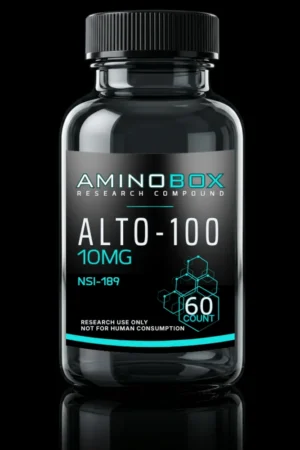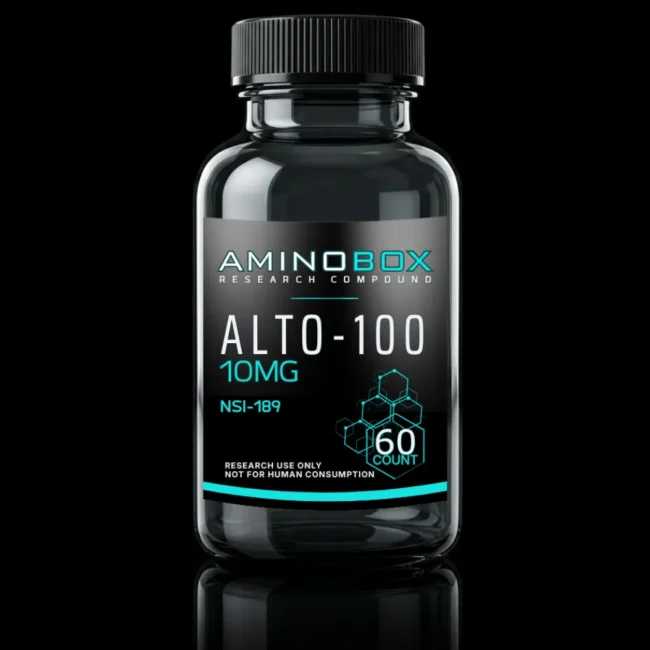

ALTO-100 | NSI-189


NSI-189 phosphate is a neurogenic signalling pathway within the central nervous system and neuroplasticity and neuronal metabolic regulation.
$67.00
In stock
Guaranteed Safe Checkout


| Product Name | ALTO-100 | NSI-189 |
| Functional Class | Synaptics |
| Form | Lyophilized |
| Purity | 99%+ |
| Content | 5mg |
| Count | 1 capsule |
| Research Use | Research Grade |
| CAS Number | See COA |
| Molecular Weight | See COA |
| Molecular Formula | See COA |
| PubChem CID | See COA |
| Appearance | White to off-white powder |
| Storage | 2-8C preferred |
| Water | Highly soluble |
| Acidified Water | Highly soluble |
| DMSO | Highly soluble |
| Ethanol | Moderate |
| Lipid solvents | Poor compatibility |
| Lyophilized | 2–8°C preferred |
| Long-term | −20°C recommended |
| Light Sensitivity | Moderate |
| Moisture | High sensitivity |
| Stability | Stable when dry |
| Container | Sterile sealed vial |
AminoBox products are supplied for research, analytical, and laboratory use only. Product information is provided for educational and technical reference and does not constitute medical advice. Products are not intended to diagnose, treat, cure, or prevent any disease.
Product Composition
| Property | Specification |
|---|---|
| Product Name | ALTO-100 |
| Alternate Names | NSI-189, NSI-189 Phosphate, Amdiglurax |
| Peptide Content | 10mg |
| Package Size | 60 capsules |
| Compound Class | Synthetic neurogenic small-molecule (benzylpiperazine-aminopyridine derivative) |
| Physical Form | Lyophilized powder / solid (research format dependent) |
| Appearance | White to off-white powder |
| Purity | Typically ≥98% |
| Research Category | Neurogenesis / antidepressant pathway research compound |
Molecular Information
| Property | Specification |
|---|---|
| Molecular Formula (phosphate salt) | C22H30N4O · H3O4P |
| Molecular Weight (phosphate) | ~464.5 g/mol |
| CAS Number | 1270138-41-4 (phosphate) |
| PubChem CID | 50922681 |
| UNII | YVE9U408ZL |
| Compound Type | Small-molecule neurogenic agent |
| Stereochemistry | Achiral |
Structural Classification
| Category | Description |
|---|---|
| Compound Type | Benzylpiperazine-aminopyridine derivative |
| Functional Class | Neurogenic / synaptic plasticity modulator |
| Biological Focus | Hippocampal neurogenesis & BDNF signaling pathways |
| Mechanistic Focus | Neuroplasticity and neuronal growth signaling |
| Chemical Family | CNS-active small molecule (non-peptide) |
Mechanism Research Profile
| Research Focus | Description |
|---|---|
| Neurogenesis | Studied for stimulation of hippocampal neural progenitor proliferation |
| BDNF Modulation | Associated with increased brain-derived neurotrophic factor expression |
| Synaptic Plasticity | Investigated for enhancement of neuronal connectivity and remodeling |
| Antidepressant Pathways | Evaluated as monoamine-independent antidepressant mechanism |
| Cognitive Function | Explored for effects on learning and memory performance models |
Research Areas Commonly Associated
| Research Area | Focus |
|---|---|
| Neuropsychiatric Research | Depression & PTSD modeling |
| Cognitive Enhancement Research | Learning and memory pathways |
| Neuroregeneration | Hippocampal structural plasticity |
| Brain Injury Research | Stroke and neuronal recovery models |
| Precision Psychiatry | Biomarker-guided antidepressant response studies |
Solubility Profile
| Solvent | Solubility |
|---|---|
| DMSO | Highly soluble |
| Sterile Water | Moderately soluble (varies by salt form) |
| Bacteriostatic Water | Compatible for dilution (research context) |
| PEG-based solvents | Compatible in formulation systems |
| Saline | Limited solubility without co-solvents |
Storage Specifications
| Parameter | Recommendation |
|---|---|
| Lyophilized Storage | -20°C preferred |
| Reconstituted Storage | 2–8°C refrigerated |
| Light Sensitivity | Moderate |
| Moisture Sensitivity | High |
| Stability | Stable in dry form for extended periods |
| Container Type | Sterile sealed vial |
Technical Characteristics
| Feature | Notes |
|---|---|
| Delivery Format | Lyophilized powder (10mg per unit, 60-count pack format) |
| Structural Advantage | Small-molecule CNS penetration capability |
| Configuration | Non-peptide synthetic neurogenic compound |
| Stability Profile | High chemical stability under dry conditions |
| Research Use | Laboratory research only |
ALTO-100 | NSI-189 Phosphate | 10mg
NSI-189 was developed within a pharmaceutical research framework exploring compounds capable of influencing neuronal growth, synaptic remodeling, and brain-derived neurotrophic signaling environments. It has since been studied in both preclinical models and early-phase human trials, primarily in the context of neuropsychiatric research.
ALTO-100 is classified as an experimental research compound, and while it has undergone limited clinical evaluation, its mechanism of action is not fully established and its therapeutic efficacy remains under scientific investigation.
Mechanistic Research Context
NSI-189 has been studied primarily in relation to neurogenic and neurotrophic signaling systems, particularly within hippocampal brain regions associated with memory formation, mood regulation, and cognitive processing.
Preclinical research has investigated its potential involvement in:
1. Hippocampal Neurogenesis Pathways
The hippocampus is a brain region associated with:
- Learning and memory formation
- Emotional regulation
- Cognitive flexibility
Experimental models suggest NSI-189 may influence cellular environments associated with neuronal growth and structural plasticity in this region, although the precise mechanism remains under investigation.
2. Neurotrophic Signaling Systems
Research interest in NSI-189 has focused on its relationship to:
- Brain-derived neurotrophic factor (BDNF) pathways (indirect association in models)
- Neuronal survival signaling
- Synaptic remodeling and plasticity
- Cellular stress adaptation in neural tissue
These pathways are central to modern neurobiology and are widely studied in relation to brain resilience and adaptation mechanisms.
3. Mitochondrial & Cellular Energy Research
Some experimental findings have suggested potential links between NSI-189 and:
- Neuronal mitochondrial function
- Cellular energy metabolism in brain tissue
- Oxidative stress response modulation
These observations are preliminary and remain part of ongoing mechanistic research.
Clinical Research Context
NSI-189 (ALTO-100) has undergone limited early-phase human studies, including Phase 1 and Phase 1B clinical trials evaluating:
- Safety and tolerability
- Pharmacokinetic behavior
- Preliminary mood and cognitive outcome measures
While some early findings suggested potential neuropsychiatric effects, later studies produced mixed or inconclusive efficacy results, and no definitive clinical application has been established.
As such, NSI-189 remains an investigational compound under continued scientific evaluation, rather than an approved therapeutic agent.
Theoretical Cognitive Research Interest
Based on its investigational profile and preclinical data, NSI-189 is frequently discussed in relation to:
- Cognitive function and memory processing pathways (experimental models)
- Neuroplasticity and synaptic adaptation systems (preclinical research)
- Mood regulation circuitry in the hippocampal-prefrontal axis (early clinical hypotheses)
- Brain energy metabolism and neuronal resilience (mechanistic exploration)
These associations are research-based hypotheses, not confirmed functional outcomes.
Research Status & Limitations
Important scientific limitations include:
- Mechanism of action not fully characterized
- Limited and mixed clinical trial outcomes
- No approved medical indication
- Insufficient long-term human data
- Ongoing investigation into neurogenic claims
Therefore, ALTO-100 (NSI-189) is best classified as a neuroplasticity-associated investigational research compound.
Important Notice
This product is supplied strictly for laboratory research, analytical use, and scientific investigation purposes only. It is not intended for human consumption, medical use, or therapeutic application.
ALTO-100 (NSI-189) is an investigational compound with limited and mixed clinical data, and all information provided reflects experimental research contexts rather than confirmed clinical outcomes.
Scientific References – ALTO-100 (NSI-189)
| Ref # | Title | Journal | Focus | Link |
|---|---|---|---|---|
| 1 | Enhancement of Mitochondrial Function by NSI-189 Accompanies Reversal of Neuropathy and Memory Impairment | Journal of Diabetes Research | Mitochondrial activity, cognitive function in animal models | https://pubmed.ncbi.nlm.nih.gov/31431552/ |
| 2 | Amelioration of Central and Peripheral Neuropathy by NSI-189 in Mouse Models of Diabetes | Diabetes (American Diabetes Association) | Neuroprotection, nerve function, metabolic brain effects | https://pubmed.ncbi.nlm.nih.gov/30459284/ |
| 3 | A Phase 1B Randomized Controlled Study of NSI-189 Phosphate in Major Depressive Disorder | Molecular Psychiatry | Human clinical safety, mood effects, cognition outcomes | https://pubmed.ncbi.nlm.nih.gov/27428075/ |
| 4 | Hippocampal Neurogenesis and Structural Plasticity in Adult Brain Function | Nature Reviews Neuroscience | Neurogenesis mechanisms relevant to NSI-189 research | https://pubmed.ncbi.nlm.nih.gov/18368048/ |
| 5 | Adult Hippocampal Neurogenesis in Depression and Antidepressant Response | Nature Medicine | Brain plasticity, depression models, cognitive effects | https://pubmed.ncbi.nlm.nih.gov/21297682/ |
| 6 | Neurotrophic mechanisms in psychiatric drug development | Nature Reviews Drug Discovery | BDNF pathways, neuroplasticity drug frameworks | https://pubmed.ncbi.nlm.nih.gov/25209910/ |