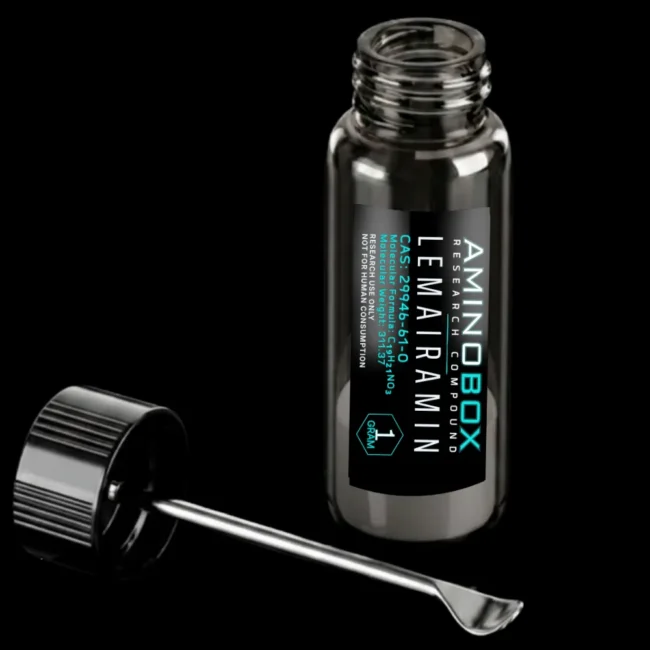

WGX-50 | Lemairamin


WGX-50 (Lemairamin) is a next-generation Advanced Neuro-Cosmetic. Known for neuroinflammation modulation, skin–brain axis research, and cellular aging pathways.
$82.00
In stock
Guaranteed Safe Checkout


| Product Name | WGX-50 | Lemairamin |
| Functional Class | Synaptics |
| Form | Lyophilized |
| Purity | 99%+ |
| Content | 5mg |
| Count | 1 mg |
| Research Use | Research Grade |
| CAS Number | See COA |
| Molecular Weight | See COA |
| Molecular Formula | See COA |
| PubChem CID | See COA |
| Appearance | White to off-white powder |
| Storage | 2-8C preferred |
| Water | Highly soluble |
| Acidified Water | Highly soluble |
| DMSO | Highly soluble |
| Ethanol | Moderate |
| Lipid solvents | Poor compatibility |
| Lyophilized | 2–8°C preferred |
| Long-term | −20°C recommended |
| Light Sensitivity | Moderate |
| Moisture | High sensitivity |
| Stability | Stable when dry |
| Container | Sterile sealed vial |
AminoBox products are supplied for research, analytical, and laboratory use only. Product information is provided for educational and technical reference and does not constitute medical advice. Products are not intended to diagnose, treat, cure, or prevent any disease.
Product Composition
| Property | Specification |
|---|---|
| Product Name | WGX-50 (Lemairamin) |
| Alternate Names | Lemairamin, WGX-50, cinnamoyl homoveratrylamine |
| Capsule Content | 1g (bulk research grade) |
| Package Size | 1 gram |
| Compound Class | Natural/semisynthetic aromatic amide alkaloid |
| Physical Form | White to off-white powder |
| Appearance | Fine crystalline powder |
| Purity | Typically ≥98% (HPLC grade reported) |
| Research Category | Neuroinflammatory / analgesic / longevity signaling research compound |
Molecular Information
| Property | Specification |
|---|---|
| Molecular Formula | C19H21NO3 |
| Molecular Weight | ~311.38 g/mol |
| CAS Number | 29946-61-0 |
| Secondary CAS | 56361-03-6 |
| PubChem CID | Limited/variable registry indexing |
| Compound Type | Aromatic amide alkaloid derivative |
| Stereochemistry | Achiral (no defined stereocenters in core structure) |
Structural Classification
| Category | Description |
|---|---|
| Compound Type | Zanthoxylum-derived aromatic amide |
| Functional Class | α7 nicotinic acetylcholine receptor (α7nAChR) modulator (reported) |
| Biological Focus | Neuroinflammation & pain signaling pathways |
| Mechanistic Focus | Cholinergic anti-inflammatory signaling modulation |
| Chemical Family | Amide-linked phenethyl aromatic compound |
Mechanism Research Profile
| Research Focus | Description |
|---|---|
| α7nAChR Activity | Reported agonist/modulator activity influencing cholinergic anti-inflammatory signaling |
| Pain Modulation | Studied in animal models for reducing nociceptive signaling |
| Neuroinflammation | Investigated for effects on inflammatory cytokine pathways in CNS models |
| Immune Signaling | Explored in IL-10 / inflammatory cascade regulation models |
| Amyloid / Neurodegeneration Models | Studied in Alzheimer’s-related preclinical pathways (Aβ-related signaling) |
Research Areas Commonly Associated
| Research Area | Focus |
|---|---|
| Neuroinflammation Research | CNS inflammatory signaling pathways |
| Pain Biology | Chronic and neuropathic pain models |
| Alzheimer’s Research Models | Amyloid and neuronal protection pathways |
| Immune Modulation | Cytokine and inflammatory regulation |
| Gut-Brain Axis Research | Inflammatory bowel disease models |
Solubility Profile
| Solvent | Solubility |
|---|---|
| DMSO | Highly soluble |
| Ethanol | Moderately soluble |
| Sterile Water | Poor to low solubility |
| Bacteriostatic Water | Limited compatibility |
| Organic solvents | Generally compatible |
Storage Specifications
| Parameter | Recommendation |
|---|---|
| Bulk Storage | 15–25°C (dry, sealed environment) |
| Long-term Storage | 2–8°C recommended |
| Light Sensitivity | Moderate |
| Moisture Sensitivity | High |
| Stability | Stable in dry powdered form |
| Container Type | Airtight amber vial or sealed container |
Technical Characteristics
| Feature | Notes |
|---|---|
| Delivery Format | Bulk powder (1g research quantity) |
| Structural Advantage | Lipophilic aromatic amide backbone supports CNS activity in models |
| Configuration | Natural plant-derived alkaloid derivative (Zanthoxylum species origin) |
| Stability Profile | High stability in dry crystalline form |
| Research Use | Laboratory research only |
WGX-50 | Lemairamin
Unlike conventional cosmetic actives, WGX-50 is designed as a dual-function neuroactive and dermal signaling compound, targeting interconnected pathways involved in inflammatory regulation, neuronal stress response, and skin structural integrity.
Its primary mechanism of interest involves modulation of α7 nicotinic acetylcholine receptor (α7nAChR) signaling pathways, which are widely studied in both neurodegenerative research and systemic inflammation control.
WGX-50 is a synthetically refined compound, engineered for high purity, structural consistency, and reproducible research applications.
Mechanism of Action (Research Framework)
WGX-50 is primarily studied through its interaction with cholinergic anti-inflammatory signaling systems, particularly the α7 nicotinic acetylcholine receptor (α7nAChR).
This receptor is a critical node in the cholinergic anti-inflammatory pathway, which regulates immune signaling, cytokine release, and neuronal stress responses.
1. α7nAChR Agonist Activity (Neuroinflammatory Regulation)
Preclinical research suggests that activation of α7nAChR may:
- Downregulate pro-inflammatory cytokine signaling
- Modulate microglial activation in neural tissue models
- Support neuronal resilience under inflammatory stress conditions
- Regulate immune–neural communication pathways
WGX-50 is investigated for its potential to engage these pathways as a selective receptor agonist in experimental models.
2. Neuroinflammation & Neuroprotection Research Context
Neuroinflammation is a central mechanism in cognitive decline and neurodegenerative disease models.
WGX-50 has been studied in preclinical frameworks for:
- Reduction of Aβ-induced neuronal stress signaling
- Inhibition of apoptosis pathways triggered by amyloid toxicity (cell models)
- Modulation of intracellular calcium dysregulation
- Support of neuronal survival pathways under inflammatory conditions
These findings are currently limited to laboratory and preclinical models, and have not been validated as clinical outcomes.
3. Skin–Brain Axis & Dermal Inflammatory Signaling
Emerging research in the skin–brain axis suggests that neuroinflammatory signaling pathways can influence dermal structure, inflammation, and aging-related changes.
WGX-50 is of interest in this context due to its potential to:
- Reduce inflammatory signaling cascades that contribute to dermal aging
- Support improved skin barrier homeostasis under stress conditions
- Modulate oxidative-inflammatory pathways linked to wrinkle formation
- Influence cellular communication between neural and dermal systems
Key Functional Research Domains
Anti-Aging & Cellular Integrity Research
WGX-50 is investigated for its potential role in:
- Reducing oxidative-inflammatory stress markers associated with aging
- Supporting extracellular matrix stability in dermal models
- Modulating cellular resilience pathways in neurocutaneous systems
These mechanisms are considered experimental and pathway-based, not clinically validated cosmetic outcomes.
Cognitive & Neurobiological Research Interest
In neuroscience research contexts, WGX-50 is associated with:
- Modulation of cholinergic signaling pathways
- Neuroinflammation reduction in preclinical models
- Protection against amyloid-induced neuronal toxicity (cellular models)
- Support of calcium homeostasis in stressed neurons
- Investigation of synaptic stability under inflammatory conditions
These findings are derived from experimental research environments, not human cognitive enhancement trials.
Anti-Inflammatory System Modulation
WGX-50’s primary scientific interest lies in its ability to influence inflammatory signaling networks, including:
- Cytokine regulation pathways
- Immune–neural interface modulation
- Oxidative stress response balancing
- Microglial activation pathways in CNS models
Synthetic Precision & Research Consistency
WGX-50 is produced as a fully synthetic, structurally controlled compound, ensuring:
- High batch-to-batch consistency
- Elimination of botanical variability
- Defined molecular structure for reproducible research outcomes
- Controlled purity for laboratory applications
This distinguishes it from crude plant extracts or variable natural preparations.
Research Applications
WGX-50 is currently explored in scientific contexts involving:
- Neuroinflammation and cholinergic signaling research
- Alzheimer’s disease pathway modeling (preclinical)
- Skin aging and dermal inflammation studies
- Oxidative stress and cellular resilience pathways
- Calcium toxicity and neuronal survival models
- Skin–brain axis biological research
Important Notice
This product is supplied strictly for laboratory research, analytical use, and scientific investigation purposes only. It is not intended for human consumption, medical use, or therapeutic application.
WGX-50 (Lemairamin) is an experimental research compound with preclinical mechanistic data only, and all described effects relate to laboratory and theoretical models rather than confirmed clinical or cosmetic outcomes.
Scientific References – WGX-50 (Lemairamin Context)
| Ref # | Title | Journal | Focus | Link |
|---|---|---|---|---|
| 1 | The cholinergic anti-inflammatory pathway: a link between the nervous system and immunity | Nature Reviews Immunology | α7nAChR-mediated inflammatory regulation | https://pubmed.ncbi.nlm.nih.gov/14647384/ |
| 2 | Alpha7 nicotinic acetylcholine receptor as a therapeutic target in inflammation | British Journal of Pharmacology | α7nAChR agonism and cytokine suppression | https://pubmed.ncbi.nlm.nih.gov/23194403/ |
| 3 | Nicotinic acetylcholine receptors in the regulation of inflammation | Journal of Neuroimmune Pharmacology | Neuroimmune signaling via cholinergic pathways | https://pubmed.ncbi.nlm.nih.gov/19816755/ |
| 4 | Neuroinflammation in Alzheimer’s disease: mechanisms and therapeutic implications | Nature Reviews Neurology | Aβ toxicity, neurodegeneration pathways | https://pubmed.ncbi.nlm.nih.gov/29184254/ |
| 5 | Calcium dysregulation and neuronal cell death in neurodegenerative disease | Nature Reviews Neuroscience | Calcium toxicity + neuronal apoptosis mechanisms | https://pubmed.ncbi.nlm.nih.gov/24503563/ |
| 6 | The skin-brain axis: stress, inflammation and skin aging | Trends in Immunology | Neurocutaneous signaling + skin inflammation link | https://pubmed.ncbi.nlm.nih.gov/32810422/ |
| 7 | Neuroimmune regulation of skin inflammation and barrier function | Journal of Investigative Dermatology | Skin inflammation + neural signaling interaction | https://pubmed.ncbi.nlm.nih.gov/30337491/ |