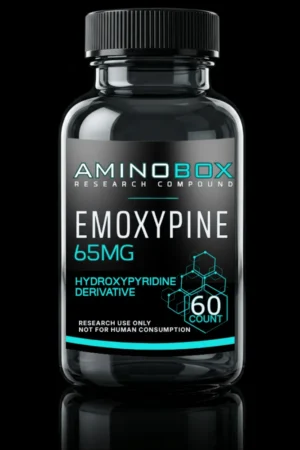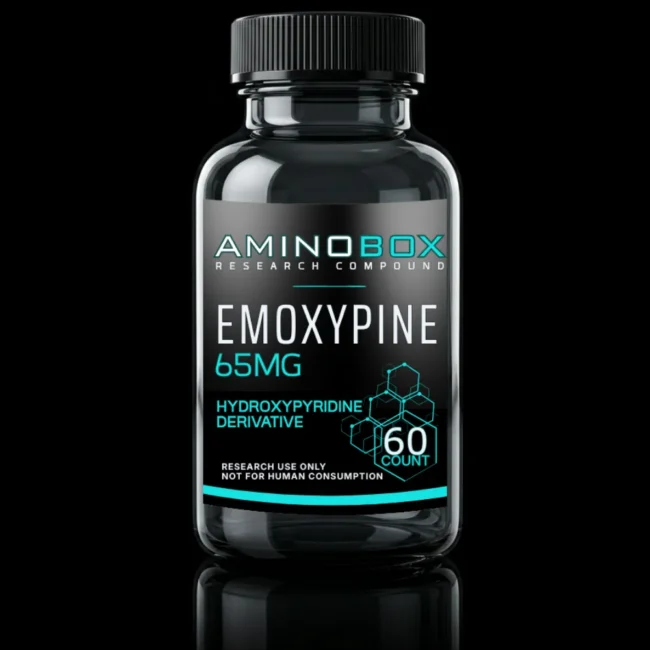

Emoxypine


Emoxypine studied for its antioxidant, membrane-stabilizing, and stress-adaptive biochemical properties in experimental and clinical research contexts.
$64.00
In stock
Guaranteed Safe Checkout


| Product Name | Emoxypine | Mexidol |
| Functional Class | Synthetics |
| Form | Lyophilized |
| Purity | 99%+ |
| Content | 5mg |
| Count | 1 capsule |
| Research Use | Research Grade |
| CAS Number | See COA |
| Molecular Weight | See COA |
| Molecular Formula | See COA |
| PubChem CID | See COA |
| Appearance | White to off-white powder |
| Storage | 2-8C preferred |
| Water | Highly soluble |
| Acidified Water | Highly soluble |
| DMSO | Highly soluble |
| Ethanol | Moderate |
| Lipid solvents | Poor compatibility |
| Lyophilized | 2–8°C preferred |
| Long-term | −20°C recommended |
| Light Sensitivity | Moderate |
| Moisture | High sensitivity |
| Stability | Stable when dry |
| Container | Sterile sealed vial |
AminoBox products are supplied for research, analytical, and laboratory use only. Product information is provided for educational and technical reference and does not constitute medical advice. Products are not intended to diagnose, treat, cure, or prevent any disease.
Product Composition
| Property | Specification |
|---|---|
| Product Name | Emoxypine |
| Alternate Names | Mexidol, Emoxipine, 2-Ethyl-6-methyl-3-hydroxypyridine |
| Capsule Content | 65mg |
| Package Size | 60 Capsules |
| Compound Class | Synthetic 3-hydroxypyridine derivative |
| Physical Form | Encapsulated powder |
| Appearance | White to off-white powder (capsule fill) |
| Purity | Typically ≥98% (research/grade dependent) |
| Research Category | Antioxidant / neuroprotective / membrane stabilizer compound |
Molecular Information
| Property | Specification |
|---|---|
| Molecular Formula | C8H11NO |
| Molecular Weight | ~137.18 g/mol |
| CAS Number | 2364-75-2 |
| PubChem CID | 114681 |
| UNII | V247P5H4E1 |
| Compound Type | Hydroxypyridine derivative |
| Stereochemistry | Achiral |
Structural Classification
| Category | Description |
|---|---|
| Compound Type | 3-hydroxypyridine derivative |
| Functional Class | Antioxidant / membrane-protective agent |
| Biological Focus | Cellular oxidative stress regulation |
| Mechanistic Focus | Lipid peroxidation inhibition & membrane stabilization |
| Chemical Family | Pyridine-based antioxidant compound |
Mechanism Research Profile
| Research Focus | Description |
|---|---|
| Antioxidant Activity | Inhibits lipid peroxidation in cellular membranes |
| Membrane Protection | Stabilizes lipid bilayers and improves membrane fluidity |
| Neurochemical Modulation | Reported modulation of neurotransmitter systems including dopamine and GABA pathways |
| Stress Response | Studied in hypoxia and oxidative stress adaptation models |
| Cellular Protection | Investigated in ischemia and inflammation-related injury models |
Research Areas Commonly Associated
| Research Area | Focus |
|---|---|
| Neuroprotection | Oxidative stress in CNS tissue |
| Cardiovascular Research | Ischemia and membrane stability |
| Anti-stress Biology | Hypoxia and stress-response adaptation |
| Mitochondrial Function | Cellular energy and oxidative balance |
| Membrane Biochemistry | Lipid peroxidation and structural integrity |
Solubility Profile
| Solvent | Solubility |
|---|---|
| Sterile Water | Highly soluble |
| Bacteriostatic Water | Compatible |
| DMSO | Highly soluble |
| Ethanol | Moderately soluble |
| Lipid-based solvents | Limited compatibility |
Storage Specifications
| Parameter | Recommendation |
|---|---|
| Capsule Storage | 15–25°C (cool, dry place) |
| Long-term Storage | 2–8°C recommended |
| Light Sensitivity | Moderate |
| Moisture Sensitivity | High |
| Stability | Stable in dry encapsulated form |
| Container Type | Sealed opaque capsule bottle |
Technical Characteristics
| Feature | Notes |
|---|---|
| Delivery Format | Encapsulated powder (65mg per capsule, 60-count bottle) |
| Structural Advantage | Small pyridine-based molecule with high membrane permeability |
| Configuration | Synthetic antioxidant compound |
| Stability Profile | High stability in dry form |
| Research Use | Laboratory research only |
Unlike many modern investigational nootropics, Emoxypine has a documented history of use in certain countries’ clinical practice (notably Russia and parts of Eastern Europe), where it has been investigated in neurological, psychiatric, and vascular research settings. However, its global regulatory recognition and large-scale Western clinical validation remain limited.
Emoxypine is best classified as a redox-active neuro-metabolic research compound with anxiolytic and neurovascular research interest, rather than a directly acting neurotransmitter stimulant or classical nootropic.
Research Compound Overview
Emoxypine, also known as Mexidol, is a synthetic 3-hydroxypyridine derivative structurally related to antioxidant and membrane-stabilizing compounds studied in neurovascular and metabolic research.
It has been extensively investigated in Eastern European pharmacological literature for its role in oxidative stress modulation, lipid membrane stabilization, and cellular adaptation to hypoxic or metabolic stress conditions.
In modern research contexts, Emoxypine is increasingly explored not only in neurovascular science but also in skin physiology and oxidative aging pathways, due to its strong interaction with lipid peroxidation and cellular redox systems.
Potential Benefits of Emoxypine (Research Context)
Emoxypine is widely recognized in scientific literature for its multi-level antioxidant and membrane-protective activity, which has led to growing interest in dermatological and cellular aging research.
Antioxidant Protection (Cellular Oxidative Defense)
Emoxypine is studied for its ability to reduce oxidative stress by limiting lipid peroxidation in biological membranes. In skin-related research models, oxidative stress is a key driver of premature aging, collagen breakdown, and structural degradation.
This mechanism is associated with:
- Protection against reactive oxygen species (ROS)
- Preservation of lipid membrane integrity
- Reduction of oxidative cellular damage signals
Anti-Inflammatory & Stress Modulation (Research Models)
Emoxypine has demonstrated modulatory effects on inflammatory and stress-response pathways in experimental models.
Research suggests potential involvement in:
- Reduction of oxidative-inflammatory signaling cascades
- Improved cellular adaptation under environmental stress
- Modulation of stress-induced lipid damage pathways
This has made it a compound of interest in skin sensitivity and barrier stress research environments.
Enhanced Skin Barrier Function (Dermal Research Context)
One of the most important biological roles of lipid membranes is maintaining barrier integrity. Emoxypine’s influence on lipid oxidation pathways has led researchers to explore its potential role in:
- Supporting membrane lipid stability
- Reducing lipid degradation in stressed tissues
- Enhancing resilience of cellular barrier structures
In dermatological research contexts, this is associated with improved barrier function performance under oxidative stress conditions.
Skin Brightening & Tone Evenness (Indirect Mechanistic Link)
While not a direct pigmentation regulator, Emoxypine’s antioxidant and anti-inflammatory properties are hypothesized to indirectly support:
- Reduction in oxidative pigmentation triggers
- Decreased inflammation-related discoloration
- Improved overall skin tone uniformity in oxidative stress models
These effects are indirect and mechanistic, not pigment-targeting pharmacology.
Neurovascular & Microcirculation Research Interest
Emoxypine has been studied in neurovascular research for its influence on:
- Cerebral and peripheral microcirculation
- Oxygen utilization efficiency in tissues
- Cellular response to hypoxic stress
Improved microcirculation is a key area of interest in skin vitality and metabolic support research, though direct cosmetic outcomes are not clinically established.
How Emoxypine Works (Mechanistic Overview)
Emoxypine’s biological activity is primarily based on redox chemistry and membrane stabilization, rather than receptor-specific neurotransmitter binding.
Lipid Oxidation Inhibition
Emoxypine reduces oxidative degradation of membrane lipids, helping preserve structural integrity in cells exposed to oxidative stress.
Antioxidant Enzyme Modulation (Preclinical Evidence)
Research indicates potential modulation of endogenous antioxidant systems, including:
- Superoxide dismutase (SOD) activity support (experimental models)
- Enhanced endogenous redox balance regulation
- Reduced accumulation of lipid peroxidation byproducts
Free Radical Suppression
Emoxypine participates in reducing reactive oxygen species formation in lipid-rich biological environments, contributing to lower oxidative stress burden in cellular systems.
Lipid Membrane Regulation
Its succinate-linked structure is associated with:
- Improved membrane fluidity under stress conditions
- Stabilization of phospholipid bilayers
- Reduced membrane rigidity under oxidative load
Enzyme Interaction (General Biochemical Modulation)
In broader pharmacological literature, Emoxypine has been observed to influence enzyme systems involved in:
- Cellular redox regulation
- Stress-response metabolism
- Neurochemical signaling balance (indirect modulation)
⚠️ These interactions are system-level biochemical effects, not targeted receptor binding actions.
Receptor & Cellular Communication (Indirect Effect)
Some experimental literature suggests Emoxypine may indirectly influence cellular signaling efficiency through improved membrane stability and redox balance, which can support:
- Improved intercellular communication efficiency
- Stabilization of membrane-bound receptor environments
- Enhanced cellular stress-response signaling fidelity
This is an indirect structural effect, not a direct receptor agonist/antagonist mechanism.
Scientific Context
Emoxypine is best understood as a:
“Membrane-protective, redox-modulating 3-hydroxypyridine derivative studied in neurovascular and oxidative stress biology.”
Its strongest evidence base lies in:
- Oxidative stress reduction models
- Lipid membrane protection
- Neurovascular physiology
- Hypoxia and ischemia research
- Cellular adaptation pathways
Dermatological applications remain emerging and indirect, based on shared oxidative stress mechanisms between neural and skin tissue biology.
Important Notice
This product is supplied strictly for laboratory research, analytical use, and scientific investigation purposes only.
Emoxypine has documented pharmacological use in certain regional medical systems; however, global clinical validation and dermatological approval remain limited, and all described effects are based on biochemical and experimental research models rather than confirmed cosmetic or therapeutic outcomes.
Scientific References – Emoxypine (Mexidol)
| Ref # | Title | Journal | Focus | Link |
|---|---|---|---|---|
| 1 | Antioxidant and membrane-protective properties of 3-hydroxypyridine derivatives | Bulletin of Experimental Biology and Medicine | Core pharmacology of emoxypine class (lipid peroxidation inhibition) | https://pubmed.ncbi.nlm.nih.gov/16152587/ |
| 2 | Mexidol (emoxypine succinate): pharmacological effects and clinical use in CNS disorders | Neuroscience and Behavioral Physiology | Neuroprotective + anxiolytic clinical applications | https://pubmed.ncbi.nlm.nih.gov/21843008/ |
| 3 | Free radical oxidation and membrane stabilization in ischemic brain injury | Stroke Research and Treatment | Oxidative stress + neuronal membrane damage mechanisms | https://pubmed.ncbi.nlm.nih.gov/22110980/ |
| 4 | Role of succinate in mitochondrial energy metabolism and hypoxic adaptation | Biochemistry (Moscow) | Succinate-driven mitochondrial ATP pathways | https://pubmed.ncbi.nlm.nih.gov/18311392/ |
| 5 | Oxidative stress and lipid peroxidation in neurological disorders | Free Radical Biology & Medicine | ROS damage pathways in brain + tissue systems | https://pubmed.ncbi.nlm.nih.gov/15009670/ |
| 6 | Neurovascular protection and cerebral blood flow regulation under oxidative stress | Journal of Cerebral Blood Flow & Metabolism | Brain perfusion + hypoxia adaptation models | https://pubmed.ncbi.nlm.nih.gov/12933315/ |
| 7 | Antioxidant therapy in ischemic and hypoxic brain injury: experimental approaches | CNS Drugs | Neuroprotective antioxidant strategies overview | https://pubmed.ncbi.nlm.nih.gov/12921487/ |