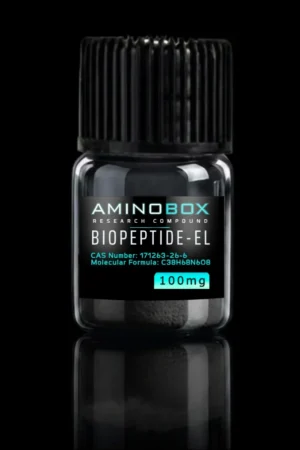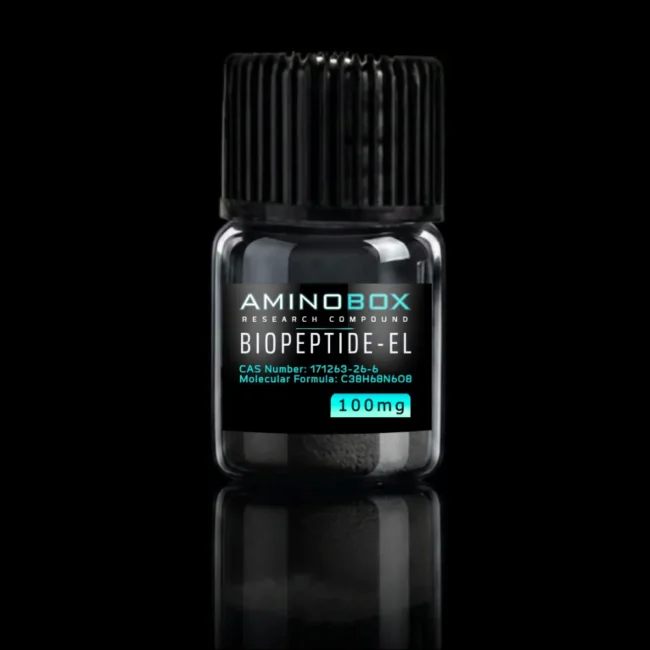

Biopeptide-EL | Palmitoyl Hexapeptide-12


Biopeptide-EL is an advanced biomimetic lipopeptide engineered to support dermal matrix integrity, collagen signalling pathways, and visible skin rejuvenation.
$58.00
In stock
Guaranteed Safe Checkout


| Product Name | Biopeptide-EL | Palmitoyl Hexapeptide-12 |
| Functional Class | Dermatics |
| Form | Lyophilized |
| Purity | 99%+ |
| Content | 5mg |
| Count | 1 vial |
| Research Use | Research Grade |
| CAS Number | See COA |
| Molecular Weight | See COA |
| Molecular Formula | See COA |
| PubChem CID | See COA |
| Appearance | White to off-white powder |
| Storage | 2-8C preferred |
Active Peptide 2 items
Excipients 4 items
Reconstitution Solvents 4 items
Buffer Systems 4 items
Lyoprotectants & Cryoprotectants 3 items
Preservatives & Antimicrobials 3 items
Counter Ions & Salt Forms 3 items
Chelating Agents 2 items
Antioxidants & Stabilizers 3 items
| Water | Highly soluble |
| Acidified Water | Highly soluble |
| DMSO | Highly soluble |
| Ethanol | Moderate |
| Lipid solvents | Poor compatibility |
| Lyophilized | 2–8°C preferred |
| Long-term | −20°C recommended |
| Light Sensitivity | Moderate |
| Moisture | High sensitivity |
| Stability | Stable when dry |
| Container | Sterile sealed vial |
AminoBox products are supplied for research, analytical, and laboratory use only. Product information is provided for educational and technical reference and does not constitute medical advice. Products are not intended to diagnose, treat, cure, or prevent any disease.
| Property | Specification |
|---|---|
| Product Name | Biopeptide-EL |
| Alternate Names | Palmitoyl Hexapeptide-12, Biopeptide EL™, Pal-VGVAPG |
| Content Amount | 100 mg |
| Compound Class | Synthetic lipopeptide |
| Physical Form | Lyophilized peptide powder |
| Appearance | White to off-white powder |
| Purity | Typically ≥98% (HPLC dependent) |
| Research Category | Cosmetic peptide / elastin signaling peptide |
| Primary Function | Skin elasticity and extracellular matrix research |
Molecular Information
| Property | Specification |
| Molecular Formula | C38H68N6O8 |
| Molecular Weight | ~736.98 g/mol |
| CAS Number | 171263-26-6 |
| INCI Name | Palmitoyl Hexapeptide-12 |
| FDA UNII | HO4ZT5S86C |
| Peptide Sequence | Val-Gly-Val-Ala-Pro-Gly (VGVAPG) |
| Compound Type | Palmitoylated signaling peptide |
| Structural Classification | Elastin-derived matrikine analog |
Structural Classification
| Category | Description |
| Compound Type | Synthetic elastin-mimetic peptide |
| Functional Class | Signal peptide / matrikine peptide |
| Biological Focus | Extracellular matrix restructuring |
| Mechanistic Focus | Fibroblast signaling and elastin support |
| Chemical Family | Palmitoylated hexapeptides |
| Lipid Modification | Palmitic acid conjugation for enhanced permeability |
Mechanism Research Profile
| Research Focus | Description |
| Fibroblast Activation | Studied for stimulation of fibroblast mobility and signaling |
| Elastin Support | Mimics elastin peptide fragments involved in dermal repair |
| Collagen Research | Investigated for collagen and glycosaminoglycan synthesis support |
| Skin Firmness | Associated with elasticity and structural integrity research |
| Barrier Interaction | Palmitoyl chain improves lipid membrane affinity |
| Matrix Remodeling | Explored for extracellular matrix restructuring activity |
Research Areas Commonly Associated
| Research Area | Focus |
| Cosmetic Peptide Research | Anti-aging and skin-conditioning applications |
| Extracellular Matrix Research | Collagen and elastin signaling pathways |
| Dermatological Research | Skin elasticity and firmness studies |
| Peptide Delivery Research | Lipophilic peptide transport mechanisms |
| Fibroblast Biology | Cellular migration and tissue remodeling |
| Skin Barrier Science | Lipid-peptide permeability optimization |
Solubility Profile
| Solvent | Solubility |
| Water | Limited |
| DMSO | Soluble |
| Ethanol | Moderately soluble |
| Glycols | Good compatibility |
| Lipid Systems | Enhanced compatibility due to palmitoylation |
Storage Specifications
| Parameter | Recommendation |
| Short-Term Storage | 2–8°C |
| Long-Term Storage | -20°C preferred |
| Light Sensitivity | Moderate |
| Moisture Sensitivity | High |
| Stability | Stable when lyophilized and protected from moisture |
| Container Type | Sealed amber peptide vial |
Technical Characteristics
| Feature | Notes |
| Delivery Format | Lyophilized peptide powder (100 mg) |
| Structural Advantage | Lipophilic palmitoyl chain enhances membrane interaction |
| Bioactivity Profile | Elastin-mimetic signaling peptide |
| Sequence Origin | Derived from repeating elastin fragment VGVAPG |
| Functional Target | Fibroblast and extracellular matrix signaling |
| Stability Profile | Improved stability versus non-lipidated peptides |
| Research Use | Laboratory research only |
Precision-Engineered Dermal Signaling Peptide
Biopeptide-EL, chemically identified as Palmitoyl Hexapeptide-12, is a sophisticated synthetic lipopeptide developed to emulate naturally occurring extracellular matrix signaling mechanisms involved in skin firmness, elasticity, and structural resilience. By conjugating a biologically active hexapeptide sequence with a palmitic acid lipid chain, this compound demonstrates enhanced transdermal affinity and improved integration within the skin’s lipid barrier.
Originally inspired by peptide domains found within elastin-associated proteins, Palmitoyl Hexapeptide-12 has become increasingly recognized within advanced cosmetic and longevity-focused formulations for its ability to support fibroblast communication and extracellular matrix optimization.
The Science Behind Palmitoyl Hexapeptide-12
Palmitoyl Hexapeptide-12 functions as a signal peptide, meaning it is designed to interact with dermal fibroblasts and encourage biochemical processes associated with tissue maintenance and structural protein synthesis.
The peptide sequence is believed to influence pathways associated with:
- Collagen biosynthesis
- Elastin fiber organization
- Fibronectin expression
- Dermal matrix remodeling
- Skin tensile strength and elasticity
The palmitoyl modification substantially increases lipophilicity, allowing the peptide to more effectively penetrate the stratum corneum and maintain prolonged interaction within dermal environments.
Unlike abrasive resurfacing compounds or aggressive chemical interventions, Biopeptide-EL operates through cellular signaling modulation, supporting the skin’s intrinsic regenerative mechanisms rather than forcing inflammatory turnover.
Mechanistic Overview
Fibroblast Communication Support
Fibroblasts are responsible for synthesizing critical structural proteins within connective tissue. Palmitoyl Hexapeptide-12 is designed to mimic extracellular matrix fragments that naturally activate fibroblast response pathways involved in tissue repair and maintenance.
Extracellular Matrix Optimization
The extracellular matrix serves as the structural scaffold of the skin. Age-related degradation of collagen and elastin contributes to reduced firmness and elasticity. This peptide has been explored for its ability to support matrix organization and dermal density.
Lipid-Conjugated Delivery Enhancement
Attachment of a palmitic acid chain improves peptide affinity for lipid-rich skin environments, increasing topical compatibility and enhancing dermal bioavailability compared to non-lipidated peptide structures.
Research & Cosmetic Interest
Palmitoyl Hexapeptide-12 has generated substantial interest within cosmetic science due to its role in formulations targeting:
- Fine lines and visible aging markers
- Loss of elasticity
- Skin texture irregularities
- Environmental stress response
- Dermal firmness support
- Advanced anti-aging applications
Its biomimetic structure and non-invasive mechanism make it particularly attractive in modern peptide-based cosmetic development.
Why Researchers Choose Biopeptide-EL
Advanced Biomimetic Design
Engineered to emulate naturally occurring extracellular signalling fragments involved in dermal maintenance.
Enhanced Dermal Affinity
Palmitoylation improves lipid compatibility and supports effective topical integration.
High-Purity Manufacturing
Produced under stringent analytical standards with rigorous identity and purity verification.
Longevity-Focused Innovation
A next-generation cosmetic peptide is investigated for supporting youthful skin architecture and connective tissue integrity.
Disclaimer
This product is intended strictly for laboratory research, analytical, and cosmetic formulation applications only. Not intended to diagnose, treat, cure, or prevent any disease. This material is not approved for human consumption or pharmaceutical use.
Biopeptide-EL (Palmitoyl Hexapeptide-12) — Reference Table
| Reference Source | Information Provided | Link |
|---|---|---|
| PubChem | Molecular formula, molecular weight, peptide sequence, identifiers, structural data | PubChem – Palmitoyl Hexapeptide-12 |
| INCI Guide | INCI classification, Biopeptide EL™ identity, functional overview | INCI Guide – Biopeptide EL™ |
| INCI Guide | CAS number, peptide sequence, cosmetic activity profile | INCI Guide – Palmitoyl Hexapeptide-12 |
| Cosmetic Ingredients Guide | Barrier support, elastin fragment activity, fibroblast research | CI Guide – Palmitoyl Hexapeptide-12 |
| INCI Beauty | Cosmetic ingredient registry listing and INCI validation | INCI Beauty – Palmitoyl Hexapeptide-12 |
| PubChem Biological Description | Sequence VGVAPG and palmitoylated peptide classification | PubChem Biological Data |